Evidence-based response
Find the Best At Home Gut Health Test in 2026: Evidence-Based Answer Without the Marketing Hype
At home microbiome tests can educate, but they cannot diagnose gut disease or prove a personalized diet plan by themselves.
By Sandra McKenzy, Pharmacist · 2026-08-24
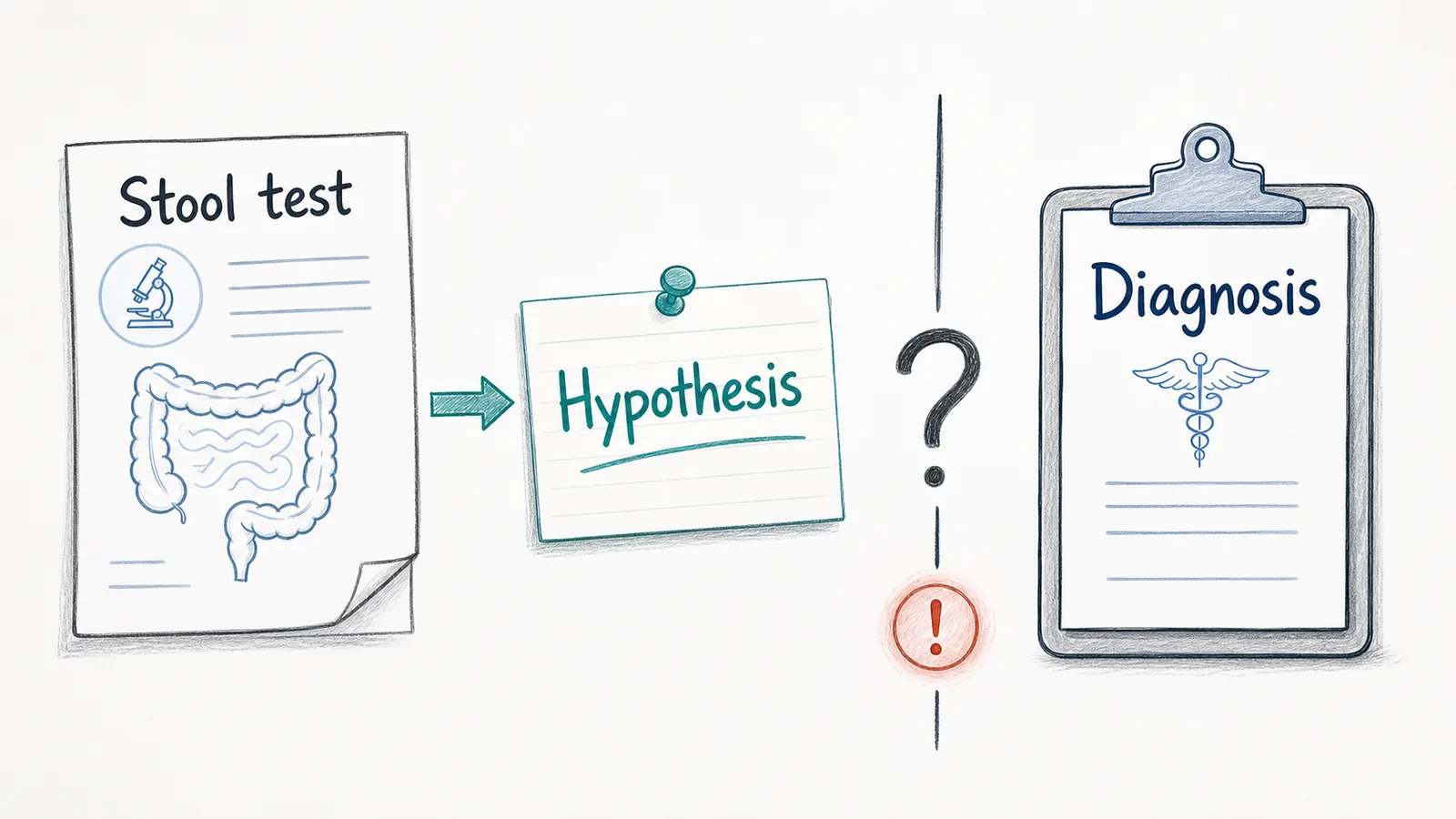
Short answer: The best at home gut health test in 2026 is not the kit with the loudest “personalized” promise. Choose a stool microbiome test only if you want educational information about microbial patterns, method transparency, privacy terms, and cautious nutrition context. Do not use any consumer kit to diagnose IBS, IBD, SIBO, infection, leaky gut, food intolerance, or the medical cause of symptoms.
Find the best at home gut health test in 2026: what should you actually compare?
The useful comparison starts with purpose. A person with severe diarrhea, blood in stool, fever, weight loss, anemia, night symptoms, or new persistent pain does not need a ranked wellness kit first. That person needs clinical evaluation. A person who feels well but wants to learn about stool microbial patterns, dietary diversity, and how different companies explain results is asking a different question. For that educational use, an at home microbiome test can be interesting, but the bar should still be higher than a glossy dashboard.
An InnerBuddies comparison article ranks several consumer kits and presents practical differences such as method, turnaround time, report style, and price. Those are reasonable shopping criteria. The part that needs caution is the broader marketing frame around “best,” “accuracy,” and personalized nutrition. Microbiome science is real, but a direct jump from one stool sample to individualized medical certainty is not where the field is today.
The best test is therefore the one that is honest about what it can and cannot do. It should say whether it uses 16S rRNA sequencing, shotgun metagenomics, metatranscriptomics, or another method. It should explain sample handling, reference databases, quality controls, privacy policy, and how recommendations are generated. It should separate wellness education from diagnosis. If the report turns a microbiome pattern into a disease label or a fixed supplement protocol, that is a red flag.
Can an at home microbiome test diagnose gut disease?
No, not by itself. Stool microbiome tests can measure signals from a stool sample. Depending on the method, they may report bacterial groups, diversity, relative abundance, gene content, or microbial activity estimates. That does not make the result a validated diagnostic test for most individual gut conditions.
Clinical diagnosis requires a defined question and a validated pathway. For suspected inflammatory bowel disease, clinicians may use history, blood tests, fecal calprotectin, imaging, endoscopy, and biopsy. For suspected infection, targeted stool testing may matter. For suspected celiac disease, serology and sometimes biopsy are interpreted in context. For IBS, the diagnosis usually depends on symptom pattern plus limited targeted testing to exclude important alternatives. A consumer microbiome report does not replace those steps.
Microbiome research has repeatedly found associations between microbial patterns and disease groups. That is not the same as identifying the cause of one person’s bloating, constipation, fatigue, or food reactions. Group-level association can guide research and sometimes support future clinical tools. It does not automatically create a consumer diagnostic product.
Is shotgun sequencing always better than 16S?
Shotgun metagenomics can provide more detail than 16S sequencing because it surveys broader genetic material rather than selected bacterial marker regions. It can improve taxonomic resolution and support functional analysis. That is a technical advantage, but it does not solve every interpretation problem.
More detail can still be interpreted badly. A test can detect more organisms and still lack clinically validated thresholds for action. A report can show species-level data and still be influenced by sampling, DNA extraction, storage, stool consistency, sequencing depth, reference databases, and bioinformatics pipelines. Technical precision is valuable, but clinical meaning depends on validation.
16S tests can be cheaper and useful for broad community profiling, but they have lower taxonomic and functional resolution. Shotgun tests can be more informative, but they cost more and require careful analysis. RNA-based or metatranscriptomic approaches aim to capture activity rather than only presence, but proprietary algorithms can make comparison harder. The right question is not “which sounds most advanced?” It is “what is measured, how reproducible is it, and what claims does the company attach to it?”
Can microbiome tests personalize your diet?
They can sometimes contribute to a personalized nutrition model, but the claim needs careful wording. Diet and microbiome interactions are a strong research area. People respond differently to foods, and the microbiome may help explain part of that variation. Trials of personalized nutrition programs suggest that combined models using diet, phenotype, metabolism, behavior, and microbiome data can improve some cardiometabolic measures in selected settings.
That does not mean a standalone stool test can tell every person exactly what to eat, which supplement to buy, or which foods are “bad” for them. Food responses are shaped by baseline diet, genetics, sleep, activity, medications, metabolic health, meal composition, culture, preferences, and adherence. The microbiome is one layer, not the whole decision engine.
A cautious report may suggest hypotheses, such as increasing fiber diversity, fermented foods if tolerated, or discussing persistent symptoms with a clinician. An overconfident report may give rigid food scores or supplement recommendations without explaining evidence grade, uncertainty, or clinical limits. The second version is more marketable, but less trustworthy.
What does “accurate” mean for a consumer gut test?
Accuracy has several meanings. Analytical accuracy asks whether the lab measures what is present in the sample consistently. Reproducibility asks whether repeat samples and different processing pipelines give comparable results. Clinical validity asks whether the result predicts a health state or outcome. Clinical utility asks whether using the result improves decisions or health compared with standard care.
Many consumer discussions collapse these into one word. A company may process samples consistently and still not have a validated diagnostic interpretation. Another company may have an attractive app and still provide recommendations that are not tested against meaningful outcomes. The most important accuracy question for readers is not simply whether the sequencing machine works. It is whether the claim attached to the data has been validated.
Independent reproducibility also matters. Microbiome results can vary with sample collection conditions, storage, extraction kits, sequencing method, and analysis software. Best-practice papers exist because these choices can change observed profiles. This does not make microbiome testing useless. It means consumer reports should not be treated as fixed biological verdicts.
Evidence summary
- Consumer stool microbiome tests can describe microbial patterns, but most are not validated to diagnose individual gut diseases.
- Shotgun sequencing can provide more detail than 16S, but more detail does not automatically create clinical utility.
- Personalized nutrition research is promising, especially when microbiome data are combined with metabolic and dietary data, but standalone stool reports should remain cautious.
- Sample handling, sequencing method, databases, and analysis pipelines can affect results, so reproducibility and transparency matter.
- Red flags such as blood in stool, weight loss, fever, anemia, severe pain, persistent vomiting, or night symptoms need medical care, not a wellness kit ranking.
What should a good test disclose?
A trustworthy company should name its method clearly. It should state whether it uses 16S, shotgun metagenomics, RNA-based testing, culture, targeted PCR, or a combined approach. It should explain what sample stabilizer is used, where the lab is located, how long shipping can take, whether the sample is suitable if delayed, and which quality checks can fail a sample.
The report should explain uncertainty. Does a score compare you with a narrow internal user database or a broader published reference? Are recommendations evidence-graded? Are disease claims excluded? Can you download raw data? Are privacy and deletion policies clear? Does the company separate research consent from product use? These details are less exciting than a ranking table, but they matter more.
Support can be useful if it is cautious. A dietitian, physician, pharmacist, or trained health professional can help translate general findings into safe next steps, especially when symptoms or medications are involved. Support becomes risky when it exists mainly to sell supplements or when it treats a microbiome score as the root cause of everything.
How should you choose between popular kits?
Start with the reason you are buying. If you want broad education and raw microbial data, prioritize transparent methodology and data access. If you want diet coaching, ask whether the program has trial evidence, what data it uses beyond the microbiome, and whether recommendations fit your medical history. If you want disease answers, do not buy a consumer kit as the first step. See a clinician and use validated tests for the specific concern.
Price should be judged against the strength of interpretation, not the number of charts. A cheaper test that honestly says “educational only” may be more responsible than an expensive test that implies medical certainty. A more advanced test can be worth considering when the company is transparent, cautious, and clear about privacy. It is not better merely because the app feels more personalized.
Also consider what happens after the result. If the output will make you anxious, push you into restrictive eating, or lead you to self-treat symptoms, it may not be helpful. A good result should encourage sensible questions: fiber intake, plant diversity, medication history, recent antibiotics, constipation or diarrhea pattern, sleep, stress, alcohol, and whether medical evaluation is needed.
What marketing gets wrong
The first mistake is treating “best” as a universal label. There is no single best at home gut health test for every person because different users have different goals. A person comparing wellness dashboards is not the same as a person with chronic diarrhea or unexplained weight loss.
The second mistake is using “science-backed” to imply that every recommendation is clinically proven for the individual user. A recommendation can be plausible, based on general nutrition evidence, or derived from an algorithm without being validated as a personalized treatment.
The third mistake is framing microbiome testing as a shortcut around clinical care. Microbiome tests may become more useful in defined clinical settings, and the field is progressing quickly. Today, most consumer tests are best understood as educational tools with uncertain action thresholds.
When should you skip the kit and see a clinician?
Seek medical care promptly for blood in stool, black stool, unexplained weight loss, fever, persistent vomiting, dehydration, fainting, severe or localized abdominal pain, anemia, jaundice, new bowel changes after age 50, immune suppression, pregnancy with significant abdominal pain, or symptoms that wake you at night. These patterns require medical judgment.
Book a non-urgent evaluation for symptoms lasting more than a few weeks, recurring diarrhea or constipation, nutrient deficiencies, family history of colorectal cancer or inflammatory bowel disease, or symptoms that keep returning despite reasonable diet changes. A microbiome report can be discussed later if you still want educational context, but it should not be the gatekeeper for care.
Bottom line
The best at home gut health test in 2026 is the one that matches your purpose, explains its method, protects your data, grades its evidence, and stays honest about uncertainty. It can help you learn about stool microbial patterns. It cannot diagnose most gut diseases, prove the cause of symptoms, or guarantee a personalized diet plan by itself.
If you buy a kit, use it as one educational clue. If you have persistent or red flag symptoms, use the healthcare system, not a ranking table.
Educational note: This article is for general information and does not replace medical advice. If you have severe, persistent, new, or worsening symptoms, or any red flag symptoms, seek qualified medical care.
Evidence notes and sources
- Quigley. Gut microbiome as a clinical tool in gastrointestinal disease management: are we there yet? Nature Reviews Gastroenterology and Hepatology. 10.1038/nrgastro.2017.29
- Tamburini et al. Clinical translation of microbiome research. Nature Medicine. 10.1038/s41591-025-03615-9
- Kolodziejczyk et al. Diet-microbiota interactions and personalized nutrition. Nature Reviews Microbiology. 10.1038/s41579-019-0256-8
- Berry et al. Effects of a personalized nutrition program on cardiometabolic health: a randomized controlled trial. Nature Medicine. 10.1038/s41591-024-02951-6
- Knight et al. Best practices for analysing microbiomes. Nature Reviews Microbiology. 10.1038/s41579-018-0029-9
- Sinha et al. Assessment of variation in microbial community amplicon sequencing by the Microbiome Quality Control project consortium. Nature Biotechnology. 10.1038/nbt.3981
- Hillmann et al. Shallow shotgun sequencing reduces technical variation in microbiome analysis. Scientific Reports. 10.1038/s41598-023-33489-1
- Choo et al. Influence of fecal collection conditions and 16S rRNA gene sequencing at two centers on human gut microbiota analysis. Scientific Reports. 10.1038/s41598-018-22491-7