Evidence-based response
Why Does My Small Intestine Hurt? Evidence-Based Answer Without the Gut-Health Hype
Small-intestine pain is often central, but location and stool microbiome data cannot diagnose the cause without clinical context.
By Sandra McKenzy, Pharmacist · 2026-08-20
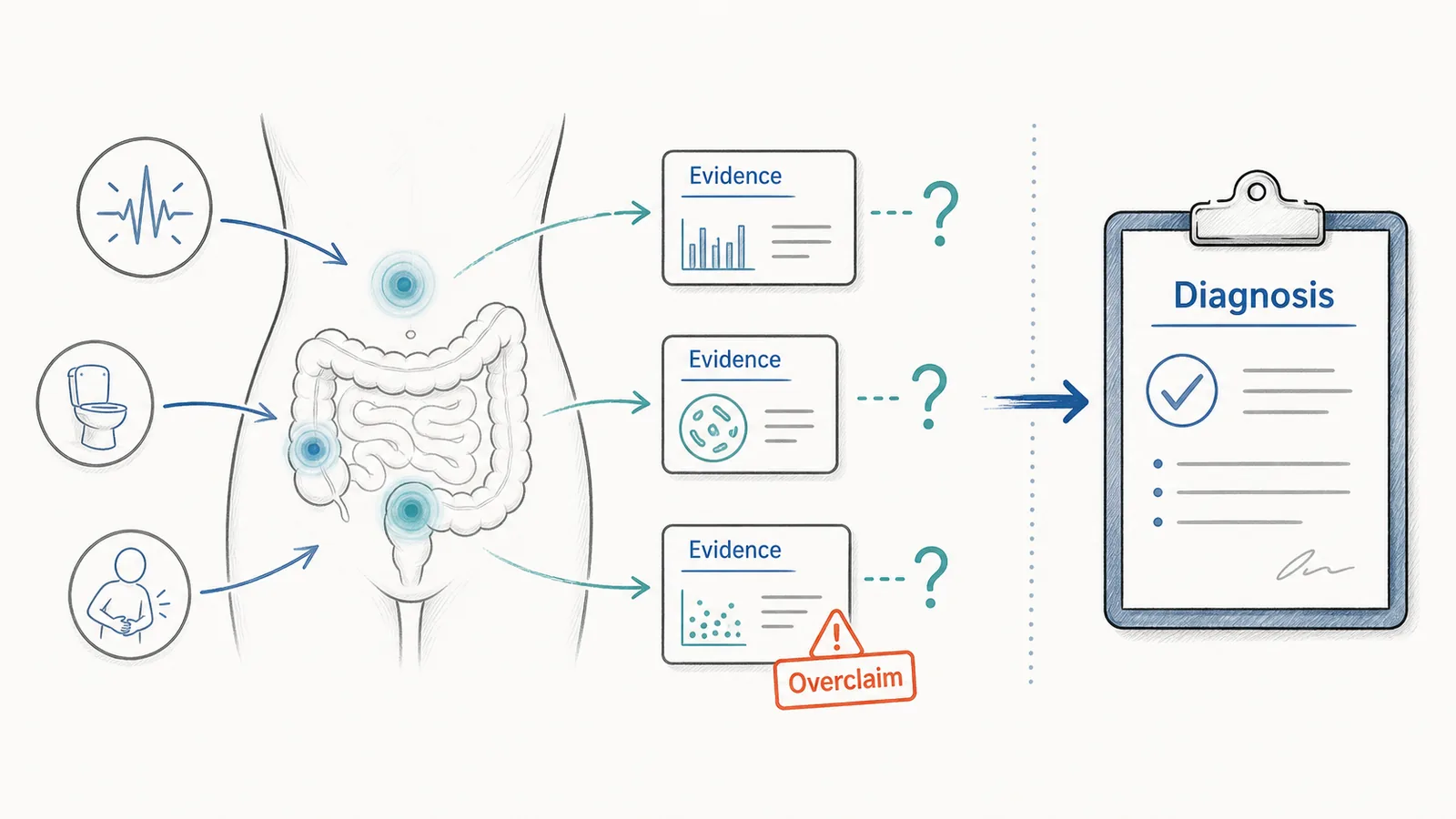
Short answer: Small-intestine pain is usually felt near the middle of the abdomen or around the navel, but location alone cannot identify the cause. Cramps, bloating, diarrhea, constipation, fever, blood in stool, and severe localized pain need clinical context. The gut microbiome can influence sensitivity, gas, inflammation, and bowel habits, but a stool microbiome test cannot diagnose appendicitis, Crohn's disease, SIBO, IBS, or the exact source of abdominal pain.
Why does my small intestine hurt?
The honest answer is that the small intestine can hurt for several reasons, and the body does not label the pain neatly. Pain from the small bowel, colon, stomach, gallbladder, appendix, urinary tract, reproductive organs, abdominal wall, and even nerves can overlap. Visceral pain from the gut is especially hard to localize because internal organs share nerve pathways and often produce vague, cramping, spreading sensations rather than a clean dot on a map.
Small-intestine discomfort is often described around the navel or central abdomen. It may feel crampy, wave-like, bloated, burning, or sharp after meals. Common benign causes include gas, viral gastroenteritis, constipation, food intolerance, medication effects, and temporary changes after antibiotics or travel. More serious possibilities include obstruction, inflammatory bowel disease, appendicitis, ischemia, infection, pancreatobiliary disease that mimics gut pain, or complications after surgery.
That is why the phrase "where does it hurt" is useful, but incomplete. A clinician asks where the pain started, where it moved, how long it lasted, whether it comes in waves, whether bowel movements change it, and whether it is paired with fever, vomiting, weight loss, rectal bleeding, anemia, pregnancy, immune suppression, or recent antibiotic use. The location matters most when it is interpreted with the full pattern.
Can colon pain location tell you what is wrong?
Sometimes it can narrow the possibilities. Lower right abdominal pain can raise concern for appendicitis, terminal ileitis, ovarian or urinary causes, or Crohn's disease involving the ileum. Lower left pain can occur with constipation, diverticular disease, colitis, or sigmoid colon spasm. Central cramping with diarrhea may fit gastroenteritis, IBS, food intolerance, or inflammatory conditions. Upper abdominal pain may come from the stomach, gallbladder, pancreas, or transverse colon rather than the small intestine.
But pain maps are not diagnostic tests. IBS, for example, is defined by recurrent abdominal pain associated with changes in stool frequency or form, not by one fixed pain location. Inflammatory bowel disease can cause pain, diarrhea, fatigue, bleeding, and weight loss, but symptoms vary. SIBO is associated with bloating, abdominal discomfort, diarrhea, or constipation in some people, yet symptoms alone do not prove overgrowth. Even serious disease can begin with nonspecific discomfort.
A safer way to use location is as a triage clue. Sudden severe pain that localizes, worsens with movement, or is paired with fever or vomiting deserves urgent medical assessment. Recurrent milder pain linked to stool changes may still deserve evaluation, but the likely workup is different. A consumer stool microbiome report should not be used as the deciding tool for either situation.
What are the seven signs that intestinal pain needs context?
First, cramping that comes in waves often reflects bowel muscle contraction, gas movement, infection, constipation, or partial blockage. Second, bloating and visible distension suggest gas handling, fermentation, motility, diet, or constipation, but they do not identify the exact bowel segment. Third, diarrhea points toward infection, inflammation, bile acid diarrhea, medication effects, food intolerance, IBS-D, or other disorders. Fourth, constipation can cause lower abdominal pain and bloating, but also has many causes.
Fifth, tenderness when pressing the abdomen can be meaningful, especially if it is localized, worsening, or paired with guarding. Sixth, pain with fever, blood, black stool, persistent vomiting, dehydration, fainting, or unexplained weight loss is a red flag rather than a wellness optimization problem. Seventh, pain that is new after age 50, wakes you from sleep, follows recent surgery, or occurs during pregnancy needs a lower threshold for professional evaluation.
These signs are more evidence-based than a single microbiome score because they help separate common functional symptoms from situations where standard medicine has validated tools: examination, blood tests, stool tests for infection or inflammation, fecal calprotectin when appropriate, imaging, breath testing in selected cases, endoscopy, colonoscopy, or urgent surgical assessment.
Does the gut microbiome cause intestinal pain?
The microbiome can contribute to intestinal symptoms, but contribution is not the same as proof of cause. Research links gut microbes to fermentation, gas production, short-chain fatty acids, bile acid metabolism, immune signaling, barrier biology, and gut-brain communication. IBS research also supports a role for visceral hypersensitivity, motility, low-grade immune activation, stress biology, prior infection, and microbiome changes.
That makes the microbiome relevant. It does not make it an all-purpose explanation. A person with abdominal pain may have dysbiosis-like stool patterns and still have lactose intolerance, celiac disease, gallstones, endometriosis, medication side effects, IBD, infection, constipation, or anxiety-related gut-brain amplification. A second person may have a low-diversity stool profile and no pain at all. Microbiome data must be interpreted as one layer, not the diagnosis.
The strongest clinical microbiome uses today are still narrower than many consumer articles imply. Fecal microbiota transplantation is established for recurrent Clostridioides difficile infection in defined settings. Some probiotics have evidence for specific endpoints, but effects are strain-specific and often modest. Microbiome-based diagnostics and personalized nutrition are advancing, yet routine consumer stool tests are not validated to pinpoint the cause of abdominal pain for an individual.
Can a microbiome test identify why your intestines hurt?
Not reliably. A stool microbiome test can describe microbial DNA in a stool sample. Depending on the platform, it may estimate taxa, diversity, and functional potential. That can generate useful questions, especially if the lab uses high-quality methods and cautious interpretation. But stool is mostly a lower-gut sample. It does not directly see the small intestinal wall, the appendix, the gallbladder, the pancreas, pelvic organs, intestinal inflammation, obstruction, or the actual nerve signaling behind pain.
This matters for SIBO claims. Small-intestinal bacterial overgrowth is about the small bowel, not simply the stool microbiome. Research often uses duodenal aspirate culture or breath testing, both with limitations. A stool report may show patterns that are interesting, but it cannot confirm where bacteria are located in the small intestine or prove that they are causing pain.
It also matters for IBS. IBS is a disorder of gut-brain interaction diagnosed from symptom patterns and appropriate exclusion of alarm features. Microbiome differences are reported in many IBS studies, but there is no single stool signature that diagnoses IBS in routine practice. A test can support a conversation about diet, fiber tolerance, prior antibiotics, or research hypotheses. It cannot safely replace clinical evaluation.
Evidence summary
- Abdominal pain location can guide triage, but it rarely identifies the exact intestinal cause by itself.
- IBS involves recurrent abdominal pain with bowel habit changes and gut-brain mechanisms, not a single pain location or stool marker.
- Microbiome changes are linked with IBS, bloating, fermentation, immune signaling, and visceral sensitivity, but individual causation is hard to prove.
- Consumer stool microbiome tests can describe lower-gut microbial DNA, but they cannot diagnose SIBO, appendicitis, IBD, obstruction, or colon pain location.
- Blood in stool, fever, severe localized pain, persistent vomiting, weight loss, anemia, dehydration, or new symptoms after age 50 need medical evaluation.
What does marketing often get wrong?
The common overclaim is that digestive symptoms are direct messages from an imbalanced microbiome and that a home test can reveal the true source. That sounds tidy, but it skips the hardest part of medicine: similar symptoms can come from very different causes. Bloating can reflect constipation, swallowed air, carbohydrate intolerance, IBS, SIBO, IBD, ovarian disease, fluid retention, or medication effects. Diarrhea can be infectious, inflammatory, bile acid-related, osmotic, medication-related, or functional. Pain after meals can involve the gut, but also the gallbladder or pancreas.
Another overclaim is that "harmful bacteria" release toxins and therefore explain tenderness or inflammation in a simple way. Some bacteria and microbial products can interact with the immune system, and dysbiosis is real in many disease contexts. But a stool report showing more or less of a bacterial group does not prove mucosal damage, leaky gut, autoimmune disease, or the need for a specific supplement. In clinical care, suspected inflammation is assessed with symptoms, examination, blood markers, stool markers, imaging, endoscopy, and histology when needed.
The most reader-protective position is not anti-microbiome. It is pro-context. Microbiome science is valuable, but pain localization and red flags should come first. A test result should never reassure someone away from urgent care, and it should never turn vague abdominal discomfort into a confident diagnosis.
What studies actually show
Reviews of gastrointestinal pain emphasize that gut pain is common and diagnostically challenging because nociceptive, inflammatory, neuropathic, cancer-related, and functional mechanisms can overlap. IBS literature shows that recurrent abdominal pain and altered bowel habits are central, and that gut-brain signaling, visceral hypersensitivity, immune factors, motility, and microbiome alterations can all contribute. Nature Reviews work on clinical microbiome translation has repeatedly warned that promising biology has not fully become routine diagnostic medicine.
Studies of small-intestinal microbial dysbiosis are also more nuanced than consumer claims. Research has shown that small-intestinal microbial composition can be altered in functional gastrointestinal disorders, and that duodenal sampling may reveal signals that stool cannot. But this also proves the limitation: stool alone is not the small intestine. A home stool test cannot localize pain or confirm that a painful episode comes from the ileum, jejunum, appendix, or colon.
Large reviews of personalized nutrition and clinical microbiome research support a future where microbiome data may help tailor interventions. That future is not the same as saying every abdominal pain pattern should be solved by stool sequencing today. The current evidence supports cautious interpretation, not one-click diagnosis.
When should you see a clinician?
Seek urgent medical care for severe or worsening abdominal pain, pain with fever, repeated vomiting, fainting, rigid abdomen, black stool, blood in stool, dehydration, chest pain, shortness of breath, pregnancy, immune suppression, recent abdominal surgery, or pain that localizes sharply to one side. These are not situations for waiting on a microbiome report.
Book a medical appointment for recurring abdominal pain, persistent diarrhea or constipation, symptoms that wake you at night, unexplained weight loss, anemia, new bowel changes after age 50, family history of colorectal cancer or IBD, or symptoms that keep returning despite basic dietary adjustments. A clinician can decide whether testing for infection, celiac disease, inflammation, anemia, thyroid disease, colon cancer screening, imaging, endoscopy, colonoscopy, or selected breath testing is appropriate.
Bottom line
Small-intestine pain is often felt centrally, and colon-related pain often appears lower in the abdomen, but real people rarely fit a perfect diagram. Location is a clue, not a diagnosis. The microbiome can influence gut sensation, gas, motility, immune activity, and IBS biology, so it belongs in the discussion. It should not be promoted as the master explanation for every cramp, tender spot, or bowel change.
If your intestines hurt, start with the pattern: severity, timing, stool changes, fever, bleeding, vomiting, weight loss, age, medications, and medical history. Use microbiome testing, if you use it at all, as descriptive background information. The safer evidence-based answer is that abdominal pain deserves clinical context first and microbiome interpretation second.
Educational disclaimer: This article is for general education and is not medical advice. Abdominal pain can have urgent causes. If symptoms are severe, persistent, new, or paired with red flags, seek care from a qualified clinician.
Evidence notes and sources
- Gastrointestinal pain. Nature Reviews Disease Primers. 10.1038/s41572-019-0135-7
- Irritable bowel syndrome. Nature Reviews Disease Primers. 10.1038/nrdp.2016.14
- The neurobiology of irritable bowel syndrome. Molecular Psychiatry. 10.1038/s41380-023-01972-w
- Gut microbiome as a clinical tool in gastrointestinal disease management: are we there yet? Nature Reviews Gastroenterology and Hepatology. 10.1038/nrgastro.2017.29
- Small intestinal microbial dysbiosis underlies symptoms associated with functional gastrointestinal disorders. Nature Communications. 10.1038/s41467-019-09964-7
- Evidence of altered mucosa-associated and fecal microbiota composition in patients with irritable bowel syndrome. Scientific Reports. 10.1038/s41598-020-57468-y
- Diet-microbiota interactions and personalized nutrition. Nature Reviews Microbiology. 10.1038/s41579-019-0256-8
- Clinical translation of microbiome research. Nature Medicine. 10.1038/s41591-025-03615-9