Evidence-based response
What to Eat for Breakfast to Relieve Constipation? Evidence-Based Answer Without the Hype
A fiber-rich breakfast can support constipation relief, but it is not an instant cure and microbiome tests cannot diagnose the cause.
By Sandra McKenzy, Pharmacist · 2026-06-06
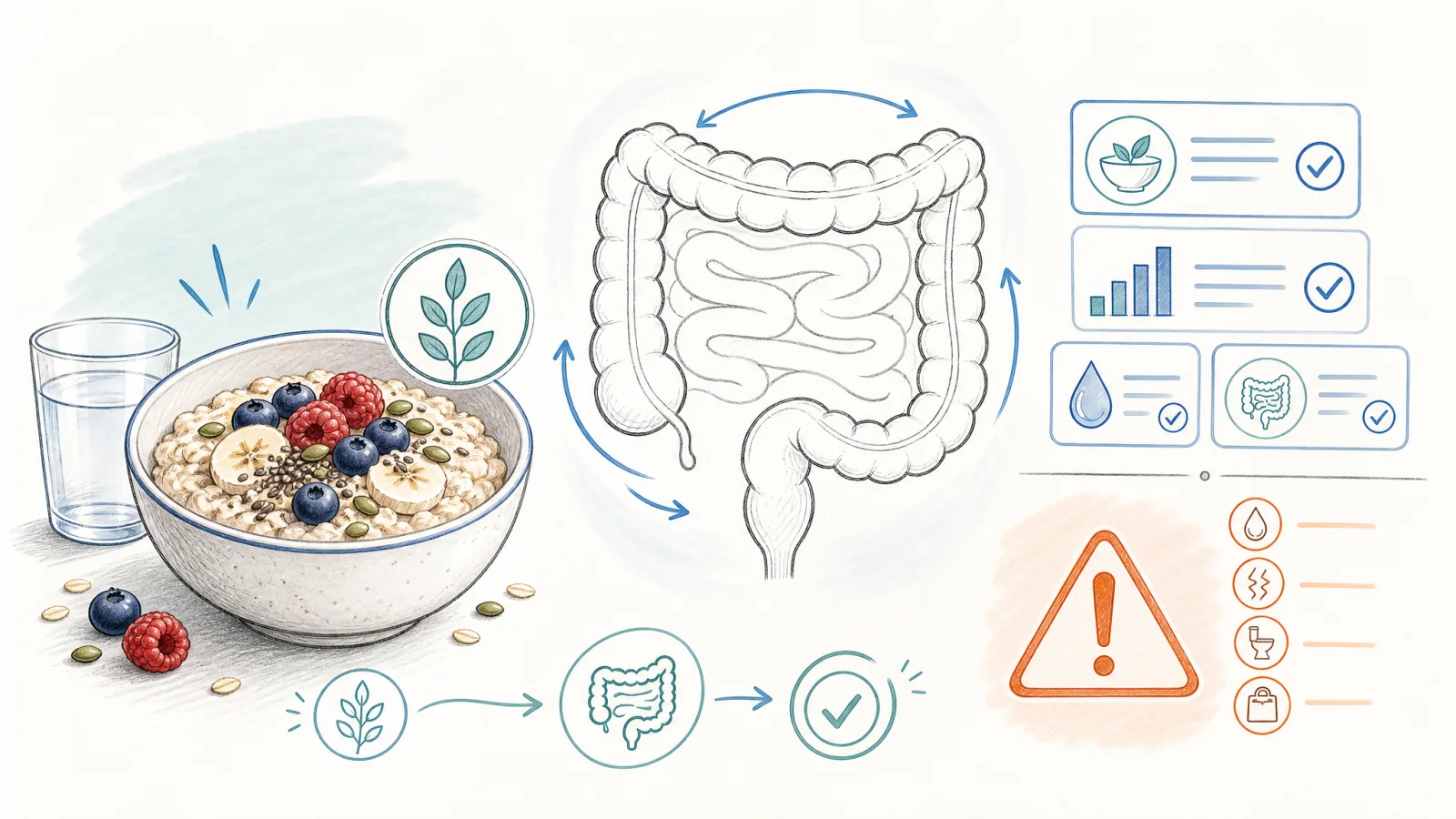
Short answer: A constipation-friendly breakfast is usually one that adds soluble and insoluble fiber, fluid, and regular meal timing. Oats, whole grains, chia or ground flax, fruit such as kiwi or prunes, and enough water may help many people. It is not a guaranteed fast cure, and severe or new constipation needs medical review.
What should you eat for breakfast to relieve constipation?
The practical answer is simple but not magical. A good breakfast for constipation gives the colon bulk, water-holding capacity, and a predictable eating signal. That can mean porridge with oats and berries, whole-grain toast with nut butter and fruit, yogurt with chia if dairy is tolerated, or a breakfast bowl with kiwi, ground flax, and enough fluid. These meals are useful because they raise total daily fiber and make the morning routine consistent.
InnerBuddies has published a consumer article on breakfast for constipation and microbiome testing. This response uses that search intent as a starting point. The safer clinical standard is narrower: breakfast can support regularity, but it cannot diagnose the cause of constipation, replace red-flag assessment, or prove that a stool microbiome report can personalize breakfast with medical certainty.
Evidence summary
- Low fiber intake is a common contributor to constipation, and gradual fiber increases can improve stool frequency for some people.
- Breakfast choices help most when they improve the whole-day pattern: fiber, fluid, movement, and regular toilet opportunity.
- Specific foods such as oats, whole grains, resistant starch sources, kiwi, prunes, chia, and flax are plausible choices, but individual tolerance varies.
- A consumer microbiome test cannot currently diagnose constipation type or prescribe a breakfast as treatment.
- Blood in stool, weight loss, anemia, fever, severe pain, vomiting, pregnancy concerns, or a sudden bowel-habit change need clinical care.
What does constipation mean clinically?
Constipation is not only “not going every day.” Clinically it can mean infrequent stools, hard stools, straining, a sense of incomplete evacuation, bloating, or needing manual maneuvers to pass stool. Some people have slow colonic transit. Others have pelvic-floor coordination problems. Many have a mix of diet, medication, dehydration, reduced activity, irritable bowel syndrome, pregnancy, thyroid disease, neurologic disease, or structural disease.
That distinction matters because a breakfast plan is supportive care, not a full work-up. Fiber can help many cases of functional constipation, but it can worsen bloating or discomfort if added too fast. It may also be the wrong focus when constipation is caused by opioid medicines, iron supplements, calcium-channel blockers, dehydration, bowel obstruction, or pelvic-floor dysfunction.
Which breakfast choices are best supported?
The best-supported breakfast advice is to raise fiber gradually and pair it with fluid. Oats, whole-grain cereals, whole-grain bread, fruit, seeds, beans, and resistant starch sources can increase stool bulk and water content. Psyllium is not exactly a breakfast food, but it is a soluble fiber with clinical use in constipation. Prunes and kiwi are common practical choices because they combine fiber with other compounds that may influence stool water and transit.
A useful constipation breakfast might be oatmeal with berries and ground flax, plus water or tea. Another option is whole-grain toast with peanut butter and kiwi. A third is unsweetened yogurt or a plant-based alternative with chia, oats, and fruit. The important point is not that one recipe “flushes the gut.” The point is that a repeatable meal helps the daily fiber target and gives the gastrocolic reflex, the normal bowel movement after eating, a chance to work.
Can breakfast relieve constipation fast?
Sometimes a morning meal, warm drink, and toilet routine can help the same day, especially when constipation is mild and recent. But “fast” is the risky word. Fiber often works over days, not minutes. Adding a large fiber load suddenly can increase gas and cramping. If a person has not passed stool for several days and has severe pain, vomiting, marked distension, or inability to pass gas, waiting for breakfast to fix it is unsafe.
For mild constipation, the safer fast plan is ordinary: drink fluid, eat a fiber-containing breakfast, walk if possible, respond to the urge to go, and avoid straining for long periods. If that pattern fails or symptoms are severe, pharmacy or medical advice is more appropriate than stronger online claims.
Can a microbiome test tell you the best breakfast for constipation?
A stool microbiome test can describe microbial DNA patterns in a sample. It may be educational, and research does show links between diet, microbes, fermentation, stool frequency, and transit. That is not the same as a validated medical prescription. Current consumer tests generally cannot prove that one person needs oats, another needs prunes, and another needs a specific probiotic breakfast to treat constipation.
MedicalBrain validation for this topic found studies on constipation, diet, fiber, resistant starch, synbiotics, and microbiome variation. The pattern is consistent: microbiome science is relevant, but translation into individual treatment requires careful methods, defined outcomes, and clinical context. A test result should not replace basic constipation assessment or conventional care.
What does marketing often get wrong?
Marketing often turns a sensible breakfast idea into a precision-health promise. Fiber-rich foods can help. The microbiome is involved in digestion. Personalized nutrition is an active research area. But combining those facts does not prove that a commercial test can identify the exact breakfast that will relieve constipation fast.
The overclaim is usually hidden in the bridge between association and action. A study may show that people with constipation have different microbial patterns, or that an intervention changes stool frequency in a trial. A consumer page may then imply that testing your gut flora can produce a tailored breakfast plan. That step needs validation. Without it, the recommendation should stay modest: improve fiber and fluid first, use testing only as context, and do not ignore symptoms.
How should you build a safer constipation breakfast?
Start low and increase slowly. If your usual breakfast is white toast or no breakfast, switching overnight to a very large bowl of bran, chia, flax, and beans may backfire. Add one fiber source, keep fluids adequate, and watch stool pattern over several days. Many adults aim for roughly 25 to 30 grams of fiber per day, but tolerance and medical context matter.
Pair fiber with routine. Eat at a similar morning time, drink enough, and allow an unhurried bathroom window after breakfast. Gentle movement helps some people. If fiber causes pain, intense bloating, or no improvement, do not keep escalating forever. That is a sign to review the cause rather than blame your willpower or gut bacteria.
When should constipation be checked by a clinician?
Seek medical care for blood in the stool, black stools, unexplained weight loss, anemia, fever, persistent vomiting, severe or worsening abdominal pain, new constipation after age 50, sudden bowel-habit change, constipation after starting a medicine, pregnancy concerns, neurologic symptoms, or constipation that persists despite reasonable self-care. Children, older adults, and immunocompromised people also deserve a lower threshold for advice.
Constipation is common, but common does not mean harmless in every case. A reader-protective article should make red flags more visible than product pathways.
Bottom line
The best breakfast for constipation is not a secret microbiome formula. It is usually a gradual, tolerable, fiber-rich meal with enough fluid and a regular routine. Oats, fruit, seeds, whole grains, and resistant starch sources can be reasonable choices. Microbiome testing may be interesting, but it is not currently a validated way to diagnose constipation type or prescribe a morning meal as treatment.
The simple version
If you are constipated, breakfast can help by adding fiber, water, and routine. Think oats plus fruit, whole grains, kiwi or prunes, chia or flax, and a drink. Do not expect an instant cleanse. Do not use a stool microbiome report as a medical diagnosis. Get care if symptoms are severe, new, persistent, or come with warning signs.
Evidence notes
- Chronic constipation. Nature Reviews Disease Primers. 10.1038/nrdp.2017.95
- Effects of rice-based and wheat-based diets on bowel movements in young Korean women with functional constipation. European Journal of Clinical Nutrition. 10.1038/s41430-020-0636-1
- Impact of resistant starch type 3 on fecal microbiota and stool frequency in Thai adults with chronic constipation randomized clinical trial. Scientific Reports. 10.1038/s41598-024-79465-1
- Improvement of gastrointestinal discomfort and inflammatory status by a synbiotic in middle-aged adults. Scientific Reports. 10.1038/s41598-020-80947-1
- Functional response to a microbial synbiotic in the gastrointestinal system of children. Pediatric Research. 10.1038/s41390-022-02289-0
- Dietary carbohydrates: a review of international recommendations and the methods used to derive them. European Journal of Clinical Nutrition. 10.1038/s41430-017-0035-4
- Diet-microbiota interactions and personalized nutrition. Nature Reviews Microbiology. 10.1038/s41579-019-0256-8
This article is educational and does not diagnose, treat, or replace care from a qualified clinician.