Evidence-based response
What Signals Do Unhealthy Intestines Give? Evidence-Based Answer and Red Flags
Unhealthy intestines may cause digestive and systemic symptoms, but those signs are nonspecific and do not prove a microbiome problem without clinical context.
By Sandra McKenzy, Pharmacist · 2026-06-06
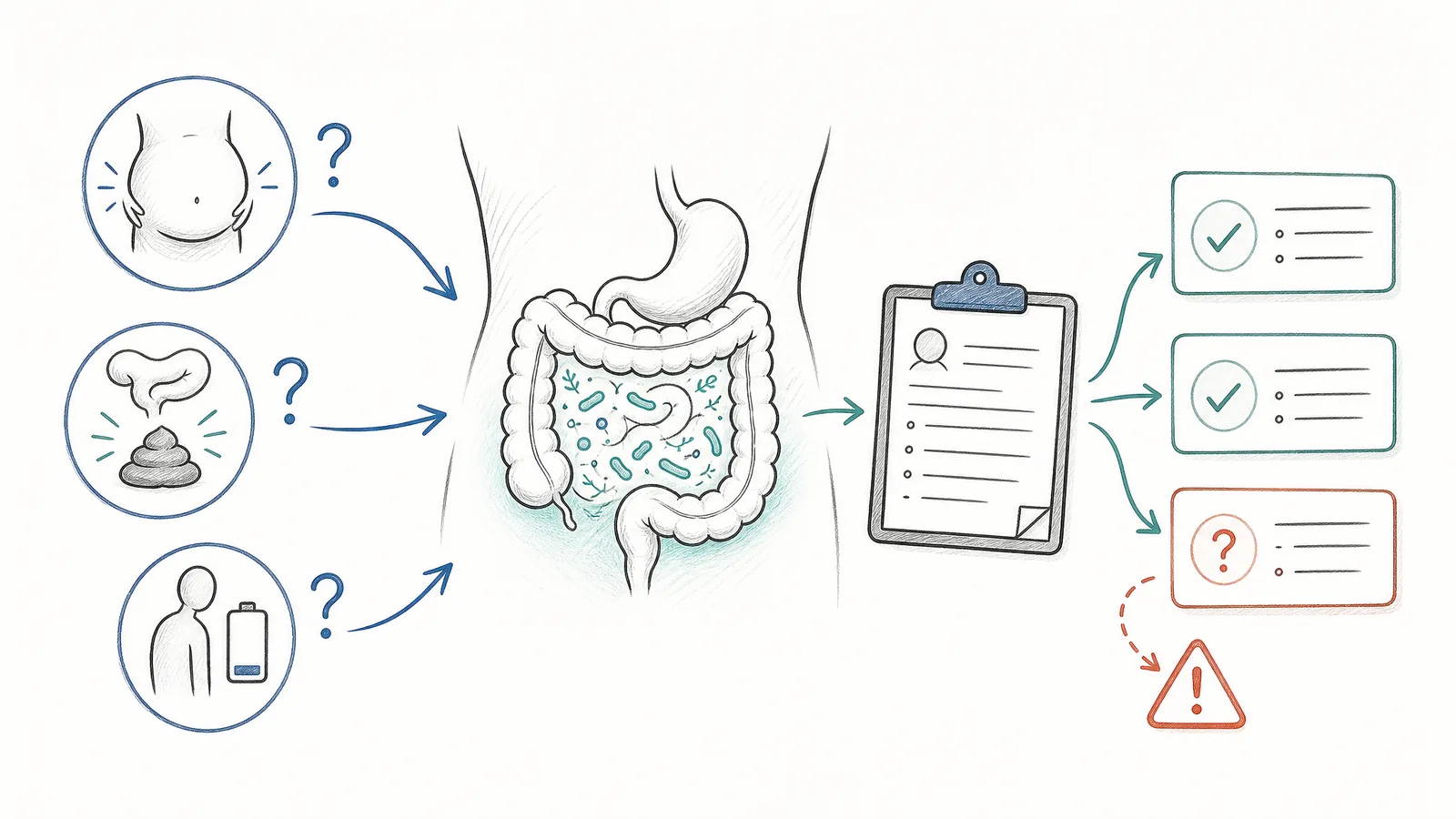
Short answer: Unhealthy intestines can signal trouble through persistent bloating, abdominal pain, diarrhea, constipation, reflux, blood, weight loss, fever, vomiting, fatigue, appetite change, and sometimes skin or mood changes. The key correction is that these symptoms are nonspecific. They do not prove an unhealthy microbiome, and red flags need medical evaluation.
What signals do unhealthy intestines give?
The most useful answer starts with ordinary clinical caution. Intestines can signal problems through changes in pain, stool pattern, bleeding, appetite, weight, energy, nausea, reflux, and how symptoms respond to food or stress. Some signs are common and benign. Some are persistent enough to justify testing. Some are red flags that should not be reframed as “just gut flora.”
InnerBuddies has a consumer article on this question that links many body-wide symptoms to gut imbalance and microbiome testing. The safer evidence-based answer is more restrained: symptoms can overlap with dysbiosis, IBS, infection, inflammatory disease, medication effects, food intolerance, and many non-gut conditions. A microbiome explanation is possible in some contexts, but it is not a diagnosis.
Evidence summary
- Bloating, gas, abdominal pain, diarrhea, constipation, and reflux can come from many causes, including IBS, infection, inflammation, diet, medication, and motility disorders.
- IBS research links symptoms with microbiome and metabolite differences, but no single stool pattern diagnoses IBS in routine care.
- Skin, mood, fatigue, and brain-fog claims are biologically plausible in some settings but are not specific signs of unhealthy intestines.
- Consumer microbiome tests can provide context. They cannot replace medical evaluation for persistent or alarm symptoms.
- Blood in stool, unexplained weight loss, anemia, fever, dehydration, severe pain, persistent vomiting, or new bowel changes after age 50 need clinician review.
Which digestive symptoms matter most?
Digestive symptoms matter most when they are persistent, severe, progressive, new for the person, or paired with alarm features. Bloating and gas can follow a high-FODMAP meal, constipation, swallowed air, lactose intolerance, SIBO, IBS, menstrual-cycle changes, medication effects, or inflammatory disease. Diarrhea can follow infection, antibiotic exposure, bile-acid diarrhea, celiac disease, IBD, microscopic colitis, IBS, pancreatic insufficiency, or medication. Constipation can reflect diet, hydration, pelvic floor dysfunction, hypothyroidism, pregnancy, opioid use, antidepressants, iron, calcium, or neurological disease.
That list is why symptom-to-microbiome certainty is risky. The microbiome can be involved in several of these conditions, but a symptom does not identify the mechanism. Abdominal pain plus diarrhea is not the same clinical problem in a teenager after a viral illness, a person with blood in stool, an older adult with new bowel changes, or someone taking antibiotics.
Can bloating and irregular stools mean dysbiosis?
They can be associated with microbial changes, especially in functional gastrointestinal disorders. Research in IBS and small-intestinal microbial dysbiosis has found differences in diversity, microbial composition, metabolites, and symptom patterns in some cohorts. That makes the microbiome scientifically relevant. It does not make dysbiosis a simple explanation for every bloated abdomen.
Clinically, IBS is diagnosed from a pattern of recurrent abdominal pain linked to bowel habits after appropriate assessment, not from a consumer microbiome report alone. Some people with IBS have diarrhea-predominant, constipation-predominant, mixed, or unclassified patterns. Others have conditions that mimic IBS and require different treatment. A careful history, medication review, diet review, alarm-feature screen, and selective testing usually matter more than a single microbiome score.
Do skin, mood, fatigue, and brain fog prove gut problems?
No. These symptoms deserve respect, but they are not specific gut signals. Skin flares can involve genetics, immune triggers, hormones, cosmetics, infections, allergies, medications, and environmental exposures. Fatigue can come from sleep disorders, anemia, thyroid disease, depression, chronic infection, medication, autoimmune disease, low intake, or many other causes. Anxiety and depression have links with the gut-brain axis in research, yet they should not be reduced to “bad gut bacteria.”
The gut-brain, gut-skin, and immune-microbiome fields are real areas of science. The problem is translation. A mechanistic pathway does not mean a person’s eczema, low mood, or fatigue is caused by dysbiosis. It also does not mean buying a stool test is the best first step. If symptoms are significant, persistent, or worsening, basic medical evaluation often gives more actionable information.
Can a microbiome test tell what your intestines are signaling?
A microbiome test can show features of one stool sample. Depending on the method, it may report relative abundance, diversity metrics, bacterial groups, and predicted functional pathways. That information can be interesting and sometimes useful for research-style questions. It can also be misleading if treated as a diagnostic panel.
Stool sequencing usually reflects the colon more than the small intestine. It does not directly see reflux, ulcers, gallbladder function, colon inflammation, strictures, tumors, pelvic floor dysfunction, or many infections unless specifically designed and validated for those targets. It also cannot decide whether blood, weight loss, anemia, or severe pain is safe to watch. Symptoms are signals from a person, not just from microbes.
What does marketing often get wrong?
Marketing often makes symptoms feel more specific than they are. A post may list bloating, fatigue, acne, bad breath, anxiety, weight change, food intolerance, and brain fog as if they form a recognizable microbiome signature. In real clinical practice, that cluster can point in many directions. Some are gut-related. Some are systemic. Some are medication-related. Some are stress-related. Some are urgent enough to investigate.
The second mistake is promising precision before validation. Words such as “pinpoint,” “root cause,” “personalized,” and “restore” sound reassuring. They should be earned by evidence. For a reader, the safer question is not “Could the microbiome be involved?” It often could. The safer question is “Would this test or recommendation change care in a validated way, and could it delay something important?”
When should you see a clinician?
Seek prompt medical care for blood in stool, black or tarry stool, unexplained weight loss, iron-deficiency anemia, persistent fever, dehydration, severe or worsening abdominal pain, persistent vomiting, difficulty swallowing, a new lump or abdominal swelling, new bowel changes after age 50, nighttime diarrhea, symptoms after recent antibiotics, pregnancy-related concerns, immune suppression, or a family history that raises colorectal cancer or IBD risk. These signs are not wellness puzzles. They are reasons for proper evaluation.
Also get help when symptoms last more than a few weeks, repeatedly disrupt meals or sleep, cause avoidance of many foods, or worsen despite reasonable changes. A clinician may consider stool pathogen tests, blood work, celiac testing, inflammatory markers, colonoscopy, imaging, medication changes, dietitian referral, or symptom-directed IBS care. The right path depends on the pattern.
Bottom line
Unhealthy intestines can send digestive signals, and the microbiome may be part of the explanation. The responsible answer is that symptoms are clues, not proof. Bloating, bowel changes, reflux, fatigue, skin flares, and mood symptoms should be interpreted with context, duration, severity, medications, age, and red flags.
Use microbiome information as one possible layer. Do not use it to self-diagnose, ignore blood or weight loss, or replace validated medical tests. The best gut-health advice protects the reader from both neglect and overtesting.
The Simple Version
Your intestines can complain in many ways: pain, bloating, diarrhea, constipation, reflux, nausea, low appetite, and sometimes tiredness or feeling generally unwell. Those signals matter, but they do not all mean the same thing. A stomach bug, IBS, constipation, medication, food intolerance, inflammation, stress, or a more serious condition can look similar at first.
A microbiome test may give clues about bacteria in one stool sample. It cannot explain every symptom or replace a clinician when warning signs are present. If symptoms are mild and short lived, simple steps may help. If they are severe, persistent, new, or come with blood, weight loss, fever, dehydration, or strong pain, get medical help instead of guessing.
Evidence notes
- Small intestinal microbial dysbiosis underlies symptoms associated with functional gastrointestinal disorders. Nature Communications. 10.1038/s41467-019-09964-7
- Irritable bowel syndrome. Nature Reviews Disease Primers. 10.1038/nrdp.2016.14
- Global burden of irritable bowel syndrome: trends, predictions and risk factors. Nature Reviews Gastroenterology & Hepatology. 10.1038/s41575-020-0286-8
- Altered metabolome and microbiome features provide clues in understanding irritable bowel syndrome and depression comorbidity. The ISME Journal. 10.1038/s41396-021-01123-5
- Emerging role of the host microbiome in neuropsychiatric disorders: overview and future directions. Molecular Psychiatry. 10.1038/s41380-023-02287-6
- Symptoms and patient factors associated with longer time to diagnosis for colorectal cancer: results from a prospective cohort study. British Journal of Cancer. 10.1038/bjc.2016.221
This article is educational and does not diagnose, treat, or replace care from a qualified clinician.