Evidence-based response
What Signals Do Diseased Intestines Give? Evidence-Based Symptoms, Limits, and Red Flags
Persistent gut symptoms, bleeding, fever, weight loss, anemia, dehydration, or nighttime diarrhea need clinical context, not a microbiome-only explanation.
By Sandra McKenzy, Pharmacist · 2026-06-06
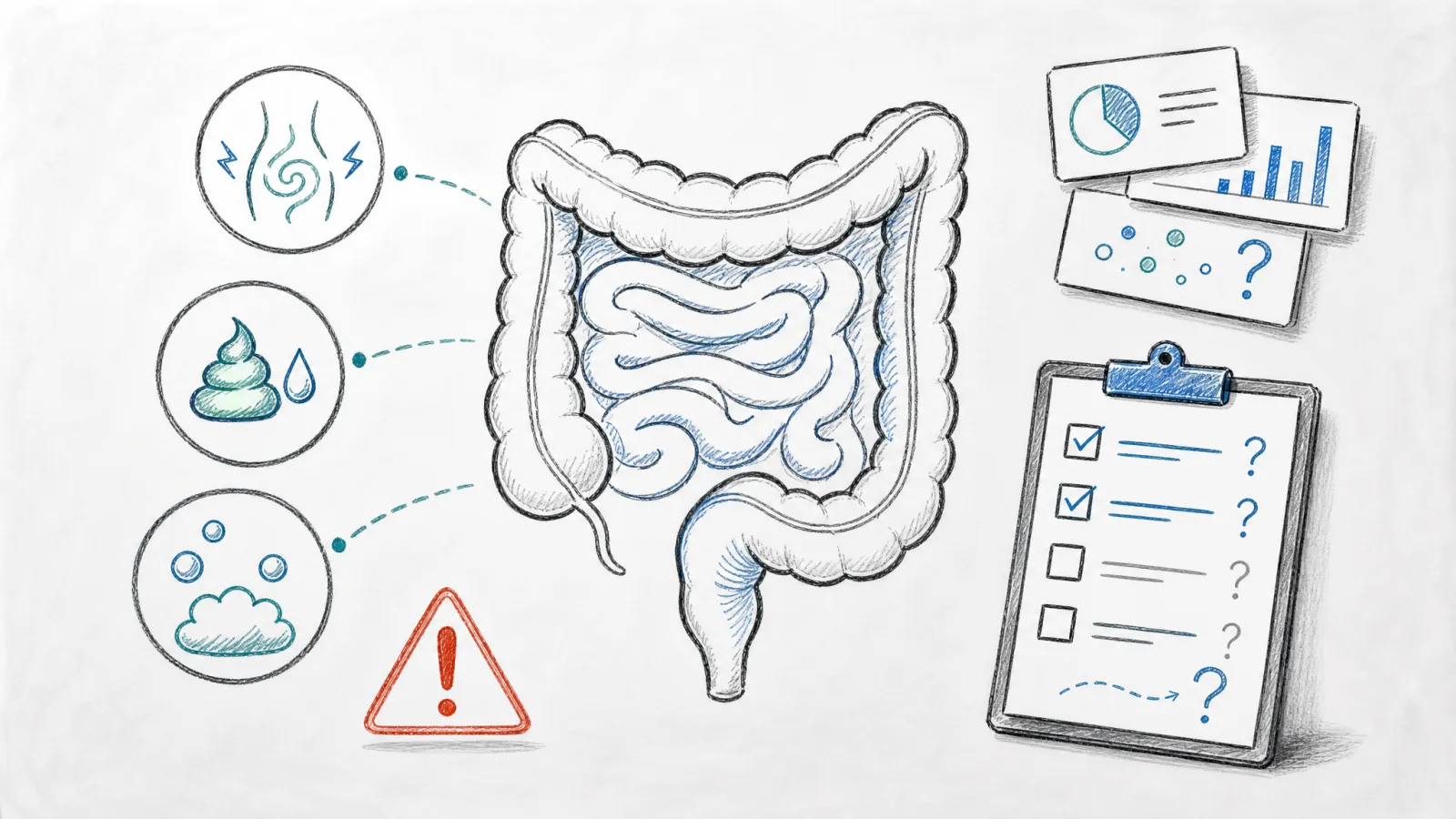
Short answer: Diseased intestines can signal trouble through persistent abdominal pain, diarrhea, constipation, blood in stool, fever, weight loss, anemia, vomiting, dehydration, or nighttime symptoms. These signs are not microbiome-specific. A stool microbiome test may add context, but it cannot diagnose inflammatory bowel disease, infection, cancer, or other intestinal disease by itself.
What signals do diseased intestines give?
The useful answer starts with pattern, duration, severity, and red flags. Occasional bloating, gas, loose stool, or constipation can happen after diet changes, stress, travel, infection, medication, or ordinary variation. Intestinal disease becomes more concerning when symptoms persist, worsen, wake a person at night, appear with systemic signs, or affect nutrition and daily function. The body does not send one clean signal that says microbiome imbalance. It sends nonspecific symptoms that need interpretation.
InnerBuddies has published a consumer-facing article on intestinal signals and microbiome testing. This response uses that search intent but keeps the clinical boundary tighter. Microbiome data can be interesting and sometimes useful, but symptoms plus a consumer stool report are not a substitute for history, examination, blood tests, stool pathogen testing, fecal calprotectin, imaging, endoscopy, or biopsy when those are indicated.
Evidence summary
- Common gut symptoms overlap across IBS, infection, inflammatory bowel disease, medication effects, food intolerance, and colorectal disease.
- Microbiome differences are reported in several intestinal conditions, but those differences rarely diagnose an individual patient alone.
- Blood in stool, unexplained weight loss, fever, anemia, dehydration, severe pain, persistent vomiting, or nighttime diarrhea are red flags.
- IBS can involve microbiome and gut-brain interaction patterns, but it remains a clinical diagnosis based on symptoms and exclusion of alarm features.
- Stool microbiome tests should not reassure someone away from medical care when red flags are present.
What symptoms are most concerning?
The most concerning signals are those that suggest inflammation, bleeding, infection, obstruction, dehydration, malabsorption, or cancer risk. Blood in stool, black stools, persistent fever, severe abdominal pain, unexplained weight loss, anemia, repeated vomiting, dehydration, new bowel habit change after age 50, and waking at night with diarrhea deserve clinical attention. So do symptoms after recent antibiotic use, hospitalization, travel with severe diarrhea, pregnancy, immunosuppression, or known inflammatory bowel disease.
Less dramatic symptoms still matter when they are persistent. Bloating, pain, constipation, diarrhea, mucus, urgency, reflux, nausea, and fatigue can reflect functional disorders such as IBS, but they can also appear in celiac disease, inflammatory bowel disease, microscopic colitis, bile acid diarrhea, endocrine disease, medication adverse effects, infection, or colorectal disease. The safe move is not panic. The safe move is matching the symptom pattern to the right level of evaluation.
Are bloating and bowel changes signs of diseased intestines?
They can be, but they often are not specific. Bloating may relate to constipation, swallowed air, fermentable carbohydrates, visceral sensitivity, small intestinal bacterial overgrowth, motility changes, or inflammation. Diarrhea can come from infection, medication, bile acids, IBS-D, IBD, microscopic colitis, malabsorption, endocrine causes, or travel-related pathogens. Constipation can come from low fiber intake, medications, pelvic floor dysfunction, slow transit, dehydration, neurologic disease, hypothyroidism, or IBS-C.
This is why a single symptom list can mislead readers. If an article implies that bloating plus fatigue equals dysbiosis, it is making a leap. Microbiome shifts have been described in IBS and other gastrointestinal conditions, but overlap is large and causality is not always clear. Symptoms should guide a differential diagnosis, not a product recommendation by default.
Can a microbiome test diagnose diseased intestines?
For most clinical questions, no. Stool microbiome testing can describe microbial composition and sometimes functional signals, depending on the method. It may show lower diversity, relative abundance changes, or patterns associated with disease groups. That does not mean it can diagnose Crohn's disease, ulcerative colitis, colorectal cancer, celiac disease, SIBO, microscopic colitis, or acute infection in an individual reader.
Validated medical testing is different. Suspected infection may require stool PCR, culture, toxin testing, ova and parasite testing, or targeted panels. Suspected inflammation may require fecal calprotectin, CRP, blood counts, imaging, endoscopy, and biopsy. Suspected colorectal cancer may require colonoscopy or other guideline-based investigation. A consumer microbiome profile can sit beside these tools as context, but it should not replace them.
Which claims are best supported?
The best-supported claim is modest: intestinal diseases and functional bowel disorders can be associated with microbiome changes. Research in IBS, IBD, travel-related diarrhea, microscopic colitis, and broad health status profiling shows microbial and metabolic differences between groups. These studies are valuable because they may help explain mechanisms, identify future biomarkers, or guide research into targeted therapies.
The second supported claim is that symptoms deserve context. In IBS, diagnosis depends on symptom patterns and the absence of alarm features, not a single microbiome signature. In Crohn's disease and ulcerative colitis, inflammation must be assessed with clinical tools. In colorectal disease, symptoms such as blood, anemia, weight loss, and altered bowel habits are evaluated because delayed diagnosis can matter. Microbiome science does not remove those conventional pathways.
Which claims go beyond the evidence?
The main overclaim is that microbiome imbalance explains most intestine signals. Another overclaim is that a microbiome test can provide diagnostic clarity for symptoms that actually need medical assessment. A low-diversity result may sound actionable, but it does not tell whether bleeding is hemorrhoids, colitis, infection, or cancer. It does not tell whether diarrhea is viral, inflammatory, medication-related, bile-acid driven, or functional. It does not tell whether abdominal pain requires urgent care.
There is also a safety problem with wellness reassurance. If a person with red flags is told to optimize gut bacteria first, diagnosis can be delayed. Reader-protective writing should say when self-care is reasonable and when it is not. That is especially important for people with immunosuppression, older age, pregnancy, known gastrointestinal disease, recent antibiotic exposure, or severe dehydration.
What does marketing often get wrong?
Marketing often makes the microbiome sound like the master explanation for every gut and whole-body symptom. The microbiome matters, but symptoms are generated by the whole person: nerves, immune activity, motility, hormones, diet, medications, infection risk, anatomy, and psychosocial stress all interact. A stool report captures one layer of that system. It does not see the intestinal wall directly, measure pain processing, inspect a tumor, or biopsy inflamed tissue.
Good communication keeps the layers separate. It can say that microbiome research is promising while also saying that consumer testing is not the right first step for blood in stool, persistent fever, severe pain, dehydration, or unexplained weight loss. That boundary is not anti-microbiome. It is basic clinical safety.
What studies actually show
MedicalBrain validation for this article found peer-reviewed evidence on IBS, Crohn's disease, travel-associated diarrhea, microbiome health-status profiling, functional gastrointestinal disorders, and colorectal cancer symptom evaluation. These sources support the same overall message: microbiome patterns can be associated with disease or symptoms, but diagnosis depends on validated clinical criteria and appropriate testing.
IBS research shows microbial differences and gut-brain interaction biology, yet IBS is not diagnosed by a consumer microbial diversity score. Crohn's disease is a chronic inflammatory disease requiring clinical evaluation and often endoscopic, radiologic, and histologic assessment. Diarrheal illness can alter the microbiome and resistome, but cause-specific testing still matters. Colorectal cancer research highlights how symptom patterns and delayed diagnosis are clinically relevant. None of these fields supports replacing red-flag evaluation with microbiome optimization.
When should you see a clinician urgently?
Seek prompt medical advice for blood in stool, black or tarry stool, unexplained weight loss, persistent fever, severe or worsening abdominal pain, ongoing vomiting, dehydration, fainting, anemia, new bowel habit change after age 50, nighttime diarrhea, persistent diarrhea after antibiotics, severe symptoms after travel, or symptoms in pregnancy or immunosuppression. Emergency care is appropriate for severe dehydration, intense pain with a rigid abdomen, fainting, confusion, high fever with bloody diarrhea, or signs of bowel obstruction.
For non-urgent but persistent symptoms, a clinician can decide whether basic blood work, stool testing, fecal calprotectin, celiac testing, medication review, imaging, colonoscopy, or referral is needed. That is a better safety pathway than trying to infer disease from a broad microbiome score.
Bottom line
Diseased intestines can signal problems through pain, stool changes, bleeding, fever, weight loss, anemia, vomiting, dehydration, and symptoms that persist or wake you at night. Those signals are important because they are nonspecific. They do not automatically mean dysbiosis, and they should not be reduced to a microbiome test result.
The microbiome may help explain some gut conditions and may become more clinically useful over time. Today, the safer answer is this: use symptoms to decide whether medical evaluation is needed, use validated tests when disease is possible, and treat consumer microbiome reports as context rather than diagnosis.
Evidence notes
- Irritable bowel syndrome. Nature Reviews Disease Primers. 10.1038/nrdp.2016.14
- Crohn's disease. Nature Reviews Disease Primers. 10.1038/s41572-020-0156-2
- Impact of international travel and diarrhea on gut microbiome and resistome dynamics. Nature Communications. 10.1038/s41467-022-34862-w
- A predictive index for health status using species-level gut microbiome profiling. Nature Communications. 10.1038/s41467-020-18476-8
- Small intestinal microbial dysbiosis underlies symptoms associated with functional gastrointestinal disorders. Nature Communications. 10.1038/s41467-019-09964-7
- Symptoms and patient factors associated with longer time to diagnosis for colorectal cancer. British Journal of Cancer. 10.1038/bjc.2016.221
- Whole-colon investigation vs. flexible sigmoidoscopy for suspected colorectal cancer based on presenting symptoms and signs. British Journal of Cancer. 10.1038/s41416-018-0335-z
This article is educational and does not diagnose, treat, or replace care from a qualified clinician.