Evidence-based response
What Is the Function of the Soil Microbiome? Evidence-Based Answer Without the Gut-Health Leap
Soil microbiomes support ecosystems, but soil-gut analogies should not be used to overpromise consumer microbiome testing.
By Sandra McKenzy, Pharmacist · 2026-06-08
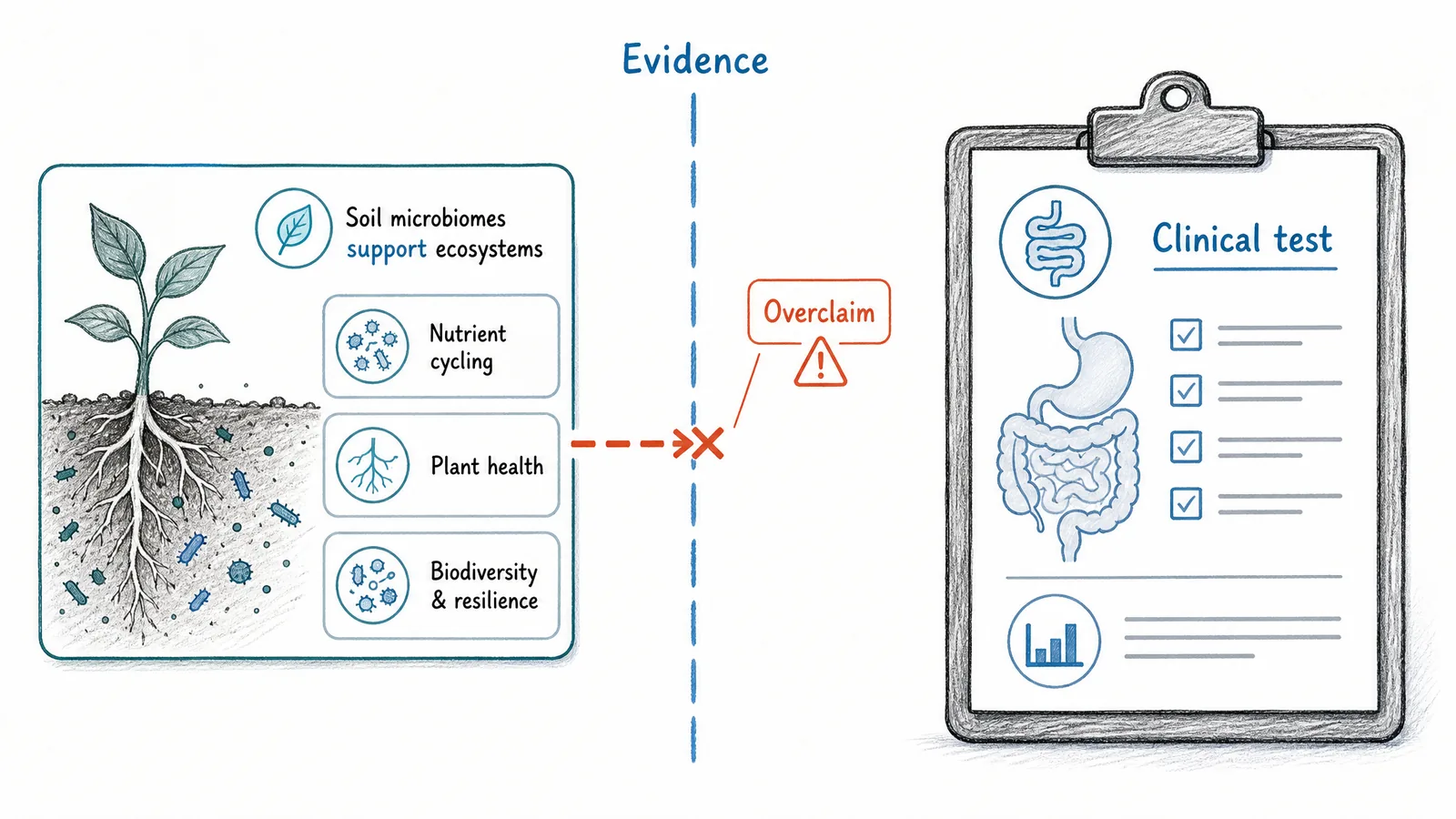
Short answer: The soil microbiome recycles nutrients, supports plants, and shapes ecosystems. Those ideas can help explain human microbiome science, but soil and gut are not the same system. Soil ecology does not prove that a consumer stool test can diagnose or prescribe personalized gut interventions.
What is the function of the soil microbiome?
InnerBuddies uses soil microbiome concepts to explain gut testing and personalized interventions. The evidence-based correction is that ecological analogy is useful, but clinical claims still need human validation.
Evidence summary
- Soil microbes support nutrient cycling, plant health, and ecosystem resilience.
- Soil and gut microbiomes share ecological ideas, but they are not interchangeable systems.
- Soil diversity does not prove a consumer stool test can prescribe diet or lifestyle actions.
- Human clinical claims require human validation, not analogy alone.
- People should not ingest soil or use environmental exposure as a treatment without medical context.
What is the function of the soil microbiome?
The soil microbiome helps recycle nutrients, build soil structure, support plant roots, suppress some plant diseases, and transform organic matter. It is a living ecological network. These functions matter for agriculture and environmental health.
The human gut also contains a microbial ecosystem, but analogy has limits. Soil is not intestine. Plant health is not patient care. Ecological ideas such as diversity, resilience, and disturbance can help explain microbiome science, yet they do not automatically create clinical recommendations for one person.
How is soil microbiome science related to human gut health?
There is growing research on the soil-plant-human gut axis. Food systems, plant microbiomes, environmental exposure, and diet can influence human microbial exposures. That is a real research area, not just a metaphor.
Still, the path from soil microbe to human health outcome is complex. A soil organism may not survive cooking, stomach acid, bile, or competition in the intestine. Even when exposure matters, the clinical effect depends on dose, host, diet, immune status, and many other variables.
Can soil concepts validate microbiome testing?
Soil ecology gave microbiome science useful tools: diversity measures, network thinking, resilience, metagenomics, and functional analysis. Those tools can inform stool research. They do not mean that a consumer report can use soil analogies to prescribe personalized interventions with clinical certainty.
Human microbiome testing is still moving from association toward validated clinical use. For specific diseases, some biomarker panels are promising. For broad wellness claims, the evidence bar is higher than “ecosystems like diversity.”
What marketing gets wrong
Marketing often borrows ecological language because it sounds wise and natural. Words such as balance, resilience, keystone species, and restoration may be useful in science. They become misleading when they imply that a simple test can diagnose a damaged ecosystem and repair it with generic advice.
Soil health also should not be converted into unsafe behavior. Eating soil, ignoring food safety, or using environmental exposure as treatment is not evidence-based gut care.
What did MedicalBrain validation show?
MedicalBrain found a recent Nature Communications perspective on the soil-plant-human gut microbiome axis, plus human microbiome papers on diversity, health markers, and the clinical limits of microbiome interpretation. The evidence supports the broad connection, not overconfident personalization.
The key distinction is translation. Ecological principles help researchers ask better questions. They do not replace human trials, validated diagnostics, or clinician assessment.
When should you see a clinician?
Digestive symptoms still deserve standard red-flag thinking. Seek care for blood in stool, black stool, fever, unexplained weight loss, persistent diarrhea, severe pain, anemia, vomiting, dehydration, or symptoms in immunocompromised people. Do not treat these with environmental or soil-based microbiome ideas.
If your concern is diet quality, a clinician or dietitian can help turn broad ecology into safe, ordinary steps: more plant variety, adequate fiber when tolerated, safe food handling, and evaluation of symptoms.
How should soil microbiome ideas be used responsibly?
The responsible use of soil microbiome science is educational. It can help readers understand why diversity, nutrients, habitat, disturbance, and recovery matter in microbial systems. It can also explain why diet quality and food systems matter for human microbial exposure. That is valuable, but it stays at the level of principle until human outcomes are tested.
For gut health, practical advice should come from human evidence. Eating a varied diet, including plants when tolerated, avoiding unnecessary antibiotics, using safe food practices, and treating disease with validated care are defensible. Claims that soil microbes directly prescribe a supplement, diagnose dysbiosis, or prove a consumer report can restore balance are not defensible.
This distinction protects both science and readers. Soil ecology is powerful enough without exaggeration. Turning it into a wellness shortcut weakens the message and may encourage unsafe behavior. The better conclusion is that ecosystems teach humility: complex systems need careful measurement before intervention. Soil research can inspire safer questions about food systems and microbial exposure, but it should never be used as a shortcut around human clinical evidence.
Bottom line
Soil microbiomes are essential for ecosystems. They can teach useful principles about diversity and resilience. But human health claims must be proven in humans. Do not let a soil analogy turn a consumer microbiome report into a diagnosis or treatment plan.
The simple version
Soil is full of microbial life that helps plants and ecosystems. Your gut also has microbes, but it is not soil. Comparisons can teach ideas, not replace medical evidence.
The safest takeaway is modest: healthy food systems matter, dietary diversity matters, and microbial exposure is scientifically interesting. None of that proves a home gut test can translate soil biology into a personal treatment plan.
Evidence notes
- The soil-plant-human gut microbiome axis into perspective. Nature Communications. 10.1038/s41467-025-62989-z
- Microbiome and well-being: a meta-analysis. npj Biofilms and Microbiomes. 10.1038/s41522-025-00829-0
- Introduction to host microbiome symbiosis in health and disease. Mucosal Immunology. 10.1038/s41385-020-00365-4
- Health and disease markers correlate with gut microbiome composition across thousands of people. Nature Communications. 10.1038/s41467-020-18871-1
- Translating microbiota analysis for clinical applications. Nature Reviews Bioengineering. 10.1038/s44222-024-00168-3
- Utilization of the microbiome in personalized medicine. Nature Reviews Microbiology. 10.1038/s41579-023-00998-9
This article is educational and does not diagnose, treat, or replace care from a qualified clinician.