Evidence-based response
What Is Included in an IBD Panel? Benefits, Limits, and Red Flags
An IBD work-up usually centers on inflammatory markers, stool testing, and imaging or endoscopy when needed. Microbiome profiling may be interesting, but it is not the core validated component of most standard IBD panels.
By Sandra McKenzy, Pharmacist · 2026-06-01
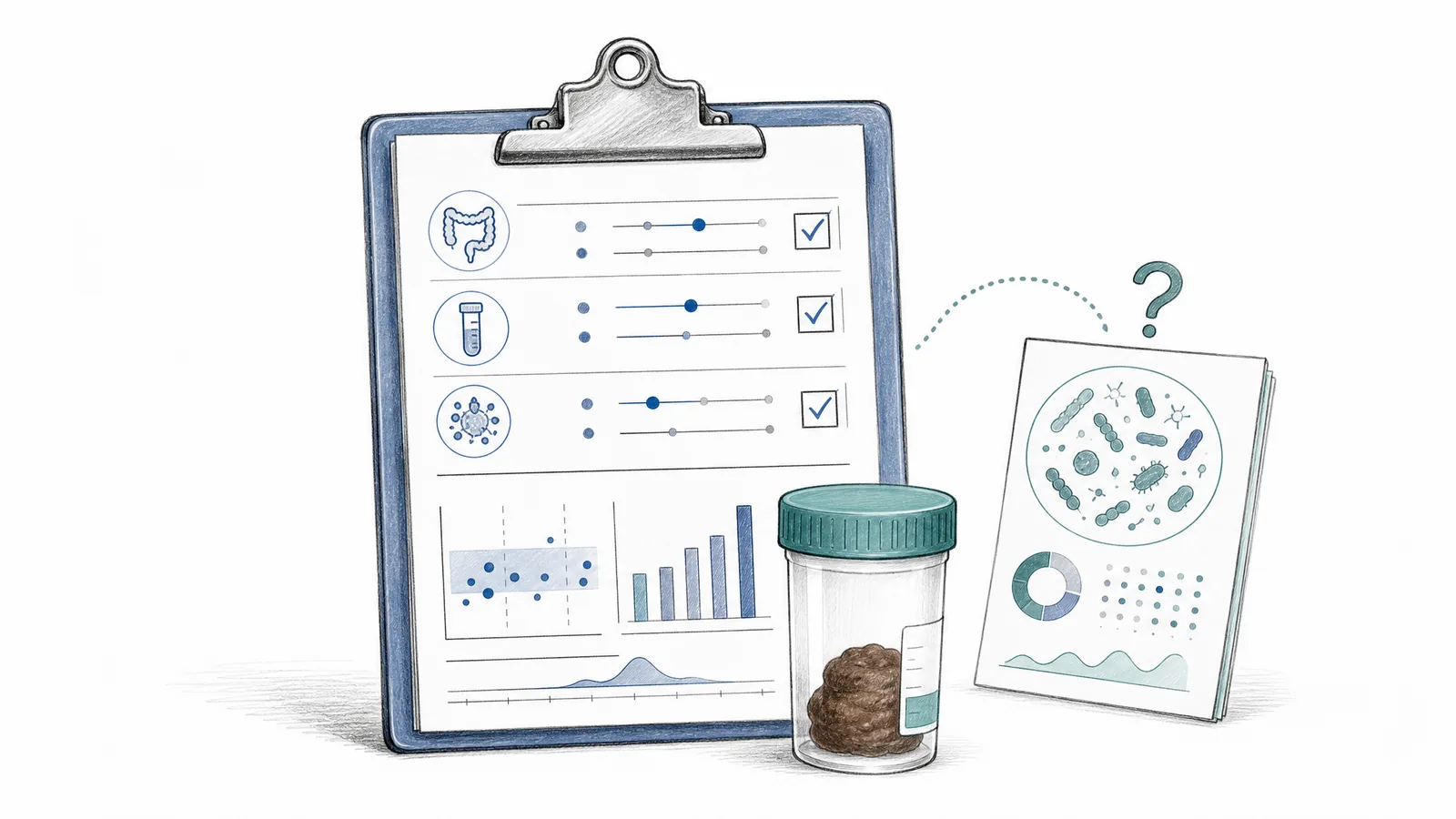
Short answer: A standard IBD work-up usually includes history, examination, blood tests, stool inflammatory markers such as fecal calprotectin, and often stool infection testing. Depending on symptoms and results, clinicians add colonoscopy, biopsy, imaging, or other targeted tests. A consumer microbiome profile is not the core validated part of most IBD panels, even if some marketing copy presents it that way.
What is an IBD panel supposed to do?
The goal is not simply to say “your gut is inflamed.” The real goal is to distinguish inflammatory bowel disease from other causes of symptoms, assess severity, rule out infection when relevant, and decide whether endoscopy or imaging is needed. That requires focused tests, not just broad omics reporting.
Evidence summary
- Fecal calprotectin is one of the most useful noninvasive stool markers in IBD work-up.
- Blood markers such as CRP, ESR, blood count, and chemistry panels add context but are not diagnostic by themselves.
- Stool pathogen testing matters when infection is a realistic alternative explanation.
- Endoscopy and histology remain central for confirmation and classification.
- Microbiome biomarker research is promising, but it is not yet a standard replacement for core IBD diagnostics.
What is commonly included?
Most real-world work-ups begin with history, symptom pattern, medication review, family history, and red-flag assessment. Blood tests often include full blood count, CRP, ESR, iron studies, albumin, and other chemistry depending on the case. Stool testing often includes fecal calprotectin and sometimes stool culture, PCR, or other infection-focused tests.
When suspicion remains high, colonoscopy with biopsy is usually more decisive than any wellness-style panel. Imaging such as MR enterography or ultrasound may help, especially for Crohn’s disease location and extent.
Are antibody panels or microbiome profiles part of every IBD panel?
No. Some labs include serologies or proprietary panels, but they are not universal or sufficient on their own. Microbiome profiling is an active research area, and some recent studies show impressive diagnostic promise. Even so, that is different from saying a routine consumer microbiome panel already functions as a standard clinical IBD panel.
What marketing gets wrong
The overreach is to present a broad stool DNA report as if it captures the same clinical value as calprotectin, endoscopy, biopsy, and targeted inflammatory assessment. Those tools answer different questions. A microbiome report may one day become more clinically integrated, but the field is not yet at the point where a branded microbiome dashboard replaces standard IBD evaluation.
When should you seek urgent care?
Red flags include GI bleeding, severe or worsening abdominal pain, persistent fever, dehydration, significant weight loss, nocturnal diarrhea, anemia, repeated vomiting, or concern for obstruction. Those symptoms need prompt medical assessment.
Bottom line
An IBD panel is best understood as a focused clinical work-up built around inflammation markers, stool testing, and, when needed, endoscopy or imaging. Microbiome profiling is scientifically interesting and increasingly relevant, but it is still an adjunct rather than the central validated component of most standard IBD diagnostics.
Evidence notes
- Torres et al. (2020). Crohn’s disease. Nature Reviews Disease Primers. 10.1038/s41572-020-0156-2
- Lee et al. (2024). Validation of rapid fecal calprotectin assay using particle enhanced turbidimetric immunoassay for inflammatory bowel disease. Scientific Reports. 10.1038/s41598-024-51580-z
- Gevers et al. (2024). Noninvasive, microbiome-based diagnosis of inflammatory bowel disease. Nature Medicine. 10.1038/s41591-024-03280-4
- Quigley (2017). Gut microbiome as a clinical tool in gastrointestinal disease management: are we there yet? Nature Reviews Gastroenterology & Hepatology. 10.1038/nrgastro.2017.29
- Wilkinson et al. (2022). Microbiome risk profiles as biomarkers for inflammatory and metabolic disorders. Nature Reviews Gastroenterology & Hepatology. 10.1038/s41575-022-00581-2
- Meng et al. (2026). Mucosa-associated bacteria and metabolites in inflammatory bowel disease: from inside to insight. npj Biofilms and Microbiomes. 10.1038/s41522-025-00887-4
This article is educational and does not diagnose, treat, or replace care from a qualified clinician.