Evidence-based response
What Does the Microbiome Do? Evidence-Based Answer Without the Testing Hype
The microbiome helps digest fiber, produce microbial metabolites, train immune responses, protect barrier surfaces, and interact with metabolism. But those broad roles do not mean a consumer stool test can diagnose your symptoms or prescribe a personalized plan on its own.
By Sandra McKenzy, Pharmacist · 2026-07-09
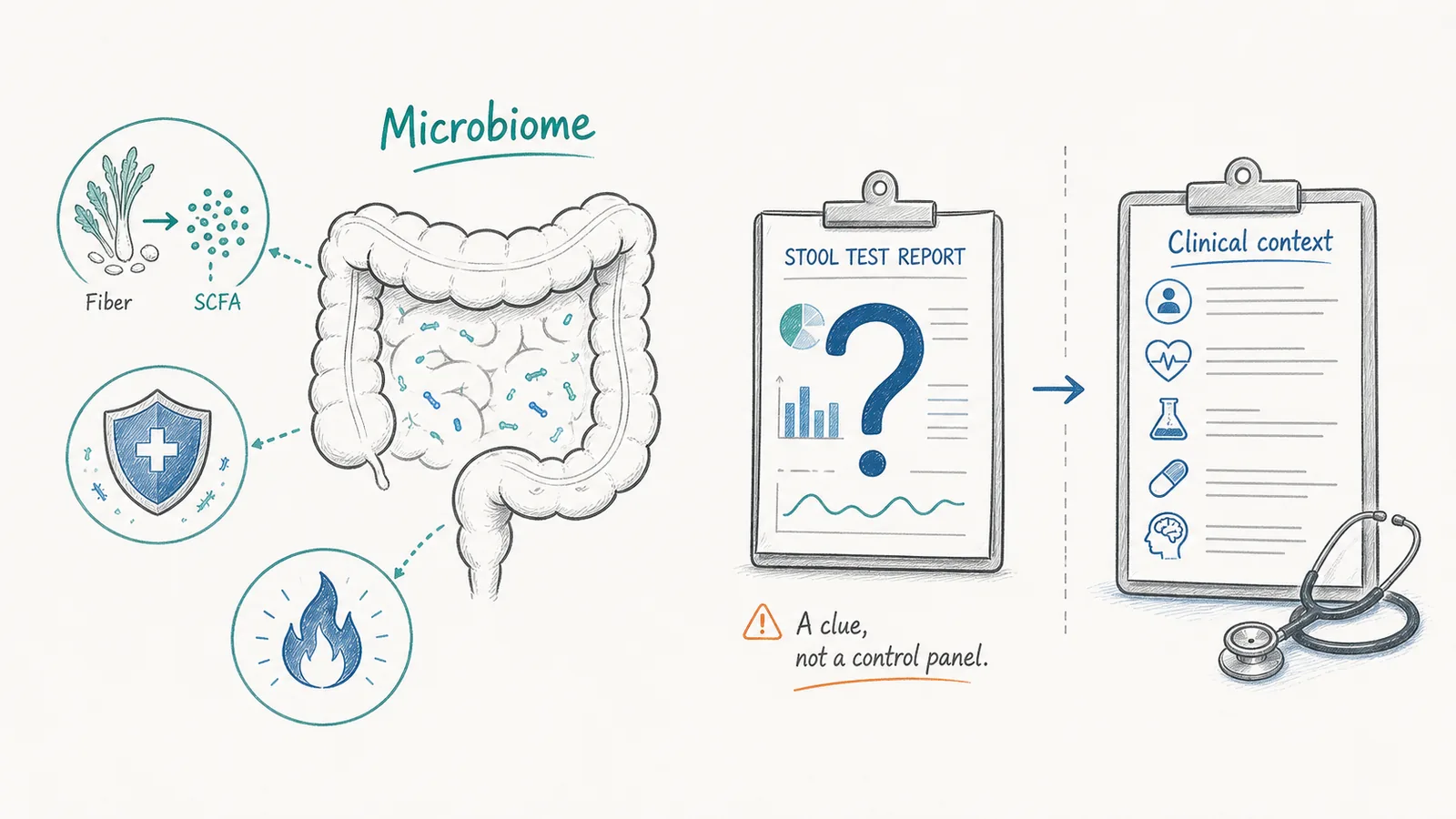
Short answer: The microbiome helps digest fiber, produce microbial metabolites, train immune responses, protect barrier surfaces, and interact with metabolism. But those broad roles do not mean a consumer stool test can diagnose your symptoms or prescribe a personalized plan on its own.
The microbiome is not a single organ with one simple job. It is a living ecosystem of microbes, genes and metabolites that interacts with the gut lining, immune cells, food, medicines and the rest of the body. That makes it scientifically important. It also makes overconfident testing claims easy to exaggerate.
What Does the Microbiome Do?
The gut microbiome helps the body process parts of food that human enzymes cannot fully digest, especially many fibers and resistant starches. Microbes transform these substrates into metabolites, including short-chain fatty acids such as acetate, propionate and butyrate. These compounds can influence colon cells, gut barrier function, immune signalling and energy metabolism.
The microbiome also helps shape the mucosal immune system. Gut microbes and their products constantly interact with immune cells at barrier surfaces. In healthy conditions, this interaction helps the immune system tolerate harmless food and commensal microbes while remaining able to respond to pathogens. In disease, infection, antibiotics, inflammation or major diet changes, that balance can shift.
Microbes also participate in bile acid transformation, vitamin production, drug metabolism, pathogen resistance and communication with nerves and endocrine signals. These roles are real, but they are not simple switches. A stool report showing more or less of a bacterial group does not automatically tell you what is happening inside the gut wall, small intestine, immune system or bloodstream.
Evidence summary
Evidence summary
- The gut microbiome helps ferment dietary fiber into metabolites such as short-chain fatty acids, which can support the intestinal barrier and immune signalling.
- Microbial communities interact with digestion, bile acids, vitamins, drug metabolism, mucosal immunity and metabolic regulation, but effects vary by person and context.
- Dysbiosis is associated with many diseases, but association does not automatically prove diagnosis, cause or treatment choice for one individual.
- Consumer stool testing can describe microbial DNA patterns, but it is not a validated stand-alone tool for diagnosing most symptoms or prescribing supplements.
- Clinical interpretation still needs symptoms, history, medications, diet, examination and validated medical tests when red flags are present.
Does the Microbiome Control Digestion?
It helps with digestion, but it does not control digestion by itself. Digestion also depends on stomach acid, pancreatic enzymes, bile flow, gut motility, the intestinal lining, the nervous system, hormones and the food pattern itself. The microbiome is especially important where food reaches the colon undigested. There, microbes ferment fiber and produce metabolites that may support the colon environment.
This is why diet can change microbial activity quickly. More fermentable fiber may increase substrate for short-chain fatty acid production. Antibiotics, very low-fiber diets, acute illness and major dietary shifts can change microbial composition and function. Still, symptoms such as bloating, pain, diarrhea or constipation cannot be assigned to one microbe from a consumer report without broader clinical assessment.
Does the Microbiome Affect Immunity?
Yes, the microbiome is deeply connected to immunity. Recent immunology reviews describe the gut as a barrier system where microbes, dietary metabolites, epithelial cells, neurons, stromal cells and immune cells interact continuously. Short-chain fatty acids are one example of microbial metabolites that can influence barrier integrity and immune cell functions.
The safe wording is influence, not command. The microbiome does not guarantee strong immunity on demand. A high or low abundance of one bacterial group in stool should not be marketed as a direct immune diagnosis. Vaccination status, age, infection exposure, medications, sleep, nutrition, chronic disease and immune disorders still matter.
Does the Microbiome Affect Metabolism and Weight?
It can. Microbes help transform dietary compounds, modify bile acids, produce metabolites and interact with host metabolic pathways. Human and animal studies support a connection between gut microbial ecology and energy metabolism. But the individual clinical translation remains difficult. Two people can have different microbiomes and still respond differently because of diet, genetics, medication, activity, sleep, disease and environment.
That is the key boundary for weight, glucose and metabolic claims. Microbiome data may eventually help personalize nutrition in selected settings. It is not currently enough for a broad consumer report to prescribe a diet, diagnose insulin resistance or explain weight change by itself.
What Can Microbiome Testing Tell You?
A stool microbiome test can identify microbial DNA patterns in the sample it receives. Depending on the method, it may estimate taxa, diversity, functional genes or predicted metabolic pathways. That can be educational, especially for understanding research language and broad patterns.
The limitation is clinical validation. A stool sample is not a complete map of the whole gut. It says little directly about the small intestine, the gut lining, immune activity, pain signalling, motility, medication effects or whether a symptom has a dangerous cause. MedicalBrain retrieval for this article found repeated caution in Nature reviews: microbiome research is powerful, but routine clinical translation is still selective and not ready for every wellness claim.
Which Claims Go Beyond the Evidence?
The source article is right that the microbiome participates in digestion, immunity, metabolism and possibly mood-related pathways. The overreach is presenting testing as a powerful route to personalized health decisions without equally clear limits. A test can generate clues. It should not be framed as a diagnostic control panel for the whole body.
Be cautious with claims that a microbiome test can uncover the root cause of chronic symptoms, prescribe the right probiotic, prevent disease, optimize immunity, explain mood, or replace traditional medical evaluation. Some of these ideas are active research questions. That is different from validated consumer guidance.
What Marketing Often Gets Wrong
Marketing often compresses a complex ecosystem into a score. Scores can be convenient, but they hide uncertainty. Healthy microbiome reference ranges vary by geography, diet, age, methods and population. A pattern that looks unusual in one comparison may be normal in another context. This is why disease models and wellness interpretations need careful validation.
Another common problem is treating dysbiosis as if it were one diagnosis. Dysbiosis simply means a departure from a chosen reference state. It does not name a cause. It does not identify whether symptoms come from infection, inflammation, celiac disease, irritable bowel syndrome, medication, bile acid malabsorption, endocrine disease or another condition.
When Should You See a Clinician?
Seek medical care for blood in stool, black stools, persistent fever, severe or worsening abdominal pain, fainting, dehydration, persistent vomiting, unexplained weight loss, anemia, symptoms after travel or suspected food poisoning, symptoms during pregnancy, symptoms in infants or older adults, or symptoms in someone who is immunocompromised. Also get help for persistent diarrhea, constipation, pain, appetite change or recurring symptoms that affect daily life.
These situations need medical assessment because they can involve infection, inflammatory bowel disease, celiac disease, medication complications, endocrine disease, cancer or other conditions where delay can be harmful. A microbiome report should not be used to rule them out.
Bottom Line
The microbiome helps digest fiber, produces metabolites, interacts with immunity, supports barrier biology, participates in metabolism and helps resist some pathogens. It is one of the most important biological systems under study. But broad importance is not the same as stand-alone diagnostic power.
The most evidence-based answer is balanced: care for the microbiome with well-supported basics such as fiber-rich foods, dietary diversity, cautious antibiotic use, sleep, physical activity and medical care when symptoms warrant it. Treat consumer microbiome results as context or a conversation starter, not as a final diagnosis or prescription.
Educational disclaimer: This article is for general science education. It does not diagnose, treat, prescribe supplements, interpret a personal test result, or replace care from a licensed clinician.
Evidence Notes and Sources
- Mechanisms and implications of the gut microbial modulation of intestinal metabolic processes (2025). Nature Metabolism. DOI: 10.1038/s44324-025-00066-1
- Short-chain fatty acids: linking diet, the microbiome and immunity (2024). Nature Reviews Immunology. DOI: 10.1038/s41577-024-01014-8
- Microbiota-mediated mechanisms of mucosal immunity across the lifespan (2025). Nature Immunology. DOI: 10.1038/s41590-025-02281-w
- Regional variation limits applications of healthy gut microbiome reference ranges and disease models (2018). Nature Medicine. DOI: 10.1038/s41591-018-0164-x
- Gut microbiome as a clinical tool in gastrointestinal disease management: are we there yet? (2017). Nature Reviews Gastroenterology & Hepatology. DOI: 10.1038/nrgastro.2017.29
- Diet-microbiota interactions and personalized nutrition (2019). Nature Reviews Microbiology. DOI: 10.1038/s41579-019-0256-8
- The promise of the gut microbiome as part of individualized treatment strategies (2022). Nature Reviews Gastroenterology & Hepatology. DOI: 10.1038/s41575-021-00499-1