Evidence-based response
What Can Falsely Elevate Calprotectin? Evidence-Based Answer Without the Gut-Health Hype
Fecal calprotectin can rise from IBD, infection, drugs, age, and sampling context. A high result needs clinical interpretation, not microbiome guesswork.
By Sandra McKenzy, Pharmacist · 2026-06-08
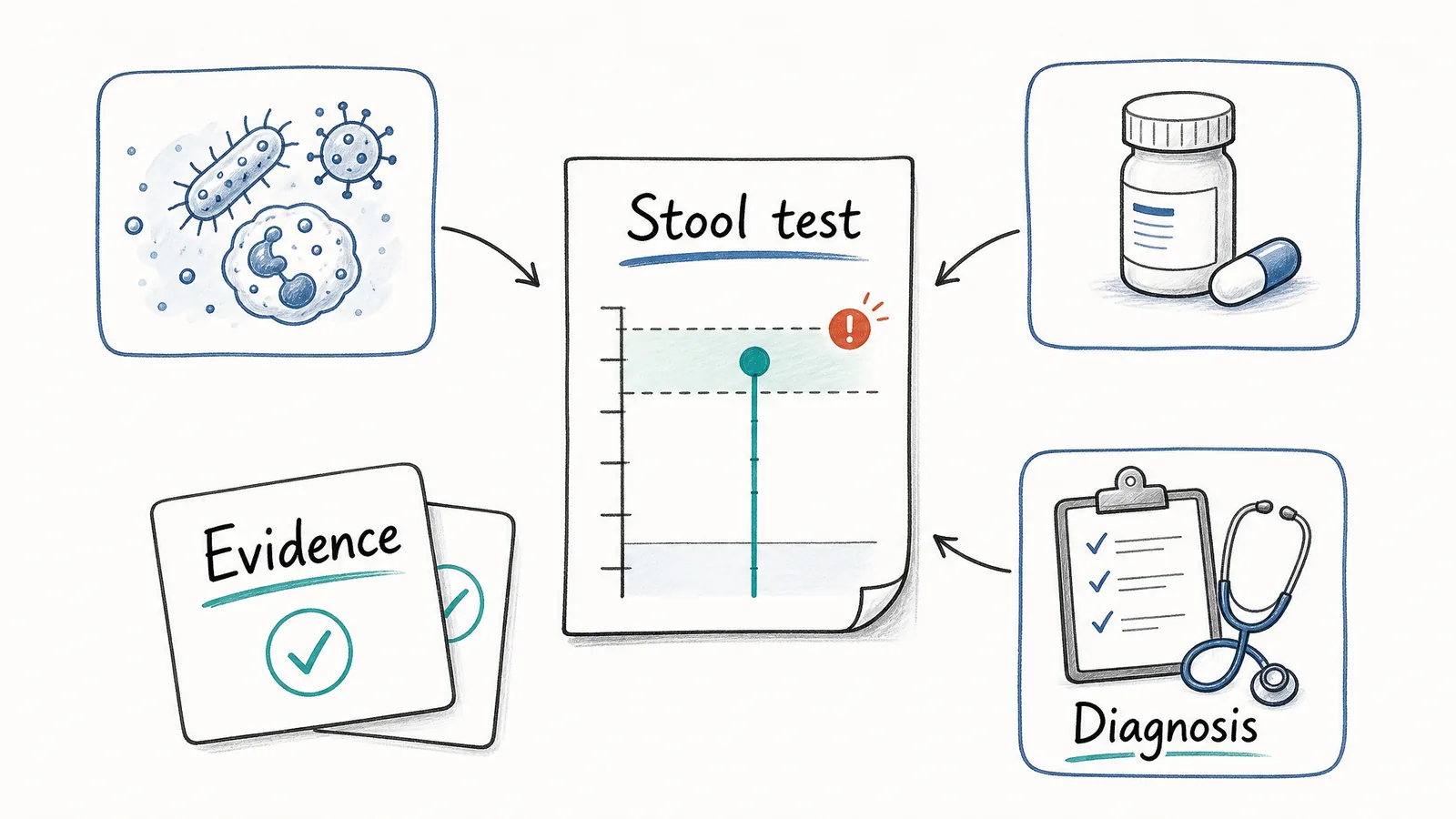
Short answer: Fecal calprotectin can be genuinely elevated by intestinal inflammation, but it can also rise with infections, some medicines such as NSAIDs, age-related variation, recent bleeding, sampling issues, and other non-IBD gut problems. A high result should be interpreted with symptoms, repeat testing when appropriate, and clinician judgment. It should not be explained away by a consumer microbiome test.
Can calprotectin be falsely elevated?
Yes. “False elevation” usually means the result is higher than expected for chronic inflammatory bowel disease, not that the protein is meaningless. Calprotectin is a neutrophil-related stool marker. It is useful because it often rises when the gut lining is inflamed, but it is not specific for one diagnosis.
InnerBuddies has an article targeting this question, What can falsely elevate calprotectin?. This response uses that search intent as a starting point and applies a stricter clinical standard. The useful question is not whether the microbiome matters. It does. The safer question is what a reader can reasonably conclude from symptoms, stool tests, diet advice, or research headlines without turning early science into personal medical certainty.
Evidence summary
- Calprotectin is a useful non-invasive marker of neutrophil-driven intestinal inflammation, especially in IBD assessment.
- A single elevated value does not identify the cause of inflammation.
- Infection, medication exposure, age, bleeding, and sampling variability can affect interpretation.
- Consumer microbiome reports cannot rule in or rule out IBD after a high calprotectin result.
- Red flags such as blood, weight loss, fever, anemia, or nocturnal diarrhea need medical evaluation.
What does this topic actually mean clinically?
Clinically, fecal calprotectin is a triage and monitoring tool. It helps separate a functional bowel pattern from a pattern that may need inflammatory bowel disease workup, colonoscopy, imaging, or follow-up. Its value is strongest when the pre-test question is clear.
The number is not a disease name. Laboratories use different cutoffs, and borderline ranges often require repeat testing or a broader review of the situation. Recent illness, medicine use, age, and symptom severity matter as much as the printed result.
What is well supported?
The supported claim is that high calprotectin often reflects neutrophil activity in the intestinal lumen. That is why it can be useful in Crohn disease and ulcerative colitis assessment and in monitoring known inflammatory disease.
The supported caution is equally important. Higher levels can occur outside classic IBD, and lower levels do not replace judgment when the clinical picture is concerning. Biomarkers help clinicians decide what to do next, rather than removing the need for clinical reasoning.
Which claims go beyond the evidence?
The overclaim is that a gut health article or consumer stool microbiome profile can “clarify what your numbers really mean” in a diagnostic sense. Microbiome composition may be associated with inflammation, but it does not explain away a raised calprotectin result or decide whether endoscopy is needed.
Another overclaim is treating common cutoff bands as universal truth. Cutoffs vary by age, assay, laboratory, and clinical context. A mild elevation during a recent gastrointestinal infection is not the same signal as a persistent high result with bleeding and weight loss.
What does MedicalBrain validation show?
MedicalBrain validation for this queue item found sources that support the biological importance of the topic but also repeatedly show limits in individual interpretation. The strongest papers are useful because they separate measurement, association, mechanism, and clinical action. That separation is the difference between evidence-based gut health communication and wellness marketing.
MedicalBrain results included sources on factors affecting calprotectin, normal pediatric variation, older adult associations, stool protein markers in ulcerative colitis, and biomarker research. Together they support calprotectin as useful but context-dependent, not a standalone explanation of gut health.
What does marketing often get wrong?
Marketing often turns a useful medical marker into a wellness score. That creates two risks. One reader may panic over a borderline result. Another may dismiss a significant result because a microbiome report says their bacteria look “balanced”.
Both mistakes are avoidable. Calprotectin is not a lifestyle personality test. It is a clinical inflammation marker that deserves proper interpretation, especially when symptoms are significant.
How should a reader use this information?
If your calprotectin is elevated, write down recent infections, NSAID use, antibiotics, stomach bugs, blood in stool, travel, and symptom duration. Bring the result and context to a clinician. Ask whether repeat testing, blood tests, stool pathogen testing, colonoscopy, or monitoring is appropriate.
If the value is borderline and symptoms are mild, your clinician may repeat it after a period of stability. If the value is high or red flags are present, do not wait for diet experiments or microbiome optimization to solve the question.
What should you not conclude from this?
Do not conclude that every microbiome association is false. The field is important and moving quickly. The safer conclusion is narrower: personal medical advice requires the right evidence for the right person, not a broad citation attached to a wellness claim.
Do not conclude that consumer information is useless either. It can help people ask better questions, notice symptom patterns, and understand why diet, medicines, infection, and inflammation matter. The line is crossed when education becomes diagnosis or treatment without validation.
Practical evidence checklist
Before acting on any microbiome claim, ask five practical questions. What exactly was measured? Was the result validated in people like you? Did the study test symptoms, disease outcomes, or only microbial composition? Would the proposed action be safe if the report were wrong? Is there a clinician-guided alternative that answers the question more directly?
This checklist is intentionally conservative. It protects readers from two common errors: rejecting useful science because marketing sounds exaggerated, and accepting weak advice because it borrows the language of sequencing, biomarkers, diversity, or personalization.
When should you see a clinician?
Seek medical care promptly for visible blood in stool, black stools, persistent or nocturnal diarrhea, fever, unintentional weight loss, anemia, severe abdominal pain, dehydration, persistent vomiting, new symptoms after age 50, or a strong family history of colorectal cancer or inflammatory bowel disease.
Also seek care when symptoms are new, persistent, worsening, unexplained, or accompanied by weight loss, fever, dehydration, blood, nighttime symptoms, severe pain, immune suppression, pregnancy, older age, recent travel, or recent antibiotic exposure. A consumer article or stool profile should never delay urgent assessment.
Bottom line
Calprotectin is valuable because it points toward intestinal inflammation, but it is not a complete diagnosis. The evidence-based response to an unexpected high result is clinical context, sometimes repeat testing, and appropriate medical workup, not reassurance from a consumer microbiome interpretation.
The simple version
Think of calprotectin as a smoke alarm for gut inflammation. A smoke alarm is useful, but it does not tell you whether the smoke came from toast, a candle, or a real fire. Do not ignore the alarm, and do not assume the cause from one number. Put the result together with symptoms and a clinician’s assessment.
Evidence notes
- Faecal calprotectin: factors affecting levels and its potential role as a surrogate marker for risk of development of Crohn disease. BMC Gastroenterology. 10.1186/s12876-016-0540-5
- Fecal calprotectin in healthy children aged 4 to 16 years. Scientific Reports. 10.1038/s41598-020-77625-7
- Elevated fecal calprotectin is associated with gut microbial dysbiosis, altered serum markers and clinical outcomes in older individuals. Scientific Reports. 10.1038/s41598-024-63893-0
- Predicting disease course in ulcerative colitis using stool proteins identified through an aptamer-based screen. Nature Communications. 10.1038/s41467-021-24235-0
- Leucine-rich alpha-2 glycoprotein as a marker of mucosal healing in inflammatory bowel disease. Scientific Reports. 10.1038/s41598-021-90441-x
- DEFB4A/hBD2, a non-invasive serum biomarker for detection of ulcerative colitis. Scientific Reports. 10.1038/s41598-025-22893-4
This article is educational and does not diagnose, treat, or replace care from a qualified clinician.