Evidence-based response
What Can Be Mistaken as Crohn’s? Evidence-Based Answer Without the Hype
Crohn’s disease has many mimics. Symptoms and microbiome patterns are not enough to diagnose it or rule it out without clinical evaluation.
By Sandra McKenzy, Pharmacist · 2026-05-31
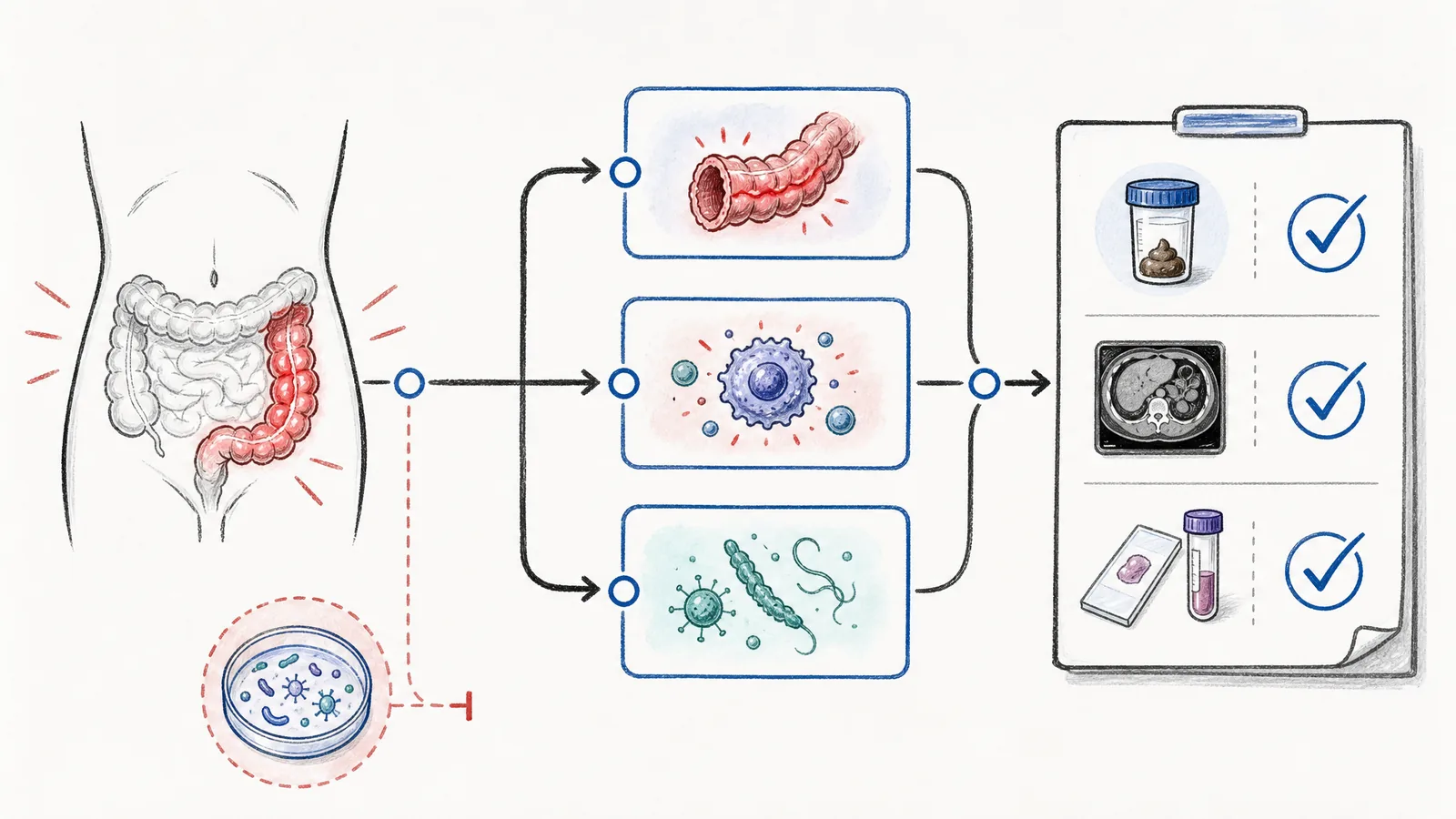
Short answer: Crohn's disease can be mistaken for IBS, ulcerative colitis, infectious colitis, terminal ileitis from infection or NSAIDs, intestinal tuberculosis, ischemic colitis, celiac disease, colorectal cancer, and several less common inflammatory or systemic diseases. Microbiome patterns may become useful as adjunctive biomarkers, but they do not replace colonoscopy, biopsy, imaging, stool pathogen testing, and inflammatory markers when Crohn's is a real possibility.
What can be mistaken as Crohn's?
Crohn's disease is an inflammatory bowel disease that can affect any part of the gastrointestinal tract, often with abdominal pain, diarrhea, fatigue, weight loss, anemia, bleeding, strictures, fistulas, or perianal disease. Those features overlap with many other conditions. That is why clinicians do not diagnose Crohn's from symptoms alone.
The common look-alikes include irritable bowel syndrome, ulcerative colitis, infectious diarrhea, Clostridioides difficile, Yersinia or Campylobacter ileitis, NSAID enteropathy, celiac disease, microscopic colitis, ischemic colitis, diverticular disease, colorectal cancer, intestinal tuberculosis, Behçet disease, sarcoidosis, and endometriosis involving the bowel. The right differential depends on age, symptom pattern, exposures, medications, immune status, travel, labs, imaging, and endoscopic findings.
Can IBS be confused with Crohn's disease?
Yes. IBS can cause abdominal pain, bloating, diarrhea, constipation, urgency, and symptom flares linked to stress or meals. Crohn's can also cause pain and diarrhea, especially early in disease. The difference is that Crohn's involves intestinal inflammation and possible tissue injury, while IBS is a disorder of gut-brain interaction without the same structural damage.
Fecal calprotectin is often used to help separate inflammatory bowel disease from IBS-like symptoms. A low value can make active intestinal inflammation less likely, while a high value needs context because infection, medications, and other inflammatory conditions can also raise it. It is a useful triage tool, not a stand-alone diagnosis.
Evidence summary
- Crohn's diagnosis usually requires a combined assessment using history, labs, stool tests, imaging, endoscopy, and biopsy.
- IBS can mimic Crohn's symptoms, but it does not cause the same chronic intestinal inflammation or tissue injury.
- Fecal calprotectin helps distinguish inflammatory from functional symptoms, but it is not specific for Crohn's.
- Microbiome biomarkers for IBD are promising, but routine consumer microbiome tests should not be used to rule Crohn's in or out.
- Infections, NSAID injury, tuberculosis, ischemia, cancer, and ulcerative colitis must be considered when symptoms or ileitis resemble Crohn's.
Can ileitis mean something other than Crohn's?
Yes. Terminal ileitis means inflammation in the end of the small intestine. Crohn's is one important cause, but it is not the only one. Infections such as Yersinia, Salmonella, Campylobacter, and tuberculosis can involve the ileum. NSAIDs can injure the small bowel and create ulcers or strictures. Ulcerative colitis can sometimes produce backwash ileitis. Vascular, malignant, and systemic inflammatory disorders can also enter the differential.
This is why a single image report saying "ileitis" is not the same as a Crohn's diagnosis. Distribution, ulcer pattern, biopsy findings, chronicity, medication history, stool testing, and follow-up all matter.
Can microbiome testing tell Crohn's from its mimics?
Research is moving in that direction. Large metagenomic studies have identified microbiome signatures associated with inflammatory bowel disease, and newer noninvasive models may eventually help triage or monitor patients. That promise should not be confused with today's consumer microbiome reports. A commercial stool microbiome profile should not reassure someone that Crohn's is absent, and it should not label Crohn's without clinical confirmation.
Microbial patterns are affected by diet, geography, medications, inflammation, sampling method, antibiotics, and disease activity. They can be part of future biomarker panels. They are not a replacement for established diagnostic workups.
What marketing gets wrong about Crohn's mimics
The risky claim is that microbiome testing can clearly differentiate Crohn's from IBS, ileitis, infections, or ulcers for individual consumers. The evidence does not support that as a broad direct-to-consumer promise. Diagnostic delay in Crohn's can lead to complications, but overdiagnosis can also expose people to anxiety, unnecessary procedures, or inappropriate immunosuppression.
A safer message is more modest: microbiome science is helping researchers understand IBD and may support future diagnostic tools. For a symptomatic person, it should remain an adjunct to medical care, not the front door to diagnosis.
When should you seek medical care urgently?
Seek medical advice promptly if you have blood in stool, black stools, persistent or nighttime diarrhea, fever, unexplained weight loss, anemia, dehydration, severe abdominal pain, vomiting, a new abdominal mass, perianal drainage, symptoms after travel or antibiotics, immune suppression, or a family history of inflammatory bowel disease or colorectal cancer. These signs need a clinical pathway rather than a wellness test.
Bottom line
Many conditions can be mistaken as Crohn's, and Crohn's can be missed when symptoms are written off as IBS. The safest answer is not one more unvalidated score. It is a structured differential diagnosis using validated inflammatory markers, infection testing, imaging, endoscopy, biopsy, and clinician judgment.
Evidence notes
- ACG Clinical Guideline: Management of Crohn’s Disease in Adults. The American Journal of Gastroenterology. 10.1038/ajg.2018.27
- Noninvasive, microbiome-based diagnosis of inflammatory bowel disease. Nature Medicine. 10.1038/s41591-024-03280-4
- Faecal calprotectin for differentiating between irritable bowel syndrome and inflammatory bowel disease: a systematic review and meta-analysis. Alimentary Pharmacology & Therapeutics. 10.1111/apt.17754
- Host-microbiota interactions in inflammatory bowel disease. Nature Reviews Immunology. 10.1038/s41577-019-0268-7
- Small intestinal microbial dysbiosis underlies symptoms associated with functional gastrointestinal disorders. Nature Communications. 10.1038/s41467-019-09964-7
- Mechanisms of NLRP3 inflammasome activation and its role in NSAID-induced enteropathy. Mucosal Immunology. 10.1038/mi.2015.89
- Protease profiling in fecal samples: a novel non-invasive diagnostic tool for gastrointestinal disorders. Scientific Reports. 10.1038/s41598-025-32301-6
This article is educational and does not diagnose, treat, or replace care from a qualified clinician. If Crohn's disease is possible, discuss testing with a qualified medical professional.