Evidence-based response
What Are the 3 Types of Microbiomes? Evidence-Based Answer Without the Hype
There are not exactly three accepted microbiome types. Human microbiomes are better understood by body site, function, and evidence limits.
By Sandra McKenzy, Pharmacist · 2026-06-06
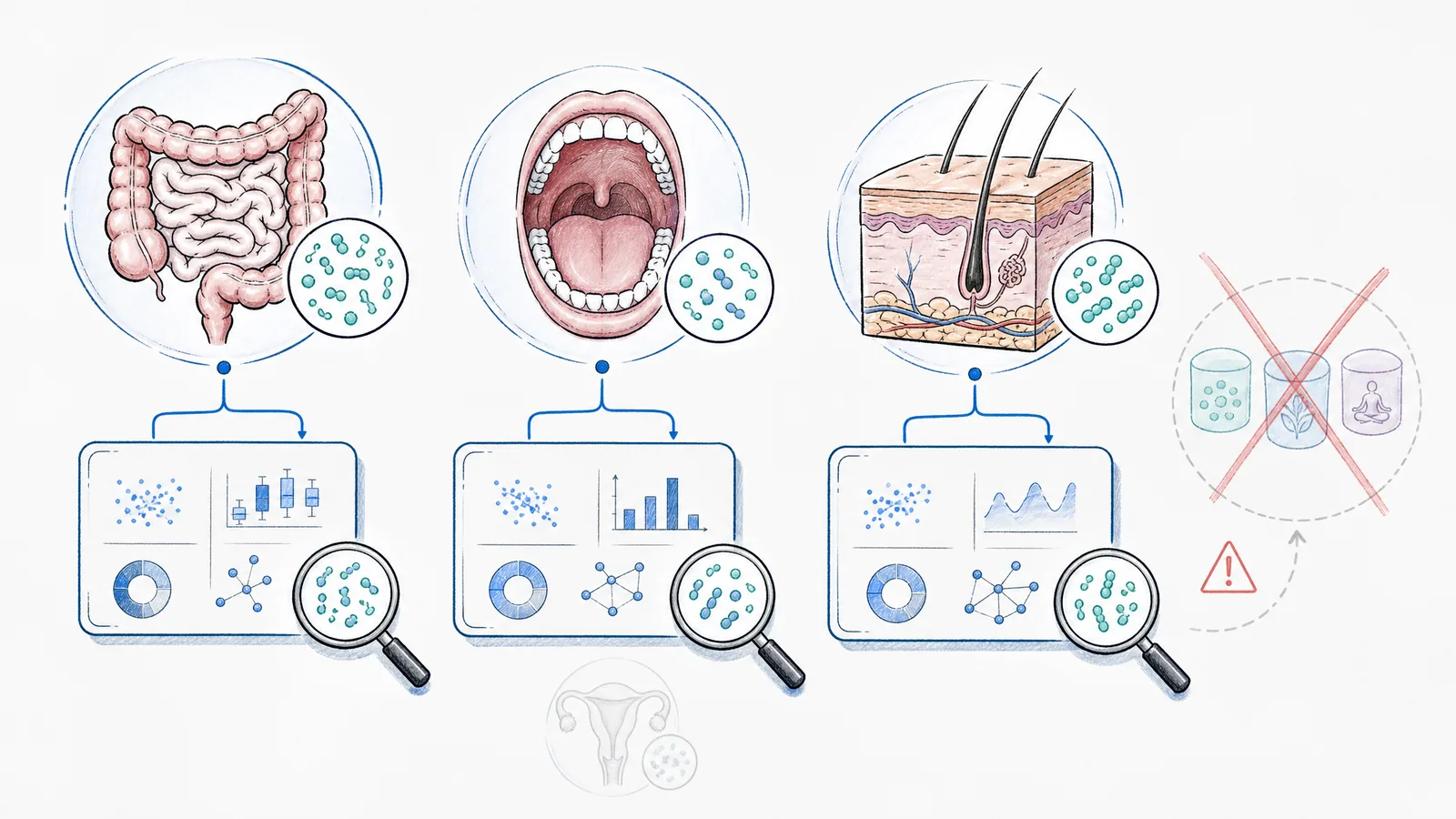
Short answer: There are not exactly three medically accepted “types of microbiomes.” In human health, it is more accurate to talk about microbiomes by body site, such as gut, oral, skin, vaginal, airway, and urogenital communities, or to discuss gut community patterns such as enterotypes. A stool test can describe part of the gut microbiome, but it cannot summarize every microbiome in the body or turn broad categories into a diagnosis.
What are the three types of microbiomes?
The safest answer is that the question is slightly misleading. Some wellness articles describe “gut flora,” “microbial communities,” and “microbiota composition” as three microbiome types. Those are useful concepts, but they are not three separate microbiomes in the way a clinician or microbiome scientist would usually use the word. Gut flora is an older term for gut microbiota. Microbial community describes how organisms interact. Microbiota composition describes which organisms are present and in what relative amounts. These are lenses on the same ecosystem, not three clean biological categories.
A more evidence-based explanation starts with body site. The mouth, gut, skin, vagina, nose, and other surfaces each have distinct microbial communities because oxygen, moisture, pH, nutrients, immune pressure, and local anatomy differ. The gut microbiome gets the most public attention because stool samples are easy to collect and because gut microbes help process diet, produce metabolites, interact with immunity, and vary in many diseases. That does not mean the gut is the only microbiome or that a gut report explains the whole body.
What does “microbiome” actually mean clinically?
Strictly, microbiota means the living microorganisms in a habitat. Microbiome can mean the microorganisms plus their genes, metabolites, structural components, and environmental context. In everyday writing, people often use the terms interchangeably. That is acceptable for a general reader, but it matters when a company makes precise claims. A stool sequencing report mainly reflects microbial DNA in a stool sample. It does not directly measure every metabolite, mucosal immune interaction, small-intestinal community, oral community, or skin community.
Human microbiome research has shown that microbial communities are structured and biologically important. The Human Microbiome Project mapped differences across body habitats and made clear that a healthy person does not have one uniform microbial profile. The same bacterial group may be common in one location and unusual in another. A result that looks concerning in stool may not mean the same thing in saliva, a skin swab, or a vaginal sample.
Is the gut microbiome one type?
The gut microbiome is one major body-site microbiome, not one of only three microbiome types. It includes bacteria, archaea, viruses, fungi, and their genes across the gastrointestinal tract. Stool is dominated by organisms from the colon and distal gut. It is useful, but it is an indirect window. It is less informative for the stomach, duodenum, jejunum, and mucosal surface unless a specific validated method is used.
The best-supported claims about the gut microbiome are still bounded. Diet, antibiotics, infections, age, geography, medications, and disease states can change gut microbial patterns. Short-chain fatty acid production, bile acid metabolism, and immune signaling are plausible and sometimes well-studied mechanisms. But a consumer report usually cannot say that one ratio proves inflammation, obesity risk, depression risk, or a precise supplement requirement for an individual.
Are enterotypes the three microbiome types?
Sometimes the phrase “three types” refers to enterotypes. Early research proposed that gut microbial communities could cluster around Bacteroides, Prevotella, or Ruminococcus-dominant patterns. That finding was important because it helped researchers think about broad community structure. It should not be sold as a simple personal health label. Later work showed that enterotypes can depend on methods, population sampling, diet, geography, and how continuous data are forced into clusters.
Enterotypes are therefore a research framework, not a diagnostic result on their own. A person is not “healthy” because one genus is high, and not “unhealthy” because another genus is dominant. The clinical question is always narrower: what symptom, disease, exposure, medication, diet pattern, or treatment decision is being considered, and has the microbial marker been validated for that decision?
Evidence summary
- Human microbiomes differ strongly by body site; gut, oral, skin, vaginal, airway, and urogenital communities are not interchangeable.
- “Gut flora,” “microbial community,” and “microbiota composition” describe related features, not three accepted medical microbiome types.
- Enterotypes can describe broad gut community patterns, but they are not validated as simple diagnostic labels for consumers.
- Stool testing can characterize part of the gut ecosystem, especially colonic DNA signals, but it does not measure every microbiome in the body.
- Clinical interpretation requires symptoms, history, medications, diet, and validated disease-specific evidence, not taxonomy alone.
What claims go beyond the evidence?
The main overclaim is that a single stool test can convert broad microbiome categories into personalized certainty. A test can report relative abundances, diversity metrics, and sometimes functional potential. It cannot by itself prove disease prevention, diagnose a body-wide microbial problem, or determine a full treatment plan. Relative abundance is especially easy to misread because it tells what fraction of detected DNA belongs to a group, not necessarily how much living, active, or clinically relevant organism is present.
Another overclaim is the use of fixed ratios as health scores. Firmicutes and Bacteroidetes are large phyla with many organisms that behave differently. A high or low ratio is not a universal diagnosis. The same caution applies to words such as “bad bacteria,” “imbalance,” and “dysbiosis.” They may be useful shorthand, but they can hide the fact that normal microbial variation is wide and that disease links are often associative.
What does microbiome testing do well?
Microbiome testing can be useful when the question is realistic. It can document broad gut composition, track large changes after antibiotics or major diet shifts, support research participation, and sometimes provide hypotheses for discussion with a clinician or dietitian. Shotgun metagenomics can provide more detailed species and functional potential than 16S sequencing, depending on laboratory quality and reference databases. Those strengths are real.
The limitation is clinical validation. A good report should separate descriptive findings from medical action. If it says a pattern is associated with fiber intake, that is different from saying it diagnoses a condition. If it suggests increasing dietary fiber, that may be reasonable for many people, but it still needs exceptions for people with strictures, severe IBS flares, active inflammatory bowel disease, eating disorders, or other clinical constraints.
When should you see a clinician?
Do not use a microbiome category or stool report to delay care if symptoms are persistent or severe. Seek medical advice for blood in stool, black stool, unexplained weight loss, fever, dehydration, persistent vomiting, night-time diarrhea, anemia, new bowel changes after age 50, severe abdominal pain, pregnancy, immune suppression, recent hospital exposure, or symptoms after travel that suggest infection. These situations need standard medical evaluation before wellness optimization.
Bottom line
The best answer to “what are the three types of microbiomes?” is that the premise is too tidy. Human microbiomes are usually understood by body site and function, while gut enterotypes are one research classification within the gut. A stool microbiome test can be informative, but only when its claims are kept modest: it describes part of the gut ecosystem and may generate hypotheses. It does not define all microbiomes, diagnose body-wide imbalance, or replace clinical assessment.
Educational disclaimer: This article is for general education and is not medical advice. Microbiome results and digestive symptoms should be interpreted with a qualified clinician when symptoms are persistent, severe, or concerning.
Evidence notes and sources
- Structure, function and diversity of the healthy human microbiome. Nature. 10.1038/nature11234
- Microbiota in health and diseases. Signal Transduction and Targeted Therapy. 10.1038/s41392-022-00974-4
- Enterotypes of the human gut microbiome. Nature. 10.1038/nature09944
- Enterotypes in the landscape of gut microbial community composition. Nature Microbiology. 10.1038/s41564-017-0072-8
- Multi-omics of the gut microbial ecosystem in inflammatory bowel diseases. Nature. 10.1038/s41586-019-1237-9
- Revised estimates for the number of human and bacteria cells in the body. PLOS Biology. 10.1371/journal.pbio.1002533
- The oral microbiome: an update for oral healthcare professionals. British Dental Journal. 10.1038/sj.bdj.2016.865