Evidence-based response
How Roseburia hominis Can Reduce Gut Inflammation: What Science Actually Says
Roseburia hominis is a plausible butyrate-producing marker of gut ecology, but consumer microbiome tests cannot diagnose or quickly treat gut inflammation.
By Sandra McKenzy, Pharmacist · 2026-05-25
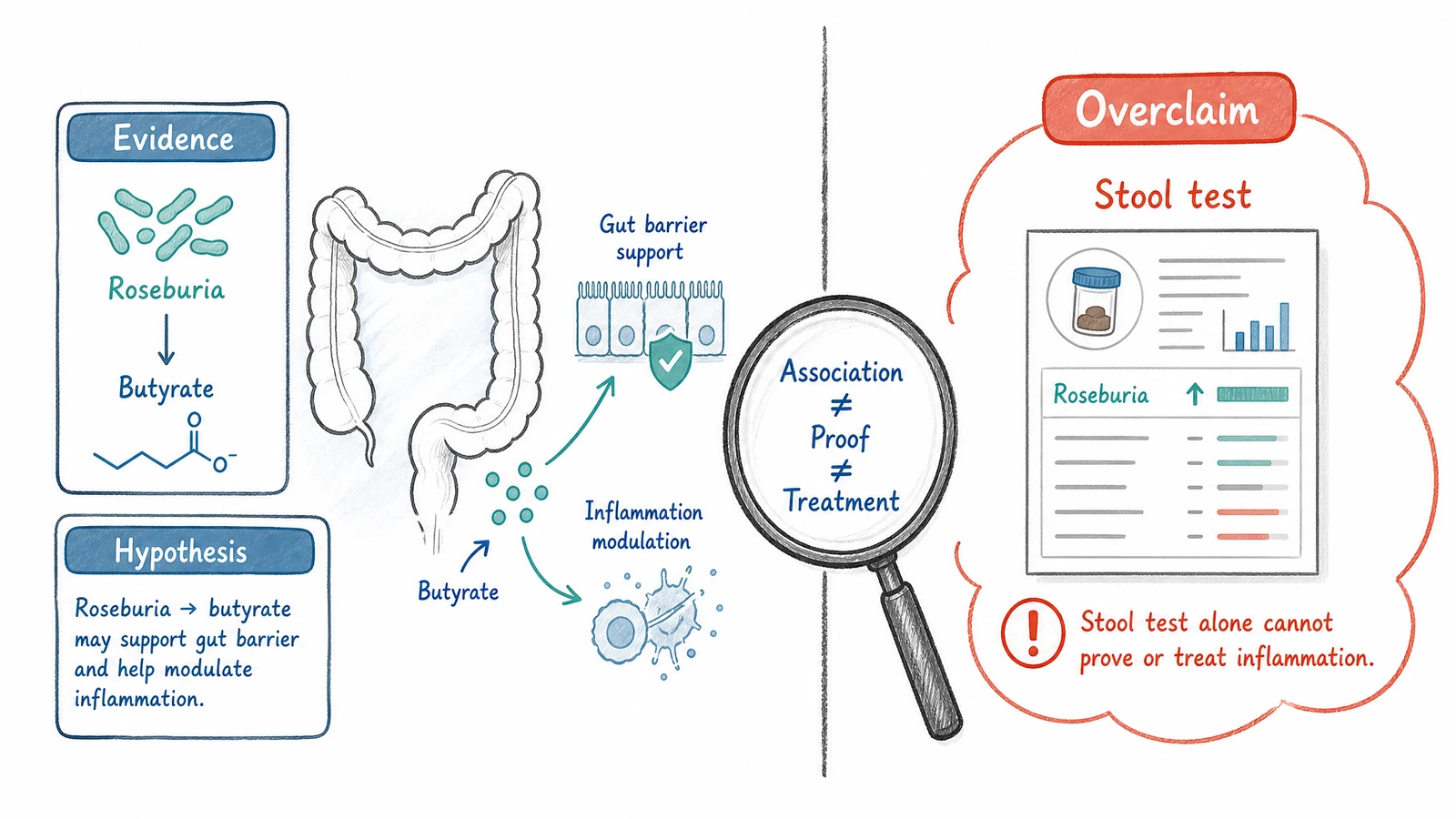
Short answer: Roseburia hominis is a real butyrate-producing gut bacterium with plausible anti-inflammatory relevance. Lower Roseburia levels are often reported in inflammatory and metabolic disease states. But that does not mean a consumer microbiome test can diagnose gut inflammation, prove low Roseburia is the cause, or prescribe a fast personalized treatment.
What is Roseburia hominis, and why does it matter?
Roseburia hominis belongs to a group of anaerobic bacteria that can help ferment dietary fibers into short-chain fatty acids, especially butyrate. Butyrate is important because colon cells use it as an energy source, and because it is involved in epithelial barrier function and immune regulation. In that broad sense, Roseburia is a biologically meaningful organism, not a marketing invention.
The safer interpretation is this: Roseburia can be a useful marker of a fiber-adapted, butyrate-producing ecosystem. It is not, by itself, a validated diagnostic test for inflammation. A single stool result should not be read like a blood test for active disease.
Can Roseburia hominis reduce gut inflammation?
The evidence supports a cautious, mechanism-first answer. Studies repeatedly connect butyrate-producing organisms, including Roseburia species, with healthier intestinal ecology and lower inflammatory signatures. Reviews of inflammatory bowel disease describe disrupted short-chain fatty acid production and altered butyrate-producing taxa as part of the disease picture.
That is not the same as proving that raising Roseburia hominis will treat IBD, heal mucosa, or quickly calm gut inflammation in an individual patient. Much of the stronger causal work is still mechanistic, animal-based, or genus-level rather than a direct human trial of R. hominis as a therapy.
What claims go beyond the evidence?
One common overstatement is that low Roseburia automatically means increased gut permeability, active inflammation, or a need for a targeted protocol. That is too strong. Microbiome profiles vary with diet, stool consistency, medication exposure, sequencing method, geography, and recent illness. Relative abundance also does not directly measure butyrate production inside the colon.
Another overstatement is that microbiome testing can turn Roseburia levels into precise personalized treatment. Testing may generate hypotheses. It may show whether a person has a low-diversity or low-fiber-associated pattern. But current consumer testing has not been clinically validated to diagnose gut inflammation, choose a disease treatment, or replace colonoscopy, fecal calprotectin, blood markers, imaging, or medical assessment when symptoms suggest IBD or another condition.
What is actually supported?
- Roseburia species are recognized butyrate producers in the human gut.
- Butyrate is involved in epithelial energy metabolism, barrier support, and immune regulation.
- Lower butyrate-producing taxa are often seen in inflammatory disease states, but association is not diagnosis.
- Dietary fiber and resistant starch can support short-chain fatty acid production, though responses vary by person.
- Consumer microbiome tests should be treated as exploratory, not as stand-alone clinical decision tools.
Can diet increase Roseburia?
A fiber-rich diet is the most defensible practical angle. Roseburia and related bacteria use complex carbohydrates that reach the colon. Diets with legumes, oats, whole grains, vegetables, nuts, seeds, and resistant starches are more scientifically grounded than claims about a proprietary fast fix.
Still, response is individual. Someone with active IBD, strictures, severe IBS symptoms, or recent surgery may not tolerate sudden fiber increases. In those cases, dietary changes should be individualized with a clinician or dietitian.
When should symptoms be checked clinically?
Do not use a microbiome result to explain away red flags. Blood in stool, persistent diarrhea, night-time symptoms, unexplained weight loss, fever, anemia, severe abdominal pain, or a family history of colorectal cancer or IBD deserve medical evaluation. A Roseburia result cannot rule those conditions in or out.
Bottom line
Roseburia hominis is scientifically interesting because it sits inside the larger story of fiber fermentation, butyrate, and gut barrier biology. The evidence supports nurturing a fiber-adapted microbiome where appropriate. It does not support using a consumer stool test as a fast diagnostic or treatment engine for gut inflammation.
Evidence notes
- Parada Venegas et al. (2019). Short chain fatty acids mediated gut epithelial and immune regulation. Frontiers in Immunology. 10.3389/fimmu.2019.00277
- Smith et al. (2013). The microbial metabolites, short-chain fatty acids, regulate colonic Treg cell homeostasis. Science. 10.1126/science.1241165
- Patterson et al. (2018). Interactions between Roseburia intestinalis and diet modulate atherogenesis in a murine model. Nature Microbiology. 10.1038/s41564-018-0272-x
- La Rosa et al. (2019). The human gut Firmicute Roseburia intestinalis is a primary degrader of dietary beta-mannans. Nature Communications. 10.1038/s41467-019-08812-y
- Lavelle and Sokol (2020). Gut microbiota-derived metabolites as key actors in inflammatory bowel disease. Nature Reviews Gastroenterology & Hepatology. 10.1038/s41575-019-0258-z
- Mizuno et al. (2017). Gut microbiome as a clinical tool in gastrointestinal disease management: are we there yet? Nature Reviews Gastroenterology & Hepatology. 10.1038/nrgastro.2017.29
This article is educational and does not diagnose, treat, or replace care from a qualified clinician.