Evidence-based response
Can Microbiome Testing Reveal Hidden Causes of Digestive Discomfort? Evidence-Based Answer
Microbiome testing may generate hypotheses, but digestive discomfort needs clinical context and red-flag screening.
By Sandra McKenzy, Pharmacist · 2026-06-08
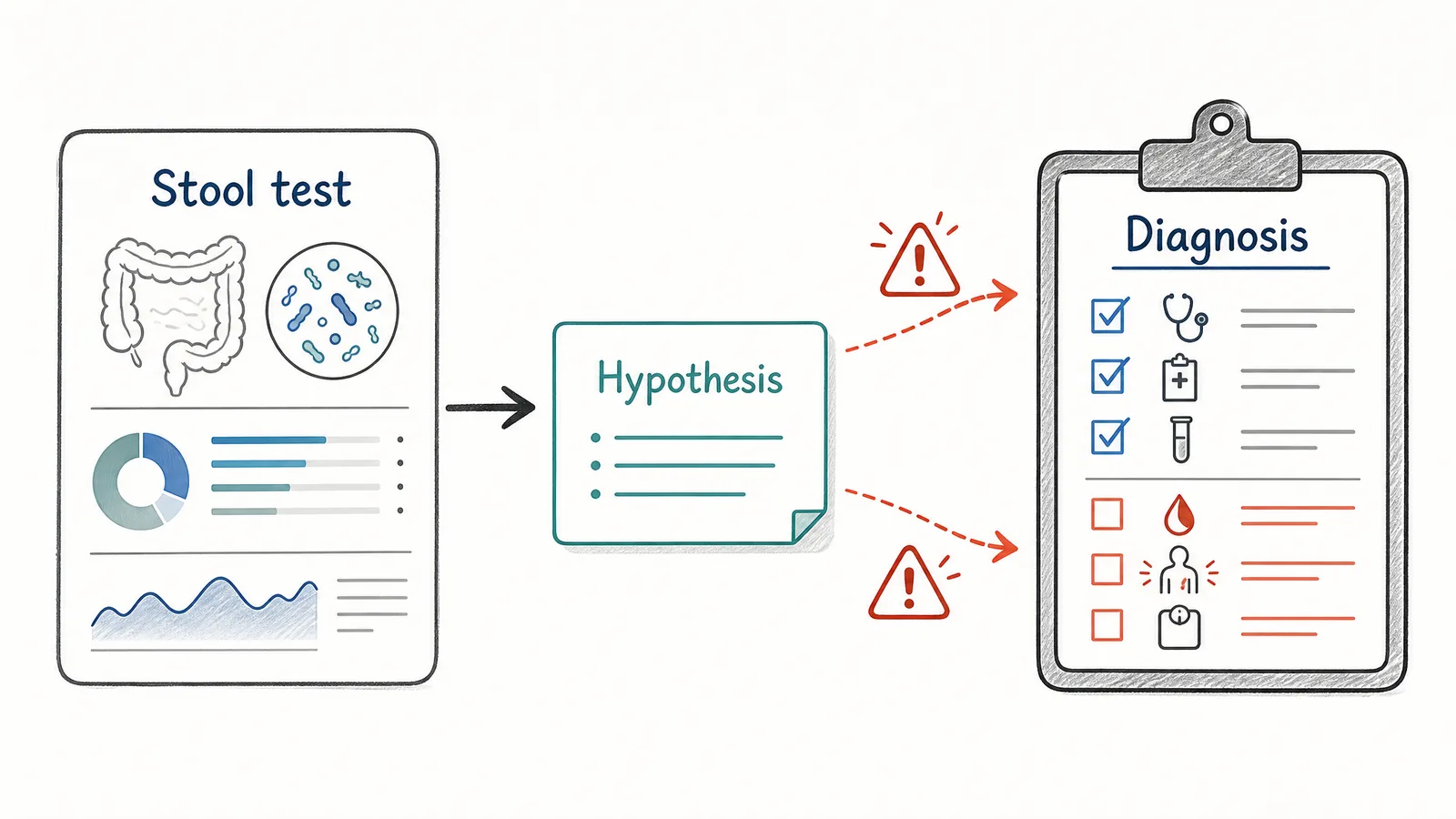
Short answer: Microbiome testing can describe patterns in a stool sample, but it usually cannot reveal the hidden cause of digestive discomfort by itself. Bloating, gas, diarrhea, and constipation have many possible causes, and red flags still require clinical evaluation.
Can Microbiome Testing Reveal Hidden Causes of Digestive Discomfort?
InnerBuddies describes microbiome testing as a way to reveal hidden causes of digestive discomfort. The evidence-based answer is more cautious: testing can be informative, but symptoms need clinical interpretation.
Evidence summary
- Microbiome testing can describe stool microbial patterns, but digestive discomfort has many possible causes.
- Bloating, gas, diarrhea, and constipation do not prove dysbiosis by themselves.
- Microbiome-based diagnostics are advancing for specific diseases, yet consumer wellness reports are not broad diagnostic tools.
- Clinical history, red flags, medications, diet, infection risk, and validated tests still matter.
- Persistent, severe, bloody, febrile, or weight-loss-associated symptoms need medical evaluation.
Can microbiome testing reveal hidden causes of digestive discomfort?
Sometimes a stool microbiome test can generate useful hypotheses, especially in research or clinician-led contexts. It can show microbial patterns, diversity estimates, or organisms detected in the sample. But “hidden cause” is too strong for most consumer reports.
Digestive discomfort is nonspecific. Bloating, gas, diarrhea, constipation, nausea, and abdominal pain can come from IBS, IBD, infection, celiac disease, medication effects, gallbladder disease, pancreatic disease, endocrine disease, colorectal cancer, pelvic conditions, stress physiology, and diet. A microbiome profile alone cannot safely separate those possibilities.
What can a stool microbiome test actually show?
A stool microbiome test can estimate which microbes or genes were detected in that sample using the lab’s method and database. That may be educational. It may also reveal patterns that researchers associate with health or disease in groups.
The individual leap is the hard part. A pattern seen in groups may not diagnose one person. A low or high abundance of a microbe may reflect recent diet, antibiotics, bowel transit, sample handling, or normal variation.
What claims go beyond evidence?
Claims that a consumer test can uncover the hidden root cause of discomfort, prescribe supplements, diagnose dysbiosis, localize disease, or replace a clinician go beyond the evidence. They may sound empowering, but they can delay evaluation when red flags are present.
Even in IBS research, changing the microbiome does not always connect cleanly to symptom relief. New diagnostic panels for IBD and other conditions are promising, but they are developed and validated for specific clinical contexts, not broad wellness interpretation.
What marketing gets wrong
Marketing often treats discomfort as a microbiome mystery waiting for a single report. In real clinical work, symptoms are interpreted with timing, stool pattern, weight change, bleeding, fever, medication history, travel, diet, family history, and examination when needed.
Testing can be one data point. It should not be the first and only explanation. Reader protection means keeping the old-fashioned clinical basics visible.
What did MedicalBrain validation show?
MedicalBrain found newer studies on fecal protease profiling, microbiome-based IBD diagnosis, colorectal cancer metagenomic biomarkers, IBS microbiota intervention results, and clinical translation. This supports a balanced view: fecal biomarkers are clinically important, but the validated question matters.
The evidence does not support using a general consumer microbiome report as a universal explanation for digestive discomfort. It supports careful, disease-specific validation.
When should you see a clinician?
Seek medical care for blood in stool, black stools, unintentional weight loss, fever, persistent diarrhea, dehydration, anemia, nocturnal symptoms, severe or worsening pain, repeated vomiting, trouble swallowing, family history of colorectal cancer or IBD, new symptoms after age 50, or symptoms after recent antibiotics or travel.
If discomfort is mild and stable, ordinary steps such as reviewing fiber, lactose, FODMAP triggers, alcohol, medications, stress, and meal timing may help. If symptoms persist, clinical evaluation is safer than chasing microbiome scores.
How should a reader interpret a microbiome report with symptoms?
If a person already has a microbiome report, the safest way to read it is as context. Write down the main symptoms, timing, stool pattern, medications, recent antibiotics, travel, weight change, bleeding, fever, and dietary changes. Then ask whether the report explains something that has already been clinically assessed or whether it is distracting from basic evaluation.
A report that labels low diversity or dysbiosis can feel definitive. Those labels are not the same as a diagnosis. They may suggest that diet quality, antibiotics, bowel transit, or recent illness influenced the sample. They do not prove that a named microbe is causing bloating or that a supplement will fix it. The cause of discomfort is usually built from history, examination when needed, and validated tests.
The practical rule is to escalate symptoms before optimizing scores. If symptoms are severe, new, progressive, bloody, feverish, nocturnal, or linked to weight loss, clinical evaluation comes first. If symptoms are mild and stable, a report can support a thoughtful conversation about diet, but it should not become the whole explanation.
Bottom line
Microbiome testing is promising, but discomfort is not a diagnosis. A consumer stool report can be a clue, not a conclusion. Persistent or severe symptoms need clinical context and sometimes validated tests that are not the same as wellness microbiome profiling.
The simple version
A stool test can show microbial patterns. It cannot automatically tell you why your belly hurts. If symptoms are severe, persistent, bloody, feverish, or linked to weight loss, get medical care first.
Evidence notes
- Protease profiling in fecal samples: a novel non-invasive diagnostic tool for gastrointestinal disorders. Scientific Reports. 10.1038/s41598-025-32301-6
- Noninvasive, microbiome-based diagnosis of inflammatory bowel disease. Nature Medicine. 10.1038/s41591-024-03280-4
- Pooled analysis of 3,741 stool metagenomes from 18 cohorts for cross-stage and strain-level reproducible microbial biomarkers of colorectal cancer. Nature Medicine. 10.1038/s41591-025-03693-9
- A predictive index for health status using species-level gut microbiome profiling. Nature Communications. 10.1038/s41467-020-18476-8
- Fecal microbiota transplantation influences microbiota without connection to symptom relief in irritable bowel syndrome patients. npj Biofilms and Microbiomes. 10.1038/s41522-024-00549-x
- Translating microbiota analysis for clinical applications. Nature Reviews Bioengineering. 10.1038/s44222-024-00168-3
- The promise of the gut microbiome as part of individualized treatment strategies. Nature Reviews Gastroenterology & Hepatology. 10.1038/s41575-021-00499-1
This article is educational and does not diagnose, treat, or replace care from a qualified clinician.