Evidence-based response
Unlocking Your Gut Microbiome Secrets: Evidence-Based Test Choices Without the Hype
A gut microbiome test can describe one stool sample, but it cannot diagnose most digestive problems or prescribe precise treatment without clinical context.
By Sandra McKenzy, Pharmacist · 2026-05-31
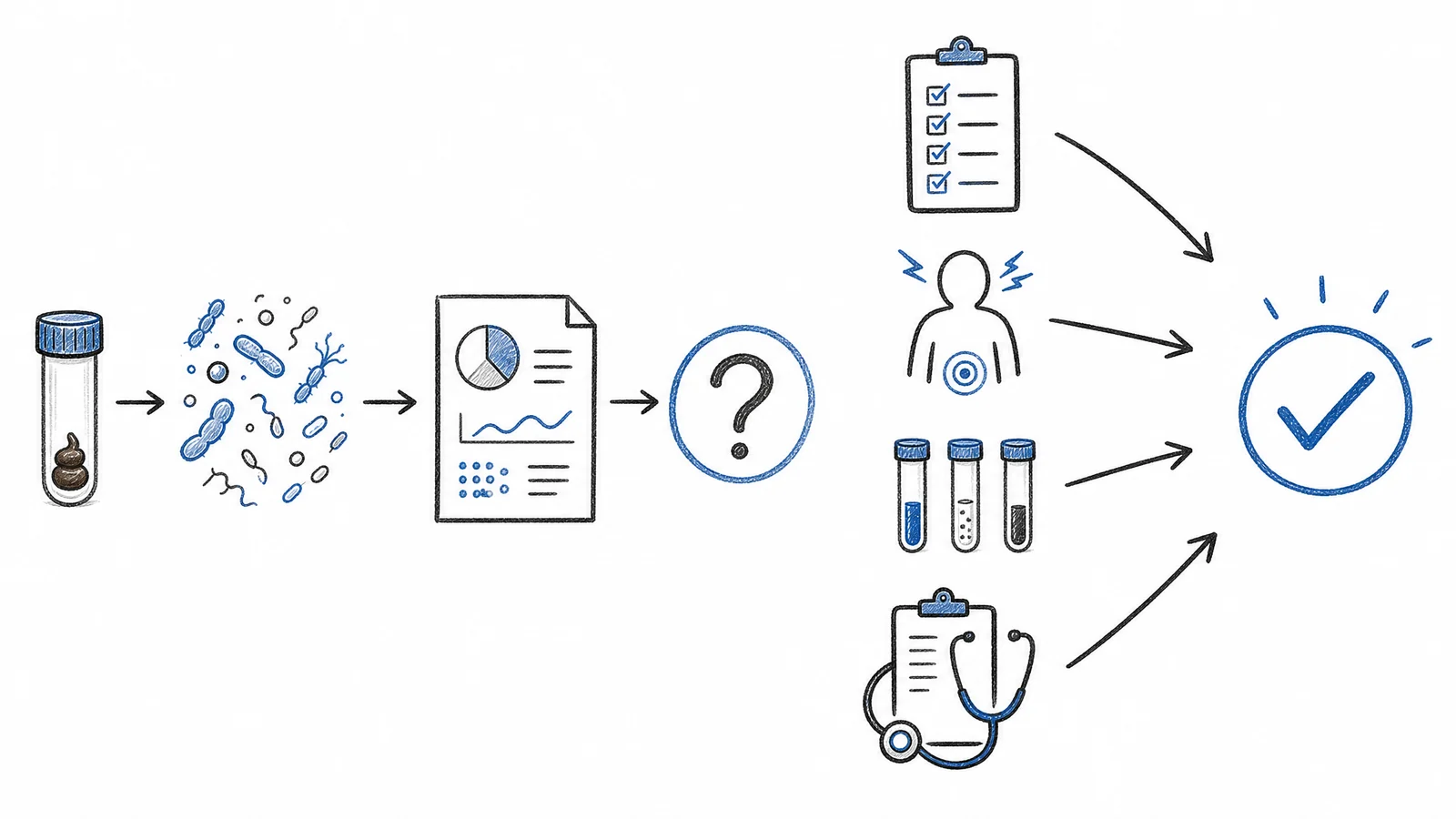
Short answer: A gut microbiome test can describe which microbial DNA patterns were found in one stool sample, but it cannot by itself diagnose digestive disease, explain every symptom, or choose a precise treatment plan. The right test depends on the clinical question. For routine digestive problems, symptoms, red flags, medication history, standard stool tests, blood tests, and clinician assessment still matter more than a consumer diversity score.
How should you choose a gut microbiome test for digestive health?
Start with the question you are trying to answer. If the question is blood in stool, persistent diarrhea, suspected infection, inflammatory bowel disease activity, anemia, malabsorption, or colorectal cancer screening, a doctor-ordered clinical test is the safer route. Those tests are built around a defined indication and a defined next step.
A consumer gut microbiome test is different. It usually uses 16S rRNA sequencing or shotgun metagenomics to estimate the relative abundance of organisms and sometimes functional potential. That can be educational, especially for people who want to understand broad diet-related patterns. It is not the same as a validated diagnostic workup. The current international consensus is cautious: microbiome testing is scientifically promising, but routine clinical use remains limited because reference ranges, methods, and interpretation are not yet standardized for most conditions.
The source article presents microbiome testing as a first step toward personalized digestive care. That framing is partly reasonable if the word personalized means education and hypothesis generation. It becomes overstated when a report is treated as a direct route to optimized digestion, immunity, mental health, or supplement choices.
What can a stool microbiome test actually show?
A stool microbiome profile can show diversity metrics, relative abundance of microbial groups, and sometimes predicted genes involved in fiber fermentation, short-chain fatty acid pathways, bile acid metabolism, or vitamin-related functions. Shotgun metagenomics can provide more detail than broad 16S profiling, but more detail does not automatically mean more clinical certainty.
Every result is shaped by collection, storage, DNA extraction, sequencing platform, bioinformatics pipeline, and the reference database. Studies have shown that even sample handling and DNA isolation kits can change measured bacterial composition. Geography and diet also matter, which means a healthy reference range from one population may not transfer neatly to another.
Evidence summary
- Microbiome testing is useful in research, but routine clinical utility remains limited for most digestive complaints.
- Stool sequencing can describe microbial patterns, not prove the cause of symptoms by itself.
- Low diversity, dysbiosis scores, or unusual taxa should be interpreted as hypotheses, not diagnoses.
- Sampling methods, DNA extraction, geography, diet, and reference databases can change results.
- Dietary patterns can shift the microbiome, but test-based supplement plans need stronger validation.
Are 16S and shotgun metagenomic tests clinically validated?
They are valid laboratory methods for profiling microbial DNA, but that is not the same as validated medical interpretation. A thermometer is useful because the number has a shared clinical meaning. Microbiome reports are harder: two companies can analyze similar samples and return different organisms, scores, and recommendations. Even when the sequencing is technically sound, the clinical leap from relative abundance to a treatment decision is often uncertain.
Shotgun metagenomics can identify more species and estimate functional genes. This is valuable for research and may become more useful clinically in selected areas. At present, it should not be marketed as if it can reliably diagnose IBS, leaky gut, immune weakness, anxiety, fatigue, or the perfect diet for every user.
Can a microbiome test tell you what to eat or which supplements to take?
Sometimes it can support sensible general advice. If a report shows low diversity and the person eats little fiber, then increasing plant variety gradually is reasonable. But that advice is already evidence-based without needing a test. The stronger claim is that a stool profile can prescribe specific probiotics, prebiotics, enzymes, or supplement stacks for a named symptom. That claim is much weaker.
Personalized nutrition research is real. Some studies show that microbiome and clinical data can help predict individual glycemic responses. But translating that research into broad consumer recommendations is difficult. A commercial report should clearly separate proven advice, plausible hypotheses, and experimental interpretation.
What marketing gets wrong about microbiome testing
Marketing often treats the gut microbiome as if every symptom has a microbial explanation. Bloating, constipation, diarrhea, fatigue, skin flares, low mood, and food intolerance can all overlap with microbiome changes, but they can also come from celiac disease, inflammatory bowel disease, thyroid disease, medication effects, pelvic floor dysfunction, infection, endometriosis, gallbladder disease, or stress-related motility changes.
The unsafe move is to let a wellness report delay proper evaluation. A microbiome test can be a conversation starter. It should not become a substitute for medical triage when symptoms are persistent, severe, progressive, or accompanied by red flags.
When should you see a clinician instead of buying a test?
Seek medical advice before relying on a consumer gut microbiome test if you have blood in stool, black stool, unexplained weight loss, anemia, persistent fever, severe abdominal pain, vomiting, dehydration, nighttime diarrhea, new bowel changes after age 50, family history of colorectal cancer, immune suppression, recent antibiotics with watery diarrhea, or known inflammatory bowel disease. These situations need targeted clinical testing, not a general wellness score.
Bottom line
The right gut microbiome test is the one matched to the question. Consumer sequencing can teach you about microbial patterns and may help you ask better questions about diet and lifestyle. It cannot yet turn one stool sample into a complete digestive-health diagnosis or a precise treatment plan. Use it as an educational tool, not as a replacement for clinical reasoning.
Evidence notes
- International consensus statement on microbiome testing in clinical practice. The Lancet Gastroenterology & Hepatology. 10.1016/S2468-1253(24)00311-X
- Gut microbiome as a clinical tool in gastrointestinal disease management: are we there yet?. Nature Reviews Gastroenterology & Hepatology. 10.1038/nrgastro.2017.29
- Regional variation limits applications of healthy gut microbiome reference ranges and disease models. Nature Medicine. 10.1038/s41591-018-0164-x
- Stool sampling and DNA isolation kits affect DNA quality and bacterial composition following 16S rRNA gene sequencing. Scientific Reports. 10.1038/s41598-019-49520-3
- Best practices for analysing microbiomes. Nature Reviews Microbiology. 10.1038/s41579-018-0029-9
- Personalized nutrition by prediction of glycemic responses. Cell. 10.1016/j.cell.2015.11.001
- Diet rapidly and reproducibly alters the human gut microbiome. Nature. 10.1038/nature12820
This article is educational and does not diagnose, treat, or replace care from a qualified clinician.