Evidence-based response
Why Clostridium butyricum Benefits Your Gut Health in 2026: Evidence-Based Answer Without the Hype
Clostridium butyricum is a strain-specific probiotic with plausible butyrate biology and some IBS-D evidence, but it is not a universal gut-health fix.
By Sandra McKenzy, Pharmacist · 2026-07-31
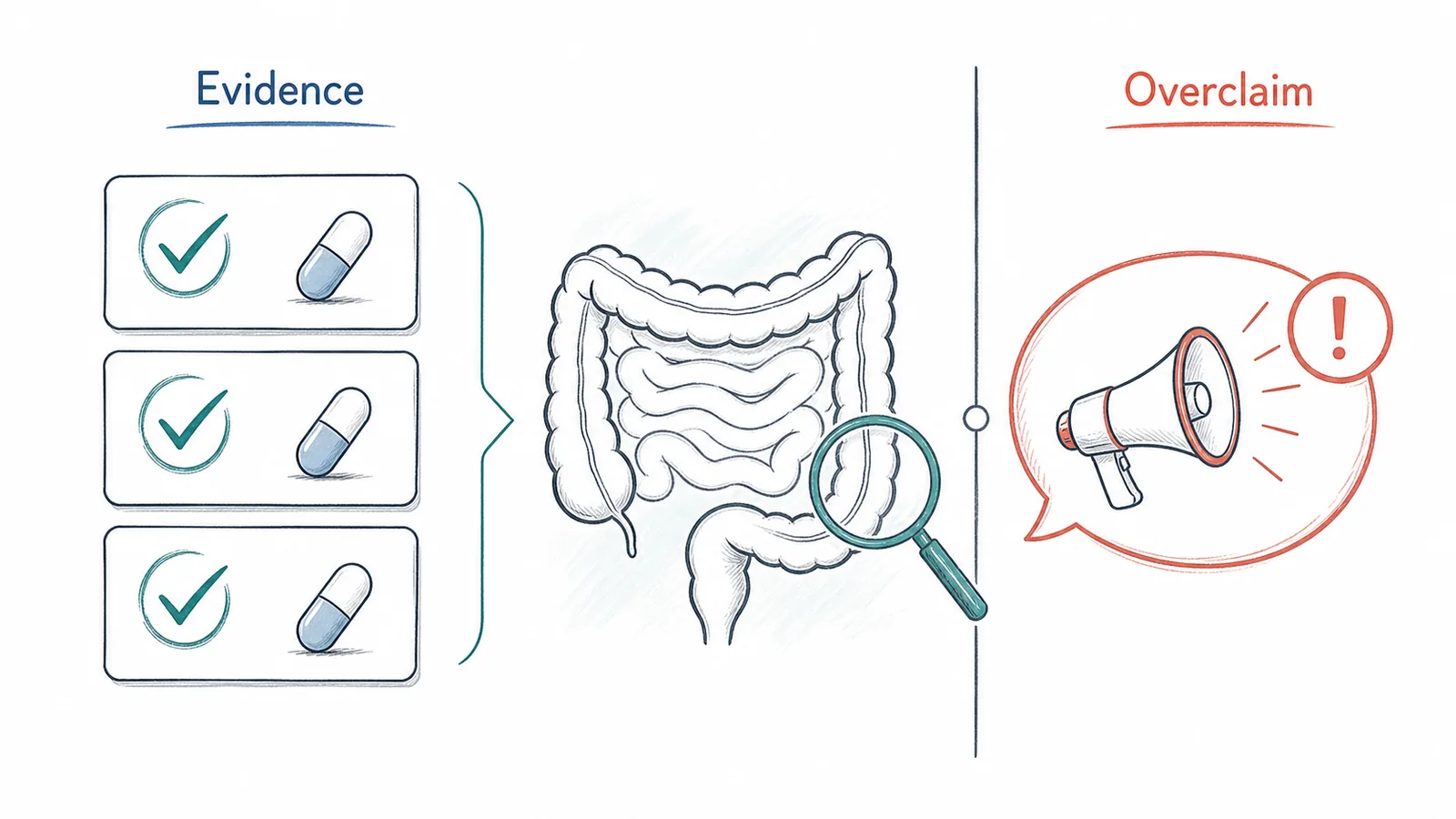
Short answer: Clostridium butyricum may benefit gut health in specific contexts because some strains can produce butyrate and have been studied as probiotics. The best human evidence is still narrower than most marketing suggests. It does not prove that any Clostridium supplement repairs the gut barrier, restores the microbiome, treats digestive disease, or can be selected reliably from a consumer microbiome test.
A recent InnerBuddies article presents Clostridium butyricum as a natural probiotic for gut health, butyrate production and intestinal flora support. Much of that framing is biologically plausible. The important correction is clinical precision: probiotic effects are strain-specific, outcome-specific and patient-specific. A promising mechanism is not the same as a guaranteed benefit.
What Is Clostridium butyricum?
Clostridium butyricum is a spore-forming anaerobic bacterium. Some strains can produce butyrate, a short-chain fatty acid that helps fuel colonocytes and participates in immune and barrier signalling. That makes the organism interesting for microbiome science, especially because butyrate is repeatedly linked with intestinal epithelial function, inflammation control and microbial ecology.
But the name alone is not enough. Probiotics are not interchangeable by genus or species. A capsule labelled with Clostridium butyricum may contain a specific strain, dose and manufacturing process. Those details matter because safety, survival through the gut, metabolite production and clinical effects can vary. A responsible answer begins with the strain and the studied outcome, not with a broad promise of “gut health.”
Evidence summary
Evidence summary
- Clostridium butyricum has plausible biology because butyrate is relevant to colonocyte energy, barrier function and immune signalling.
- A randomized placebo-controlled trial in diarrhea-predominant IBS reported symptom and microbiota effects for a studied Clostridium butyricum product.
- Evidence from one condition or strain should not be generalized to every probiotic product, digestive symptom or microbiome profile.
- Consumer stool microbiome tests cannot currently prescribe Clostridium butyricum with clinical certainty.
- People who are severely immunocompromised, critically ill, pregnant, medically complex or using invasive devices should ask a clinician before using live probiotics.
How Could Clostridium butyricum Support Gut Health?
The strongest mechanistic argument is butyrate. Short-chain fatty acids are produced when microbes ferment dietary substrates, and butyrate is especially important for the colon lining. Reviews describe roles for SCFAs in epithelial energy metabolism, immune regulation and host-microbe communication. Experimental work also supports a barrier-protective role for microbial metabolites through pathways such as Nrf2 signalling.
This does not mean that taking a butyrate-producing organism automatically raises butyrate where it matters, at a dose that changes symptoms, in every person. Diet, baseline microbiota, transit time, medications and the competing microbial ecosystem all shape what happens after ingestion. A probiotic can be a biological nudge. It is not a remote control for the gut.
What Are the Benefits of Clostridium butyricum?
The most defensible benefits are narrow. In a multicentre randomized, double-blind, placebo-controlled trial, Clostridium butyricum was tested in diarrhea-predominant irritable bowel syndrome. The paper reported advantages for overall IBS symptoms and some quality-of-life or bowel-habit measures compared with placebo. That is meaningful because it is human clinical evidence, not only cell or animal biology.
Still, readers should notice the boundary. IBS-D is not the same as constipation, inflammatory bowel disease, leaky gut, food intolerance, bloating from many causes, or a low “good bacteria” score on a home test. A trial in one population cannot validate every supplement use. It also cannot prove that the probiotic works through the exact marketing mechanism printed on a product page.
Can Clostridium butyricum Repair the Gut Barrier?
It is more accurate to say that butyrate and related microbial metabolites are involved in barrier biology. The intestinal barrier is a complex system with mucus, epithelial cells, immune cells, tight junctions, diet, infection history and inflammation all interacting. Nature Reviews work on the intestinal barrier in IBD shows how central barrier dysfunction can be in disease, but also how complicated the system is clinically.
So “supports barrier function” may be a plausible educational statement for a studied strain or metabolite pathway. “Repairs leaky gut” is a much stronger claim and usually not justified for consumer supplements. If someone has blood in stool, unexplained weight loss, anemia, persistent diarrhea or severe pain, the answer is clinical evaluation, not barrier-repair marketing.
Can a Microbiome Test Tell You to Take Clostridium butyricum?
A stool microbiome test can describe microbial DNA in one stool sample. Some tests infer functions, including short-chain-fatty-acid potential. That can be interesting and sometimes useful for education. It is not a validated prescribing system for Clostridium butyricum.
There are several reasons. Stool does not sample every gut niche. Methods and databases differ. Relative abundance is not the same as metabolic activity. Low detection of one butyrate-associated organism does not prove deficiency, disease or the need for a matching capsule. The field is moving toward more personalized microbiome care, but routine consumer reports are not yet precise enough to prescribe this probiotic with medical confidence.
What Marketing Gets Wrong About Clostridium Supplements
The first overclaim is treating “Clostridium” as a simple wellness label. The genus includes many organisms with very different biology, and even within one species strain identity matters. A safe product should specify the exact strain, dose, quality controls and intended use.
The second overclaim is converting mechanism into outcome. Butyrate biology is real, but a butyrate-related mechanism does not automatically prove symptom relief, immune improvement or microbiome restoration in a particular person. Clinical outcomes need clinical trials.
The third overclaim is implying that a microbiome test closes the loop. Testing may generate hypotheses about diet, fiber and microbial patterns. It should not be used to diagnose disease, rule out other causes of symptoms, or prescribe live microbes without clinical context.
Who Should Be Cautious With Live Probiotics?
Most healthy adults tolerate common probiotics, but “natural” does not mean risk-free. People who are severely immunocompromised, critically ill, have a central venous catheter, recently had major gastrointestinal surgery, are premature infants, are pregnant, or have complex medical conditions should discuss live probiotics with a clinician first. The same applies when symptoms are severe, persistent or unexplained.
Stop and seek medical advice if a supplement is followed by fever, worsening pain, persistent vomiting, dehydration, blood in stool, black stools, night-time diarrhea, unexplained weight loss, or new bowel changes after age 50. These are not problems to troubleshoot with a microbiome score.
Bottom Line
Clostridium butyricum is scientifically interesting and may be useful as a strain-specific probiotic in selected settings. The butyrate mechanism is plausible, and IBS-D data make the topic worth taking seriously. The safer conclusion is not that everyone needs it. The safer conclusion is that product strain, condition, dose, safety context and clinical evidence determine whether it makes sense.
Educational disclaimer: This article is for general science education. It does not diagnose disease, interpret a personal microbiome test, prescribe treatment or replace care from a licensed clinician or dietitian.
Evidence Notes and Sources
- The effect of Clostridium butyricum on symptoms and fecal microbiota in diarrhea-dominant irritable bowel syndrome (2018). Scientific Reports. DOI: 10.1038/s41598-018-21241-z
- Gut microbiota-derived short-chain fatty acids and their role in human health and disease (2025). Nature Reviews Microbiology. DOI: 10.1038/s41579-025-01183-w
- Enhancement of the gut barrier integrity by a microbial metabolite through the Nrf2 pathway (2019). Nature Communications. DOI: 10.1038/s41467-018-07859-7
- The intestinal barrier, an arbitrator turned provocateur in IBD (2021). Nature Reviews Gastroenterology & Hepatology. DOI: 10.1038/s41575-020-00399-w
- Control of lymphocyte functions by gut microbiota-derived short-chain fatty acids (2021). Cellular & Molecular Immunology. DOI: 10.1038/s41423-020-00625-0
- Role of intestinal SCFAs homeostasis in the hepatoprotective effect of Clostridium butyricum in T2DM (2025). npj Biofilms and Microbiomes. DOI: 10.1038/s41522-025-00824-5