Evidence-based response
Understanding Your Gut Microbiome Health Index: Evidence-Based Answer Without the Hype
A microbiome health index can summarize a stool sample, but it is not a validated diagnosis, treatment plan, or universal score for gut health.
By Sandra McKenzy, Pharmacist · 2026-06-25
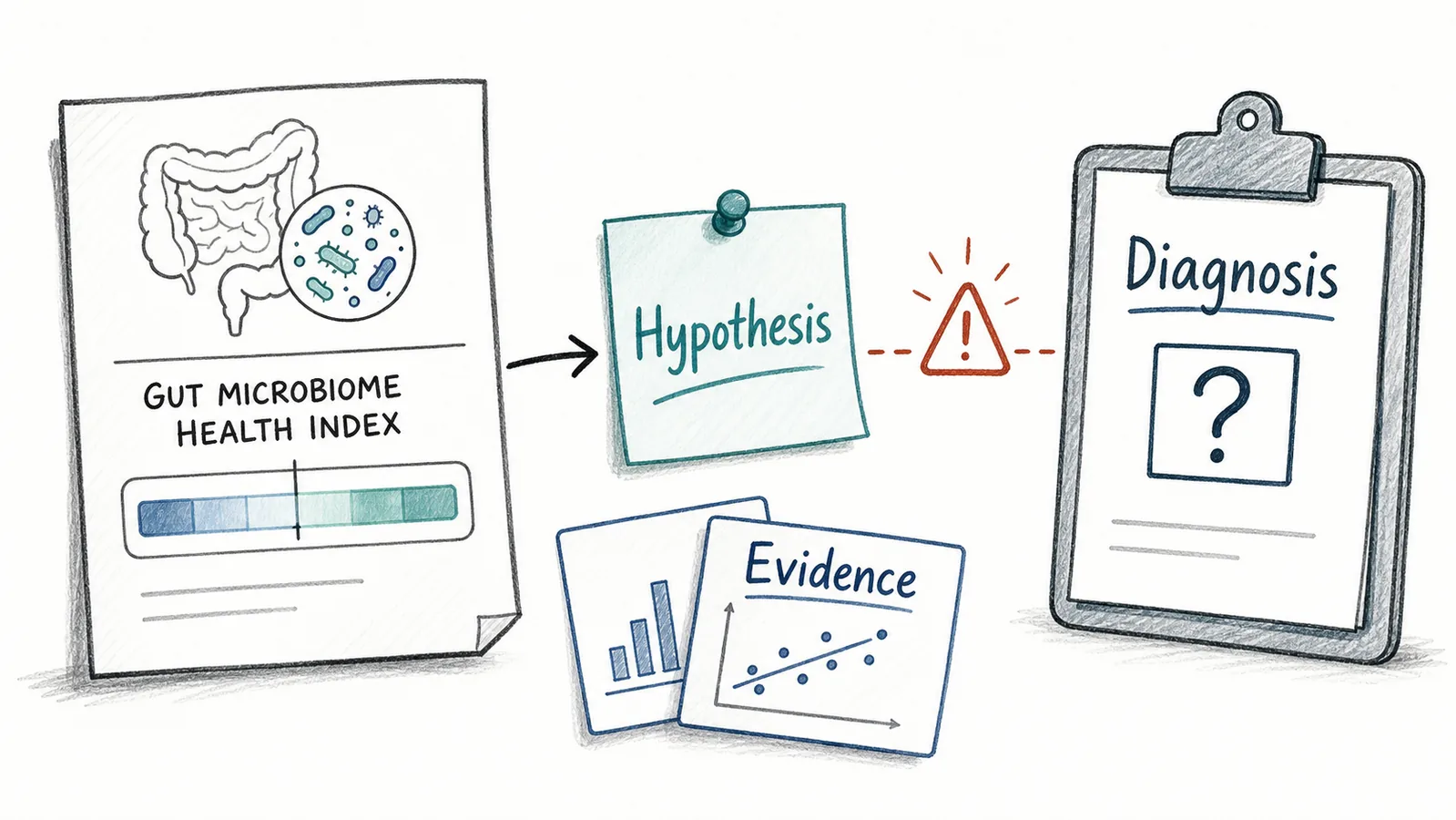
Short answer: A microbiome health index can be a useful research-style summary of one stool sample, but it should not be treated as a medical diagnosis. Current evidence supports cautious interpretation, not a universal score that proves health or disease.
This evidence-based response answers the same reader question targeted by a commercial gut-health article, while separating what can be supported from what is still speculative. InnerBuddies is mentioned here only as the source of the public claim pattern. The practical question is broader: what should a reader do with gut microbiome health index claims when the science is real but the marketing sounds more certain than the data?
The Ultimate Guide to Understanding Your Gut Microbiome Health Index: What Science Actually Says
A microbiome health index is a summary signal, not a validated medical diagnosis. That is the clinically useful starting point. Microbiome research can reveal meaningful associations, mechanisms, and hypotheses, but those findings do not automatically become an individual diagnosis, a treatment promise, or a personalized plan on command. The strongest papers found through MedicalBrain for this topic point toward nuance rather than certainty, including A predictive index for health status using species-level gut microbiome profiling, Gut Microbiome Wellness Index 2 enhances health status prediction from gut microbiome taxonomic profiles, Gut microbiome as a clinical tool in gastrointestinal disease management.
The source framing turns a complicated biomedical area into a consumer-friendly answer. That can be helpful when it encourages curiosity, better diet, symptom tracking, or a conversation with a clinician. It becomes misleading when it implies that a single product, score, food, or stool report can solve the question without clinical context.
Evidence summary
- A microbiome health index is a summary signal, not a validated medical diagnosis.
- Consumer microbiome findings are usually hypothesis-generating, not diagnostic.
- Clinical interpretation depends on symptoms, history, medication use, diet, timing, and validated tests.
- Association does not prove causation, and group-level microbiome patterns do not reliably predict one person's outcome.
- Red flags such as bleeding, weight loss, fever, anemia, severe pain, dehydration, or persistent nocturnal symptoms need medical care.
Can a Microbiome Test Answer This Question?
A stool microbiome test can describe organisms or genes detected in one sample. Depending on the method, it may report relative abundance, diversity, inferred functions, or comparison with a reference group. That can be interesting. It can also be useful for research and for carefully framed education. The limitation is that a stool sample is not the same as a full clinical work-up, and it does not directly measure every part of the digestive tract.
For gut microbiome health index, the risk is over-translation. A microbiome pattern may fit a plausible story, but the patient still needs the right question asked first. Is the concern infection, inflammation, food intolerance, malabsorption, medication side effects, IBS, IBD, mental health, diet quality, or a normal variation? Each possibility changes what counts as evidence.
What Marketing Often Gets Wrong
The common marketing mistake is to jump from microbiome science to individual certainty. A study may show that two groups differ on average. A test report may show that a person's sample differs from a reference set. Neither result proves that a symptom was caused by one bacterial pattern or that a recommended intervention will fix it.
Another mistake is treating all evidence as equal. Mechanistic studies, animal experiments, observational human cohorts, randomized trials, clinical guidelines, and diagnostic validation studies answer different questions. Good science communication keeps those levels separate. If a claim depends mainly on plausible biology, it should be called plausible. If it has human trial support for a specific product, dose, strain, or test, that support should be stated narrowly.
What Studies Actually Show About Gut Microbiome Health Index
The MedicalBrain search for this queue item returned peer-reviewed sources that support a cautious interpretation. Several Nature Portfolio papers emphasize that microbiome patterns are context-dependent, influenced by diet, medications, sampling, geography, age, disease state, and analysis pipelines. That does not make microbiome science weak. It means the field is still moving from association and prediction toward validated, patient-level decisions.
A careful article should therefore avoid two extremes. It should not dismiss the microbiome as irrelevant. It should also not promise that one sample or one lifestyle step can explain a complex symptom. The safer answer is to use microbiome information as one layer, then combine it with clinical history, conventional testing when needed, and realistic follow-up.
When to See a Clinician
Seek medical advice promptly if digestive symptoms include blood in stool, black stools, persistent fever, unexplained weight loss, anemia, severe or worsening abdominal pain, repeated vomiting, dehydration, night-time diarrhea, difficulty swallowing, new symptoms after age 50, or symptoms in pregnancy, immunosuppression, infancy, or significant chronic disease. These features should not be managed by a microbiome report or supplement plan alone.
Bottom Line
A microbiome health index can be a useful research-style summary of one stool sample, but it should not be treated as a medical diagnosis. Current evidence supports cautious interpretation, not a universal score that proves health or disease. The best use of the microbiome field is not to sell certainty where none exists. It is to ask better questions, choose appropriate tests, and keep claims proportional to the evidence.
The Simple Version
Your gut microbiome is real and important, but it is not a magic control panel. A stool report, food claim, or wellness score can sometimes give clues. It cannot automatically diagnose a disease, explain every symptom, or prescribe the perfect fix. Think of microbiome information as one piece of a larger puzzle. If symptoms are mild and short-lived, diet, sleep, stress, hydration, and time may matter. If symptoms are severe, persistent, or come with red flags, the right next step is clinical care, not a bigger promise from a gut-health product.
Educational Disclaimer
This article is for educational purposes only and does not provide personal medical advice, diagnosis, or treatment. If you have concerning, persistent, or severe symptoms, speak with a qualified clinician.
Evidence Notes and Sources
- A predictive index for health status using species-level gut microbiome profiling. Nature Communications. 10.1038/s41467-020-18476-8
- Gut Microbiome Wellness Index 2 enhances health status prediction from gut microbiome taxonomic profiles. Nature Communications. 10.1038/s41467-024-51651-9
- Gut microbiome as a clinical tool in gastrointestinal disease management: are we there yet?. Nature Reviews Gastroenterology & Hepatology. 10.1038/nrgastro.2017.29
- Is precision microbiome medicine just around the corner?. Nature Reviews Gastroenterology & Hepatology. 10.1038/s41575-025-01040-4
- The promise of the gut microbiome as part of individualized treatment strategies. Nature Reviews Gastroenterology & Hepatology. 10.1038/s41575-021-00499-1
- A Consensus Statement on establishing causality, therapeutic applications and the use of preclinical models in microbiome research. Nature Reviews Gastroenterology & Hepatology. 10.1038/s41575-025-01041-3
- Examining the healthy human microbiome concept. Nature Reviews Microbiology. 10.1038/s41579-024-01107-0