Evidence-based response
How Travel Can Affect Your Gut Microbiome Test Results: Evidence-Based Answer Without the Hype
Travel can temporarily change stool microbiome results, especially with new foods, diarrhea, antibiotics, stress, or disrupted sleep. Timing matters.
By Sandra McKenzy, Pharmacist · 2026-06-03
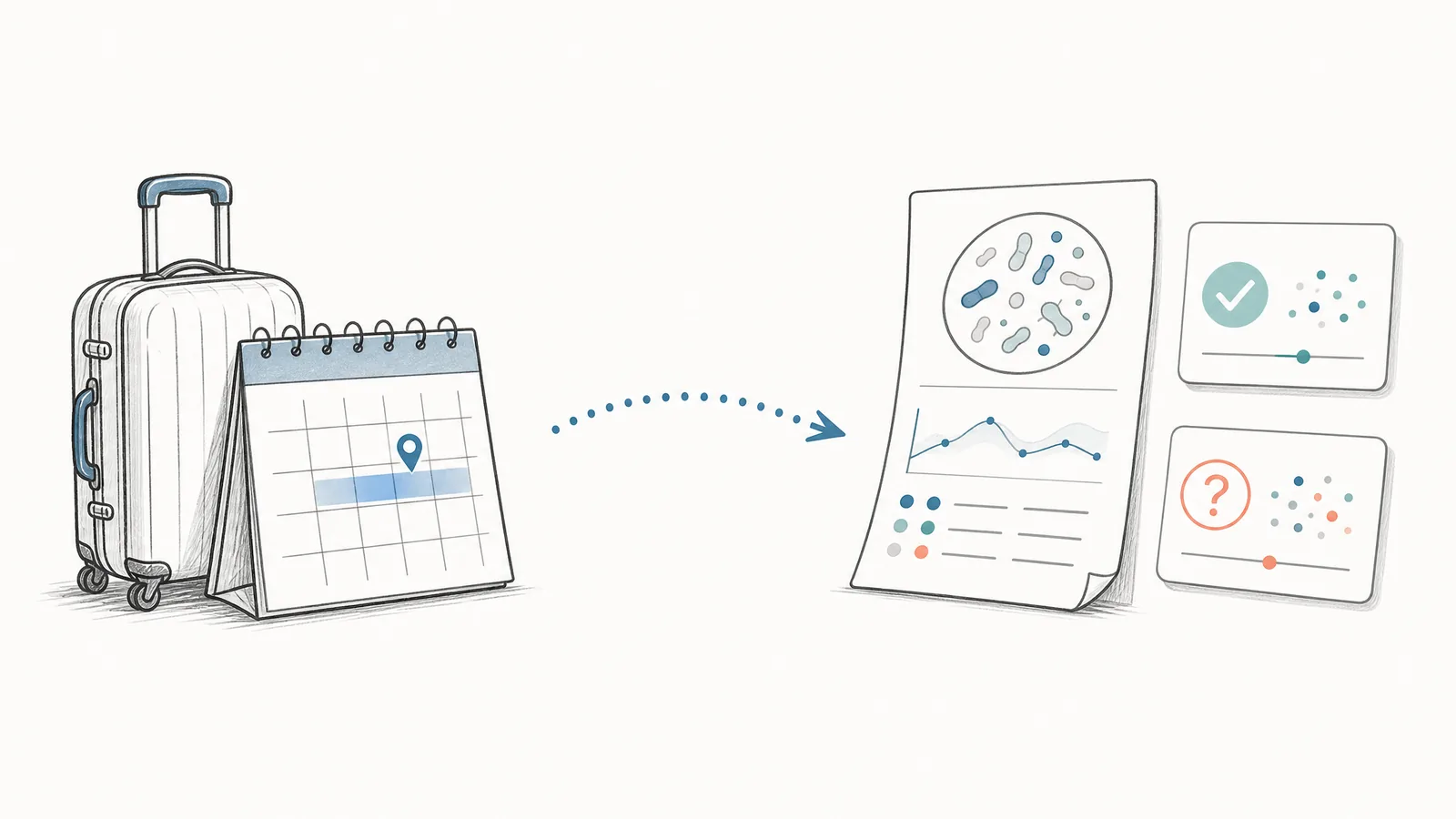
Short answer: Travel can change gut microbiome test results, especially when it involves new foods, diarrhea, antibiotics, disrupted sleep, or a different environment. That does not make testing useless, but it means timing and context matter before interpreting a result as your baseline.
How can travel affect gut microbiome test results?
A stool microbiome test captures a moment. Travel changes meals, water exposure, sleep timing, stress, physical activity, alcohol intake, and infection risk. International travel can also expose the gut to new organisms and antimicrobial resistance genes, particularly when travelers develop diarrhea or take antibiotics. A post-trip result may therefore reflect the trip as much as the person’s usual routine.
Evidence summary
- Travel can temporarily shift microbial composition and the gut resistome.
- Traveler’s diarrhea and antibiotics are especially important context for interpretation.
- A single sample after travel may not represent a person’s ordinary baseline.
- Waiting until routines stabilize can make elective consumer testing easier to interpret.
- Red-flag symptoms after travel need clinical testing, not only microbiome profiling.
Should you test during travel?
Only if the question is specifically about travel. If your goal is to understand your usual diet and routine, testing during jet lag, diarrhea, antibiotic use, or unfamiliar meals can create a noisy baseline. For many elective tests, it is more sensible to wait until bowel habits, food pattern, sleep, and medications are stable again.
Can travel make results inaccurate?
The laboratory may still measure the sample accurately. The issue is interpretation. A valid measurement can still answer the wrong question if the timing does not match the purpose. A test taken during acute diarrhea should not be treated as a calm long-term wellness profile.
What marketing gets wrong
Some advice treats travel effects as a simple reason to buy more tests or more supplements. A more evidence-based approach asks what changed, whether symptoms are present, and whether a clinical pathogen or inflammation test is needed first.
When should you see a clinician after travel?
Seek medical care for bloody diarrhea, fever, dehydration, severe abdominal pain, persistent diarrhea beyond several days, symptoms after antibiotics, pregnancy, immune suppression, or possible exposure to unsafe water or foodborne outbreaks.
Bottom line
Travel does not ruin microbiome testing, but it changes the question. The best interpretation records trip timing, symptoms, antibiotic use, and when normal routines resumed.
Why can travel change a microbiome result?
Travel changes several inputs at once. Diet often shifts within days, including fiber amount, fermented foods, fat intake, alcohol, spices, meal timing, and hydration. Sleep disruption, time zone changes, stress, heat, altitude, and altered physical activity may also affect bowel habits. Exposure to new microbes through food, water, close contact, and the local environment can temporarily change what is detected in stool.
Medication is another major factor. Antibiotics, antimalarials, acid-suppressing drugs, anti-diarrheal medicines, laxatives, probiotics, and new supplements can all influence stool patterns or microbial signals. If a sample is collected during travel, immediately after gastroenteritis, or soon after antibiotics, the result may reflect a disturbed period rather than the person’s usual baseline.
Does a travel-related shift mean damage?
Not necessarily. Some changes are temporary ecological responses. The microbiome is dynamic, and variation after travel does not automatically mean lasting harm, infection, or a need for treatment. The key question is clinical context. Short-lived changes in stool frequency after unfamiliar foods are different from fever, bloody diarrhea, dehydration, severe abdominal pain, persistent diarrhea, or symptoms in an immunocompromised person.
Marketing can overstate this by implying that a post-travel microbiome result reveals exactly what went wrong or which product will restore balance. Evidence does not support that level of certainty for most consumer reports. A stool profile may document a change, but it usually cannot identify the full cause or prove the right intervention.
When is the best time to test?
If the goal is to understand a stable baseline, avoid collecting during acute illness, antibiotic use, colonoscopy preparation, major diet changes, or immediately after international travel. Waiting until bowel habits and diet have returned to normal can make the result easier to interpret. If the goal is to investigate illness after travel, a clinician should choose targeted tests for pathogens, parasites, inflammation, or dehydration risk rather than relying on broad microbiome profiling alone.
What a cautious evidence-based answer looks like
A cautious answer does not dismiss microbiome science. It separates established biology from clinical promises. Established biology can say that microbial communities interact with diet, immune signaling, metabolites, medications, and intestinal barrier function. Clinical promises need more. They need studies showing that a specific test or intervention improves a specific outcome for a defined group of people. Without that bridge, the correct wording is possible, plausible, associated, or still being studied.
For readers, this wording is not academic nitpicking. It protects decisions. If a claim is only plausible, it may still support general habits such as eating enough fiber, avoiding unnecessary antibiotics, sleeping well, and discussing persistent symptoms with a clinician. It should not be used to self-diagnose disease, stop prescribed medication, start antimicrobial protocols, or ignore red flags.
Evidence notes
- Impact of international travel and diarrhea on gut microbiome and resistome dynamics. Nature Communications. 10.1038/s41467-022-34862-w
- Gut microbiota and colonization resistance against bacterial enteric infection. Microbiology and Molecular Biology Reviews. 10.1128/mmbr.00007-19
- Temporal variability in quantitative human gut microbiome profiles and implications for clinical research. Nature Communications. 10.1038/s41467-021-27098-7
- Stability of the human faecal microbiome in a cohort of adult men. Nature Microbiology. 10.1038/s41564-017-0096-0
- Gut microbiome as a clinical tool in gastrointestinal disease management: are we there yet?. Nature Reviews Gastroenterology & Hepatology. 10.1038/nrgastro.2017.29
- Credible inferences in microbiome research: ensuring rigour, reproducibility and relevance in the era of AI. Nature Reviews Gastroenterology & Hepatology. 10.1038/s41575-025-01100-9
This article is educational and does not diagnose, treat, or replace care from a qualified clinician.