Evidence-based response
How Sauerkraut Boosts Digestion: What Science Actually Says
Sauerkraut can be part of a gut-friendly diet, but it is not a proven microbiome cure or guaranteed digestive reset.
By Sandra McKenzy, Pharmacist · 2026-06-08
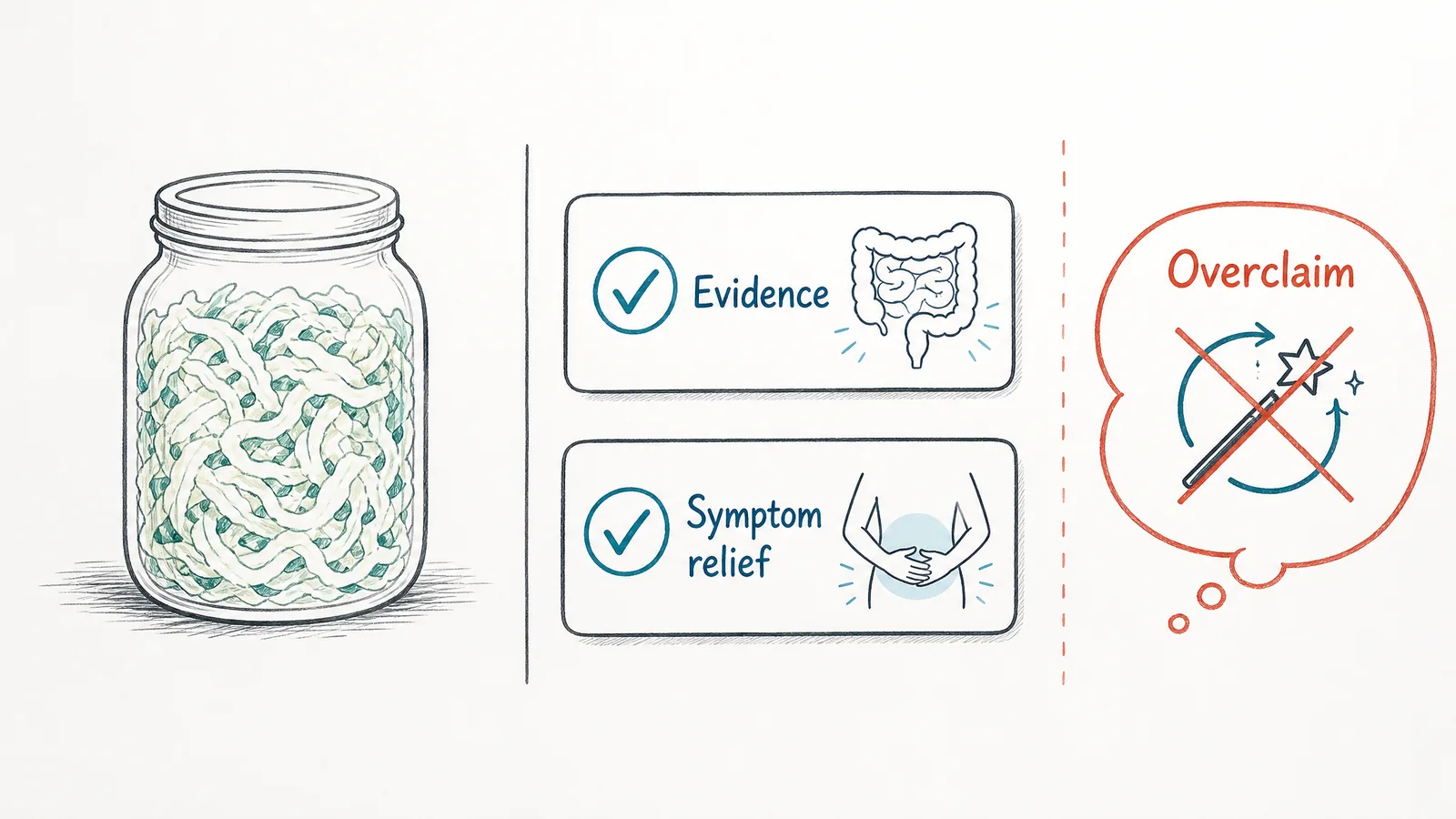
Short answer: Sauerkraut may support digestive comfort as a fermented food, especially if it is raw and tolerated, but it is not proven to regulate every person’s microbiome or treat disease. Product quality, dose, salt, histamine sensitivity, and the rest of the diet matter more than the word “probiotic” on its own.
How Sauerkraut Boosts Digestion
InnerBuddies frames sauerkraut as a microbiome-regulating fermented food. A safer answer is that sauerkraut may contribute to dietary variety and microbial exposure, but the clinical claim must stay modest.
Evidence summary
- Sauerkraut can contain live lactic acid bacteria when unpasteurized, but products vary widely.
- Fermented foods may influence gut ecology, yet sauerkraut-specific clinical trials are limited.
- It is food, not a treatment for IBS, IBD, infection, or immune disease.
- Salt content, histamine sensitivity, FODMAP load, and food safety matter for some readers.
- Persistent or severe digestive symptoms need clinical evaluation, not only fermented-food advice.
Does sauerkraut boost digestion?
Sauerkraut is fermented cabbage. During fermentation, lactic acid bacteria convert plant sugars into organic acids and other compounds. If the product is raw and not heat-treated, it may also deliver live microbes. That makes sauerkraut a plausible part of a varied diet, especially when it replaces ultra-processed foods.
The evidence boundary is important. A plausible fermented food is not the same as a probiotic drug, a validated microbiome treatment, or a guaranteed digestive fix. Studies of fermented foods often examine mixed diets, yogurt, kefir, kimchi, or broader food patterns. They do not prove that every jar of sauerkraut regulates every person’s microbiome.
What does fermentation actually change?
Fermentation can lower pH, change texture and flavor, produce lactic acid, and alter some nutrients. It can also add microbial exposure when live cultures remain. These effects are real. They still depend on product handling, pasteurization, storage, salt, and serving size.
Some people feel better when they add small portions of fermented foods. Others get gas, reflux, histamine-type symptoms, or discomfort. That does not mean sauerkraut is bad. It means response is individual and not fully predictable from marketing language.
Can sauerkraut treat gut problems?
There is no good basis to present sauerkraut as a treatment for inflammatory bowel disease, celiac disease, infection, SIBO, food allergy, or chronic unexplained symptoms. In IBS, fermented foods can be tolerated by some people and bothersome for others because symptoms are sensitive to dose, acid, fiber, and fermentable carbohydrates.
People who are immunocompromised, pregnant with food-safety concerns, or recovering from serious illness should be more careful with raw fermented foods. Foodborne infection is uncommon with properly prepared products, but safety depends on the product and the person.
What marketing gets wrong
Marketing often uses the word probiotic loosely. A fermented food with live microbes is not automatically a clinically tested probiotic with defined strains, dose, and outcomes. “Boosts immunity” and “regulates your microbiome” are too broad unless the exact claim has human evidence.
A microbiome test may show a stool pattern, but it cannot prove that sauerkraut is the missing intervention. The report may be a conversation starter, not a prescription.
What did MedicalBrain validation show?
MedicalBrain found evidence that fermented foods can be relevant to gut ecology and immune signaling, plus newer work on fermented foods and microbiome stability. It also found review-level caution that probiotics and fermented foods vary by strain, matrix, population, and outcome.
The strongest safe statement is that sauerkraut can be one fermented food option. The weakest statement is that it reliably fixes digestion or personalizes gut health by itself.
When should you see a clinician?
Seek care for blood in stool, fever, dehydration, severe abdominal pain, unintentional weight loss, persistent diarrhea, recurrent vomiting, anemia, black stool, or symptoms after travel or antibiotics. People with IBD, immune suppression, pregnancy concerns, or severe histamine reactions should ask a clinician before relying on raw fermented foods.
If sauerkraut causes mild gas, reduce the portion or pause it. If it causes severe or repeated symptoms, do not force it because a blog called it science-backed.
How should readers use sauerkraut safely?
Use sauerkraut as a small food addition, not as a rescue plan. A cautious serving might be a spoonful or two with a meal, then watching tolerance over several days. People often get into trouble when they add large portions quickly because fermented cabbage can bring acid, salt, fiber, and live microbes at once. Slow introduction is more reasonable than chasing a microbiome reset.
Look at the whole plate. Sauerkraut beside legumes, whole grains, vegetables, nuts, seeds, and adequate fluids is part of a broader dietary pattern. Sauerkraut beside an otherwise low-fiber diet cannot carry the whole job. If the product is shelf-stable and pasteurized, it may still be food, but it may not contain many live organisms. If it is raw, handle it like a perishable food and respect use-by dates.
The practical decision is simple: if you enjoy sauerkraut, tolerate it, and do not have a reason to avoid high-salt or raw fermented foods, it can be included. If it worsens reflux, diarrhea, histamine-type symptoms, or abdominal pain, it is not mandatory for gut health. A food that is good for one microbiome story can still be wrong for one person.
Bottom line
Sauerkraut can be a reasonable fermented food if you like it and tolerate it. It is not a microbiome reset button. Use small portions, choose safe products, and treat severe or persistent symptoms as medical questions, not as signs that you need more fermented cabbage.
The simple version
Think of sauerkraut as food with possible microbial benefits, not as medicine. A small serving may suit some people. If it worsens symptoms or you have red flags, stop guessing and get clinical advice.
Evidence notes
- Microbiome-based interventions to modulate gut ecology and the immune system. Mucosal Immunology. 10.1038/s41385-022-00564-1
- Fermented foods affect the seasonal stability of gut bacteria in an Indian rural population. Nature Communications. 10.1038/s41467-025-56014-6
- Comparison of the relative impacts of acute consumption of an inulin-enriched diet, milk kefir or a commercial probiotic product on the human gut microbiome and metabolome. npj Science of Food. 10.1038/s41538-023-00216-z
- Human-origin probiotic cocktail increases short-chain fatty acid production via modulation of mice and human gut microbiome. Scientific Reports. 10.1038/s41598-018-30114-4
- Utilization of the microbiome in personalized medicine. Nature Reviews Microbiology. 10.1038/s41579-023-00998-9
- Translating microbiota analysis for clinical applications. Nature Reviews Bioengineering. 10.1038/s44222-024-00168-3
This article is educational and does not diagnose, treat, or replace care from a qualified clinician.