Evidence-based response
Dirty Gut Symptoms? Evidence-Based Answer Without the Hype
“Dirty gut” is not a clinical diagnosis. Bloating, bowel changes, fatigue, skin symptoms, and mood changes can overlap with gut disorders, but they do not prove dysbiosis.
By Sandra McKenzy, Pharmacist · 2026-06-03
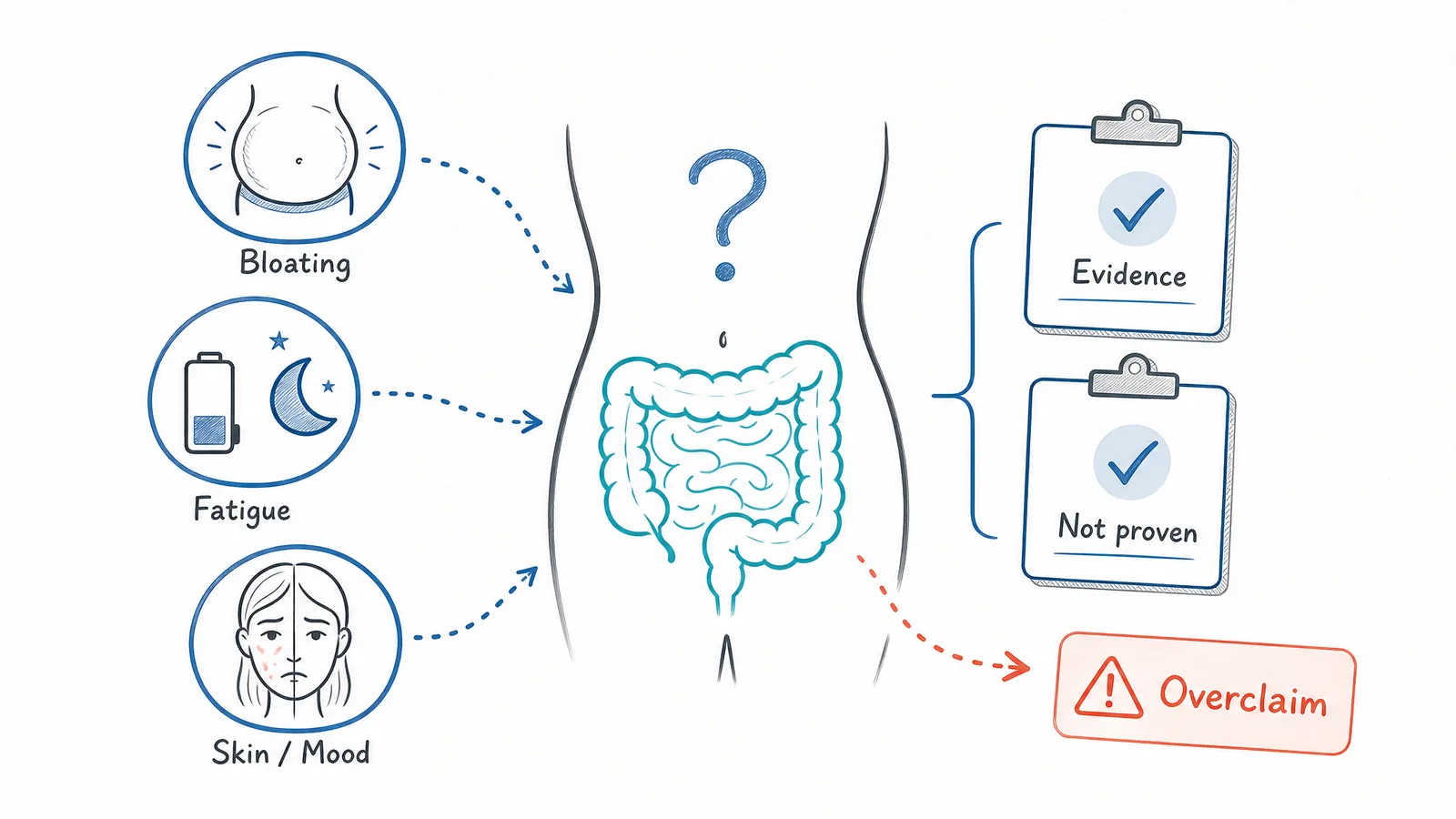
Short answer: “Dirty gut” is not a medical diagnosis. Symptoms such as bloating, gas, constipation, diarrhea, fatigue, skin flares, cravings, or mood changes may occur in people with gut disorders, but they can also come from many non-microbiome causes. A symptom list cannot diagnose dysbiosis, Candida, toxins, leaky gut, or the need for a specific supplement.
What does “dirty gut” actually mean?
In marketing, the phrase usually means an imbalanced or toxin-loaded intestine. In clinical language, doctors use more specific terms: constipation, diarrhea, irritable bowel syndrome, inflammatory bowel disease, infection, malabsorption, medication effects, food intolerance, or dysbiosis in a research context. The distinction matters because vague labels can delay useful testing.
Evidence summary
- Digestive symptoms are real, but they are nonspecific.
- Dysbiosis is associated with several disorders, but association is not diagnosis.
- Consumer microbiome profiles cannot replace targeted tests for inflammation, bleeding, infection, or celiac disease.
- Fatigue, skin symptoms, and mood changes require broader clinical context.
- Red flags should be evaluated before self-treatment.
Which symptoms may overlap with gut problems?
Bloating, abdominal pain, altered stool pattern, urgency, mucus, nausea, and food-triggered discomfort can all involve the gut. They still do not point to one microbial cause. IBS, lactose intolerance, celiac disease, IBD, infections, medication effects, thyroid disease, and stress physiology can look similar at first.
What marketing gets wrong
Marketing often treats every vague symptom as proof of a contaminated gut. That is not evidence-based. A stool profile might generate hypotheses, but it cannot prove that fatigue is caused by one missing bacterium or that skin symptoms require a detox plan.
What studies actually show
Research links microbiome patterns with inflammation, functional gastrointestinal disorders, and some treatment responses. But the field is still working out causality, reproducibility, and clinical thresholds. Even interventions that change the microbiome do not always improve symptoms.
When should you see a clinician?
Get medical care for blood in stool, black stool, unexplained weight loss, fever, anemia, persistent vomiting, nighttime diarrhea, severe or worsening pain, new symptoms after age 50, or family history of colorectal cancer, celiac disease, or IBD. These are not situations for a generic gut-cleanse plan.
Bottom line
If you have symptoms, take them seriously. Just do not let the phrase “dirty gut” replace a careful differential diagnosis. The safest path is symptom pattern, red flags, targeted tests, and only then microbiome context if it is genuinely useful.
Why symptom lists are risky
Symptom lists feel useful because they are easy to recognize. The risk is that they can make different conditions look falsely similar. Bloating can occur with constipation, IBS, lactose intolerance, small intestinal bacterial overgrowth, celiac disease, inflammatory bowel disease, medication effects, menstrual-cycle changes, stress, and ordinary dietary shifts. Fatigue can come from sleep loss, anemia, thyroid disease, depression, infection, medication, under-eating, or chronic inflammation. Skin symptoms can be dermatologic, allergic, hormonal, autoimmune, or medication-related. None of those possibilities becomes a “dirty gut” just because the gut microbiome is scientifically important.
Can dysbiosis be real but still hard to diagnose?
Yes. Dysbiosis is a useful research concept for disrupted microbial ecology. It can be associated with inflammation, infection, metabolic disease, and functional gastrointestinal symptoms. But clinical medicine needs reproducible thresholds, validated outcomes, and tests that change management. A consumer report showing low diversity or a missing taxon does not automatically identify the cause of a symptom, and it does not prove that a detox, antifungal, probiotic, or restrictive diet is needed.
What should be checked before blaming the microbiome?
The first step is the symptom pattern. How long has it been present? Is there blood, fever, pain, weight loss, nocturnal diarrhea, anemia, or recent travel? Did symptoms begin after antibiotics, a new medication, a food change, or an infection? Are there family risks for IBD, colorectal cancer, celiac disease, or autoimmune disease? Those questions often point to tests with clearer clinical meaning than a broad microbiome profile.
What is reasonable self-care?
For mild, short-lived symptoms without red flags, gentle basics are reasonable: hydration, regular meals, gradual fiber changes, enough sleep, movement, and avoiding extreme elimination diets. If symptoms persist, worsen, or restrict life, the safer move is evaluation. The goal is not to dismiss gut health. It is to keep gut-health language from becoming a shortcut that misses treatable disease.
How to read claims like this safely
A safer article separates three layers. The first layer is mechanism: what could happen biologically. The second layer is association: what has been observed in people or cohorts. The third layer is clinical action: what a patient should do differently. Many gut-health claims are plausible at the first layer, interesting at the second layer, and still unproven at the third. That does not make the science fake. It means the conclusion must be smaller than the sales pitch.
For readers, the practical question is not whether the microbiome matters. It does. The question is whether a claim has enough evidence to change care, justify a purchase, or delay medical evaluation. If the answer relies mainly on broad microbiome language, weak biomarkers, or personalized recommendations without validation, caution is appropriate. Good science should make uncertainty clearer, not hide it.
What a more evidence-based recommendation looks like
A responsible recommendation states who it applies to, what outcome it targets, how strong the evidence is, and when it should not be used. It also distinguishes general wellness advice from diagnosis. For example, increasing plant-food diversity gradually is different from claiming that a report can identify the exact cause of symptoms. Seeing a clinician for red flags is different from saying every symptom needs advanced testing. The most useful microbiome guidance is specific, modest, and connected to outcomes people can actually monitor.
Evidence notes
- Mechanisms of inflammation-driven bacterial dysbiosis in the gut. Mucosal Immunology. 10.1038/mi.2016.75
- Small intestinal microbial dysbiosis underlies symptoms associated with functional gastrointestinal disorders. Nature Communications. 10.1038/s41467-019-09964-7
- Irritable bowel syndrome. Nature Reviews Disease Primers. 10.1038/nrdp.2016.14
- Fecal microbiota transplantation influences microbiota without connection to symptom relief in irritable bowel syndrome patients. npj Biofilms and Microbiomes. 10.1038/s41522-024-00549-x
- Gut microbiome as a clinical tool in gastrointestinal disease management: are we there yet?. Nature Reviews Gastroenterology & Hepatology. 10.1038/nrgastro.2017.29
This article is educational and does not diagnose, treat, or replace care from a qualified clinician.