Evidence-based response
How Much Does a Stool Test Cost at the Pharmacy? Evidence-Based Answer Without the Hype
Stool test cost depends on purpose. Doctor-ordered clinical stool tests and consumer microbiome profiles are different products, and price alone does not prove medical value.
By Sandra McKenzy, Pharmacist · 2026-05-29
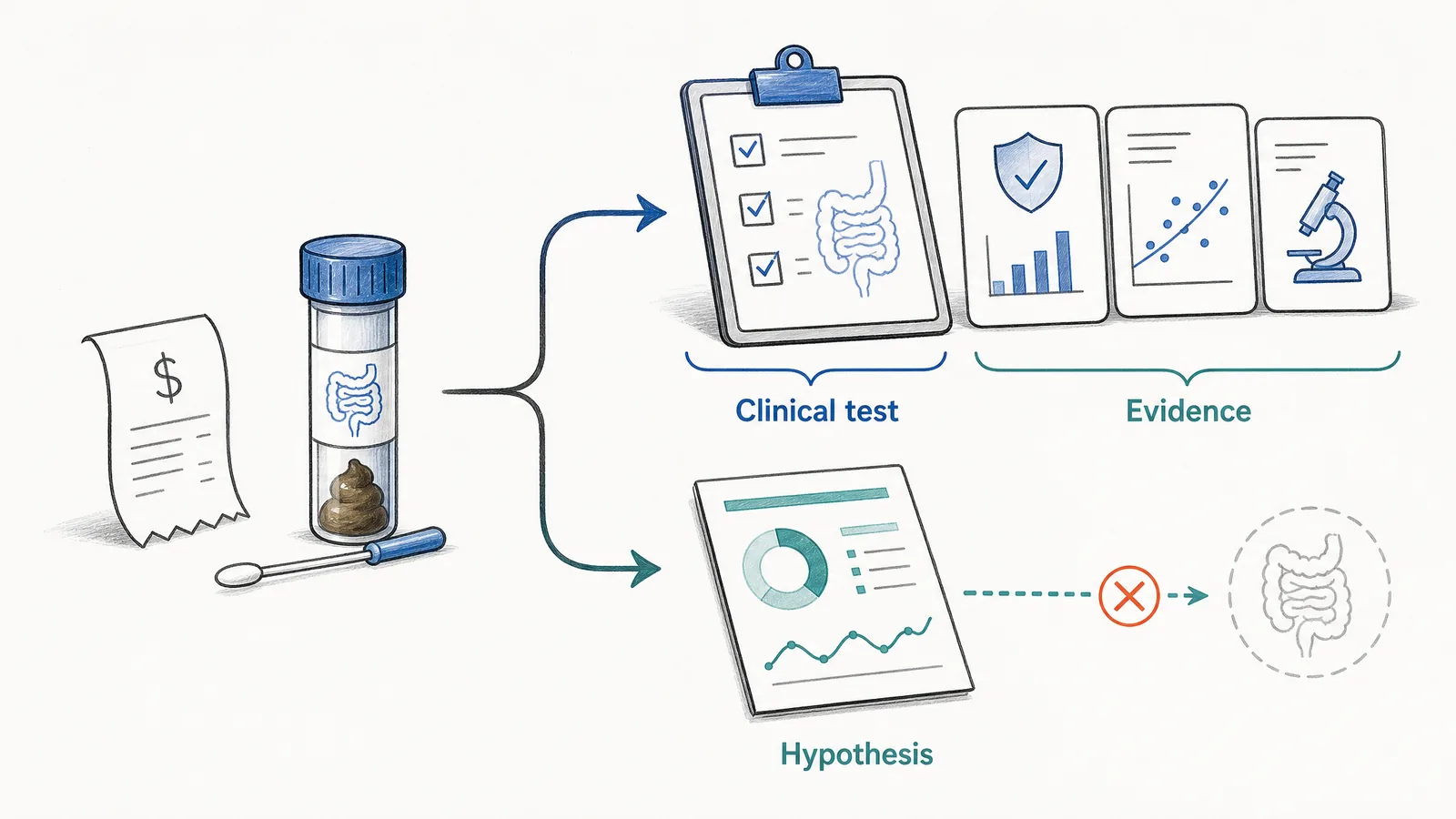
Short answer: A stool test can cost very little or several hundred dollars, but the safer question is what the test is for. Doctor-ordered stool tests for blood, inflammation, infection, parasites, or malabsorption are different from consumer microbiome profiles sold through pharmacies or online. A microbiome report may be educational, but it should not be treated as a diagnosis or a personalized treatment plan by itself.
How much does a stool test cost at the pharmacy?
At a pharmacy, the price usually depends on whether you are buying a regulated clinical test, a mail-in wellness kit, or a consumer microbiome sequencing product. A simple at-home fecal occult blood or FIT screening kit may be inexpensive. A comprehensive microbiome profile can be much more expensive because it includes collection supplies, sequencing, data analysis, shipping, and a report interface.
The problem with many price guides is that they compare products as if they answer the same question. They do not. A doctor may order stool calprotectin to help evaluate intestinal inflammation, FIT to screen for hidden blood, stool culture or PCR for infectious diarrhea, or ova and parasite testing after a specific exposure. A consumer microbiome kit usually describes microbial patterns in one sample. That can be interesting, but it is not the same as a clinically validated diagnostic workup.
What does a stool test actually measure?
Clinical stool testing is most useful when the question is narrow. Is there blood in the stool? Is there evidence of inflammation? Is a pathogen likely? Is a screening pathway needed for colorectal cancer? Those tests are interpreted with symptoms, age, medication history, travel, immune status, family history, and sometimes colonoscopy or blood tests.
Microbiome testing asks a broader question: which microbial DNA patterns are present in this sample? Research has linked gut microbiome patterns with inflammatory bowel disease, colorectal cancer risk, metabolism, medications, diet, and immune pathways. But association is not diagnosis. A single stool sample is only a partial proxy for the gut ecosystem, and results can vary with sampling method, storage, DNA extraction, geography, diet, and the reference database used.
Evidence summary
- Price is only meaningful after the clinical purpose of the stool test is clear.
- Validated clinical stool tests can support specific decisions about blood, inflammation, infection, or screening.
- Consumer microbiome reports can describe patterns, but they cannot diagnose most gut conditions on their own.
- Sampling and DNA extraction methods can change measured bacterial composition.
- Microbiome reference ranges are still limited by geography, diet, population differences, and disease heterogeneity.
Are pharmacy microbiome tests worth the money?
They may be worth it for education, curiosity, or tracking broad diet-related patterns if the report is honest about uncertainty. They are less safe when marketed as a way to explain fatigue, mood symptoms, bloating, weight change, or immune problems without a medical evaluation. A higher price does not automatically mean better clinical accuracy.
Look for three things before paying: clear laboratory method, transparent limitations, and a realistic explanation of what will change after the result. If the test mainly gives generic diet advice that would apply to almost anyone, such as eat more fiber, diversify plants, reduce ultra-processed foods, and sleep better, the same advice may not require an expensive stool profile.
What marketing gets wrong about stool test cost
The common overreach is to treat sequencing detail as medical certainty. A report may show low diversity, high or low abundance of certain taxa, or a dysbiosis score. Those findings do not prove the cause of symptoms, and they rarely identify one precise intervention. Even in research settings, microbiome-based biomarkers need careful validation before they can guide diagnosis or treatment.
This is also why insurance coverage differs. Insurers are more likely to cover doctor-ordered tests tied to recognized indications than wellness microbiome products. Some spending accounts may reimburse certain tests, but that is an administrative question, not proof of medical usefulness.
When should you ask a clinician before buying a stool test?
Speak with a clinician first if you have blood in stool, black stools, persistent diarrhea, fever, unexplained weight loss, anemia, severe abdominal pain, nighttime symptoms, dehydration, recent antibiotics with watery diarrhea, immune suppression, inflammatory bowel disease, or a family history of colorectal cancer. In those cases, the right test is chosen from the clinical picture, not from a pharmacy shelf.
Bottom line
A stool test cost can range widely, but the best value is not always the most detailed microbiome report. The best value is the test that answers a real question, has validated interpretation, and leads to safer care. Consumer microbiome testing can be informative, but it should stay in the category of hypothesis and education unless a qualified clinician connects it to an appropriate diagnostic pathway.
Evidence notes
- Mizuno et al. (2017). Gut microbiome as a clinical tool in gastrointestinal disease management: are we there yet? Nature Reviews Gastroenterology & Hepatology. 10.1038/nrgastro.2017.29
- Wilkinson et al. (2022). Microbiome risk profiles as biomarkers for inflammatory and metabolic disorders. Nature Reviews Gastroenterology & Hepatology. 10.1038/s41575-022-00581-2
- He et al. (2018). Regional variation limits applications of healthy gut microbiome reference ranges and disease models. Nature Medicine. 10.1038/s41591-018-0164-x
- Costea et al. (2019). Stool sampling and DNA isolation kits affect DNA quality and bacterial composition following 16S rRNA gene sequencing. Scientific Reports. 10.1038/s41598-019-49520-3
- Mowat et al. (2018). The value of using the faecal immunochemical test in general practice. British Journal of Cancer. 10.1038/s41416-018-0178-7
- Park et al. (2022). A hands-free stool sampling system for monitoring intestinal health and disease. Scientific Reports. 10.1038/s41598-022-14803-9
This article is educational and does not diagnose, treat, or replace care from a qualified clinician.