Evidence-based response
Is It Safe to Take a Gut Microbiome Test During Pregnancy? Benefits, Limits, and Red Flags
Stool collection is usually non-invasive in pregnancy, but consumer microbiome results should not guide prenatal care without a clinician.
By Sandra McKenzy, Pharmacist · 2026-06-06
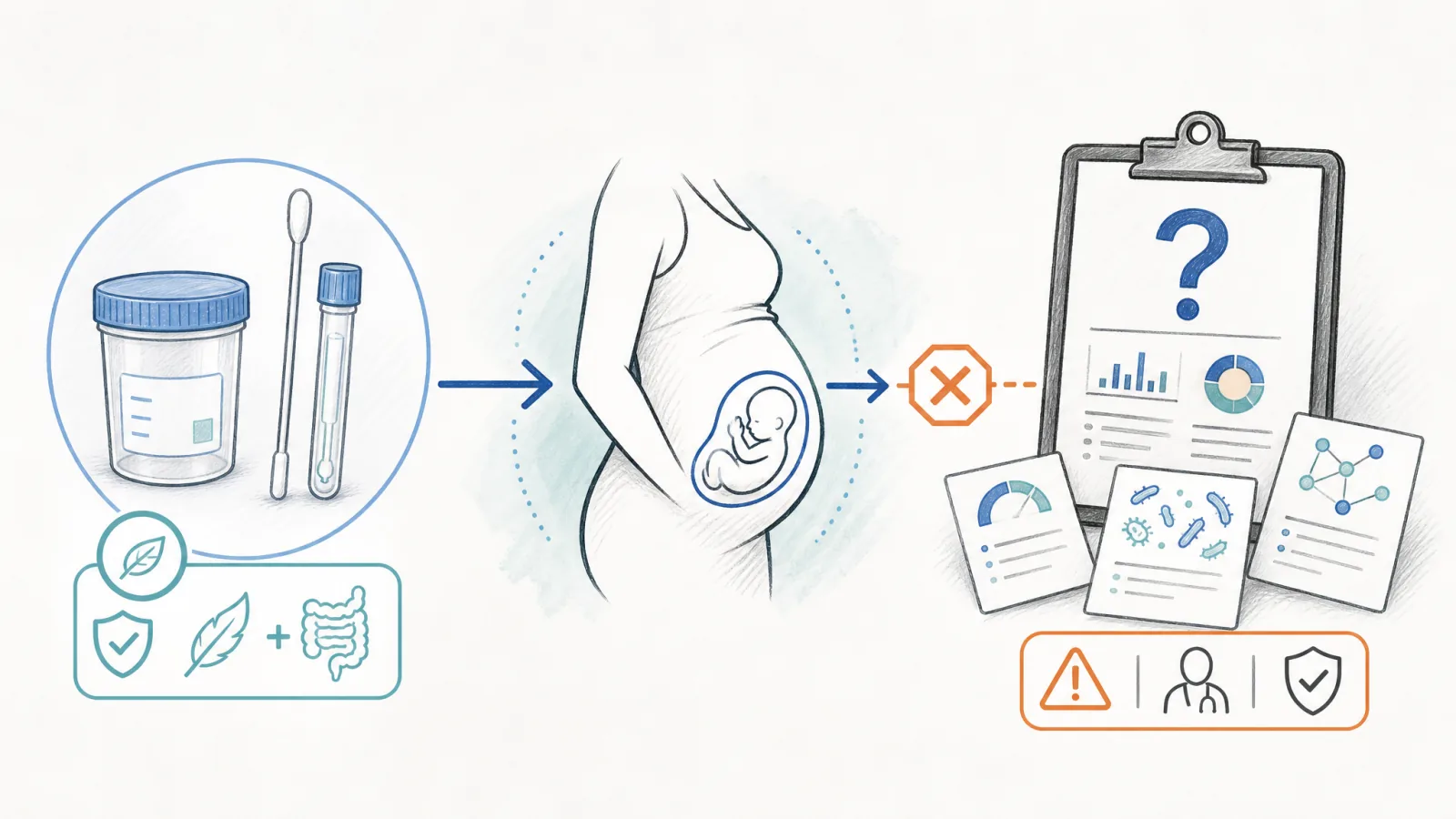
Short answer: Collecting a stool sample for a gut microbiome test during pregnancy is usually physically non-invasive, so the sample collection itself is unlikely to harm the pregnancy. The bigger issue is interpretation. Consumer microbiome results should not guide prenatal supplements, restriction diets, probiotics, or medical reassurance without an obstetric clinician.
Is it safe to take a gut microbiome test during pregnancy?
The safest direct answer separates the test procedure from the advice that may follow it. A typical gut microbiome test asks a person to collect a small stool sample at home and mail it to a lab. That act is non-invasive. It does not involve radiation, blood draw, medication, or a procedure inside the body. From a physical collection standpoint, it is very different from a diagnostic test that touches the fetus or changes treatment.
InnerBuddies has published a consumer article on microbiome testing during pregnancy. This response uses that search intent as a starting point. The evidence-based boundary is important: pregnancy is a medical context, and a consumer stool report is not prenatal diagnosis. The risk is less the swab or collection tube and more the confidence a report may create.
Evidence summary
- Stool collection is non-invasive, but report interpretation during pregnancy should be cautious.
- Pregnancy is associated with microbiome variation, yet variation does not equal disease or a treatment target.
- Consumer microbiome tests are not validated prenatal screening tests for fetal health, miscarriage risk, gestational diabetes, preterm birth, or nutrient needs.
- Do not start restrictive diets, strong supplements, probiotics, antibiotics, or microbiome interventions in pregnancy based only on a consumer report.
- Pregnant readers should seek medical care for bleeding, severe pain, fever, dehydration, persistent vomiting, reduced fetal movement, or concerning bowel symptoms.
What does a pregnancy gut health test actually measure?
Most consumer gut microbiome tests analyze microbial DNA in stool. The report may describe taxa, diversity, relative abundance, or broad comparison with a reference group. Some products turn those findings into food suggestions, supplement ideas, or wellness scores. The technology can be scientifically interesting, but the clinical meaning depends on validation.
Pregnancy changes physiology. Hormones, immune regulation, bowel motility, diet, nausea, iron supplements, antibiotics, constipation, weight change, and gestational conditions can all influence stool and microbes. A result may reflect normal pregnancy variation, recent food, sampling conditions, transport, or analysis method. It should not be treated as a diagnosis by itself.
What is actually safe about the test?
The collection step is the part most likely to be safe for most pregnant people. Handling stool at home requires hygiene, but it is not invasive. Use the kit as directed, wash hands well, keep it away from children and food surfaces, and mail it according to the instructions. If a person has an infection risk or household hygiene concern, they can ask their clinician before collecting.
The report is different. A report can feel medical because it uses sequencing, percentages, diversity, dysbiosis, and personalized language. Those terms do not make it a prenatal test. A result should be brought to a clinician if it raises concern or if the user is considering any pregnancy-related change.
What claims go beyond the evidence?
The main overclaim is that a consumer microbiome test can optimize pregnancy health in a precise, proven way. Research links maternal microbes with metabolism, immune signals, infant colonization, and pregnancy complications. But a research association is not the same as a clinically validated recommendation for one pregnant person.
A report should not be used to decide whether the fetus is healthy, whether gestational diabetes will occur, which probiotic is necessary, whether constipation is harmless, or whether a restrictive diet is safe. Those questions belong in prenatal care, using validated history, examination, laboratory tests, ultrasound when appropriate, and clinician judgment.
Can microbiome testing help during pregnancy at all?
It may help as education if expectations are modest. Some people use a report to start a better conversation about fiber, constipation, fermented foods, antibiotics, or diet quality. That can be useful when the recommendations are ordinary, safe, and consistent with prenatal guidance. For example, eating more tolerated fiber-rich foods or discussing constipation with a midwife is different from starting a high-dose supplement stack based on a score.
The more specific the claim, the higher the evidence bar should be. “Your stool sample contains microbial patterns” is a measurement. “Therefore you should take this product during pregnancy” is a clinical recommendation. Those are not the same thing.
What does MedicalBrain validation show?
MedicalBrain validation for this run found peer-reviewed sources on gut microbiota in pregnant women, microbiome personalization, clinical translation, regional variation, sample handling, and ethical caution around microbiome interventions. The studies support the reality of pregnancy-associated microbiome research. They also support caution: methods, populations, sampling, reference ranges, and outcomes matter.
One large pregnancy microbiota study reported substantial inter-individual variation. That is important because a single report can look precise while still being difficult to interpret. Sample collection and storage research also shows why handling and transport matter. Clinical translation reviews repeatedly warn that microbiome data need reproducibility and defined outcomes before routine individual care decisions.
What does marketing often get wrong?
Marketing often compresses three ideas into one promise. First, the pregnancy microbiome is biologically interesting. Second, stool sequencing can measure microbial patterns. Third, a product can guide personalized pregnancy action. The first two can be true while the third remains unproven.
Pregnancy also raises the safety standard. A non-invasive test can still lead to risky decisions if the report prompts unnecessary restriction, anxiety, unneeded supplements, or delayed care. Reader protection means making that difference visible.
What should you ask before using a microbiome test while pregnant?
Ask whether the test is for education or for a medical decision. Ask what outcome the report claims to improve. Ask whether the recommendation was tested in pregnant people, not only in general wellness users. Ask whether the lab explains sample stability, limitations, data privacy, and clinician involvement. Most importantly, ask what you would do differently after receiving the result.
If the likely answer is “eat a more balanced, fiber-rich diet and talk to my clinician about symptoms,” the test may be optional education. If the answer is “change supplements, restrict foods, treat dysbiosis, or skip a medical visit,” caution is warranted.
When should a pregnant person seek medical care instead?
Contact prenatal care urgently for vaginal bleeding, severe abdominal pain, persistent vomiting, fever, dehydration, fainting, severe diarrhea, blood in stool, black stools, suspected infection, reduced fetal movement after the stage when movement is expected, severe constipation with vomiting or distension, or any symptom your obstetric team has told you to treat as urgent. Also ask before starting new supplements, probiotics, laxatives, antibiotics, herbal products, or major diet restrictions.
Bottom line
A pregnancy gut microbiome test is usually physically low risk because stool collection is non-invasive. The evidence boundary is interpretation. Consumer microbiome reports are not prenatal diagnostic tools, and they should not direct pregnancy care without a clinician. Use them, if at all, as optional context, not as a replacement for validated prenatal care.
The simple version
Putting stool in a test tube is not the main concern. Acting on the report is the concern. During pregnancy, do not let a microbiome score decide supplements, strict diets, probiotics, or whether symptoms are safe. Bring questions to your obstetric clinician or midwife, especially if symptoms are new, severe, or persistent.
Evidence notes
- Systematic analysis of gut microbiota in pregnant women and its correlations with individual heterogeneity. npj Biofilms and Microbiomes. 10.1038/s41522-020-00142-y
- Utilization of the microbiome in personalized medicine. Nature Reviews Microbiology. 10.1038/s41579-023-00998-9
- The promise of the gut microbiome as part of individualized treatment strategies. Nature Reviews Gastroenterology & Hepatology. 10.1038/s41575-021-00499-1
- Clinical translation of microbiome research. Nature Medicine. 10.1038/s41591-025-03615-9
- Filling the gap between collection, transport and storage of the human gut microbiota. Scientific Reports. 10.1038/s41598-019-44888-8
- Regional variation limits applications of healthy gut microbiome reference ranges and disease models. Nature Medicine. 10.1038/s41591-018-0164-x
- Microbiome interventions for children raise the ethical stakes. Nature. 10.1038/d41586-024-03971-5
This article is educational and does not diagnose, treat, or replace care from a qualified clinician.