Evidence-based response
Prebiotics vs. Probiotics: Key Differences, Benefits, Limits, and Red Flags
Prebiotics feed selected microbes. Probiotics supply live microbes. Both can help in the right context, but benefits are specific, not automatic.
By Sandra McKenzy, Pharmacist · 2026-06-11
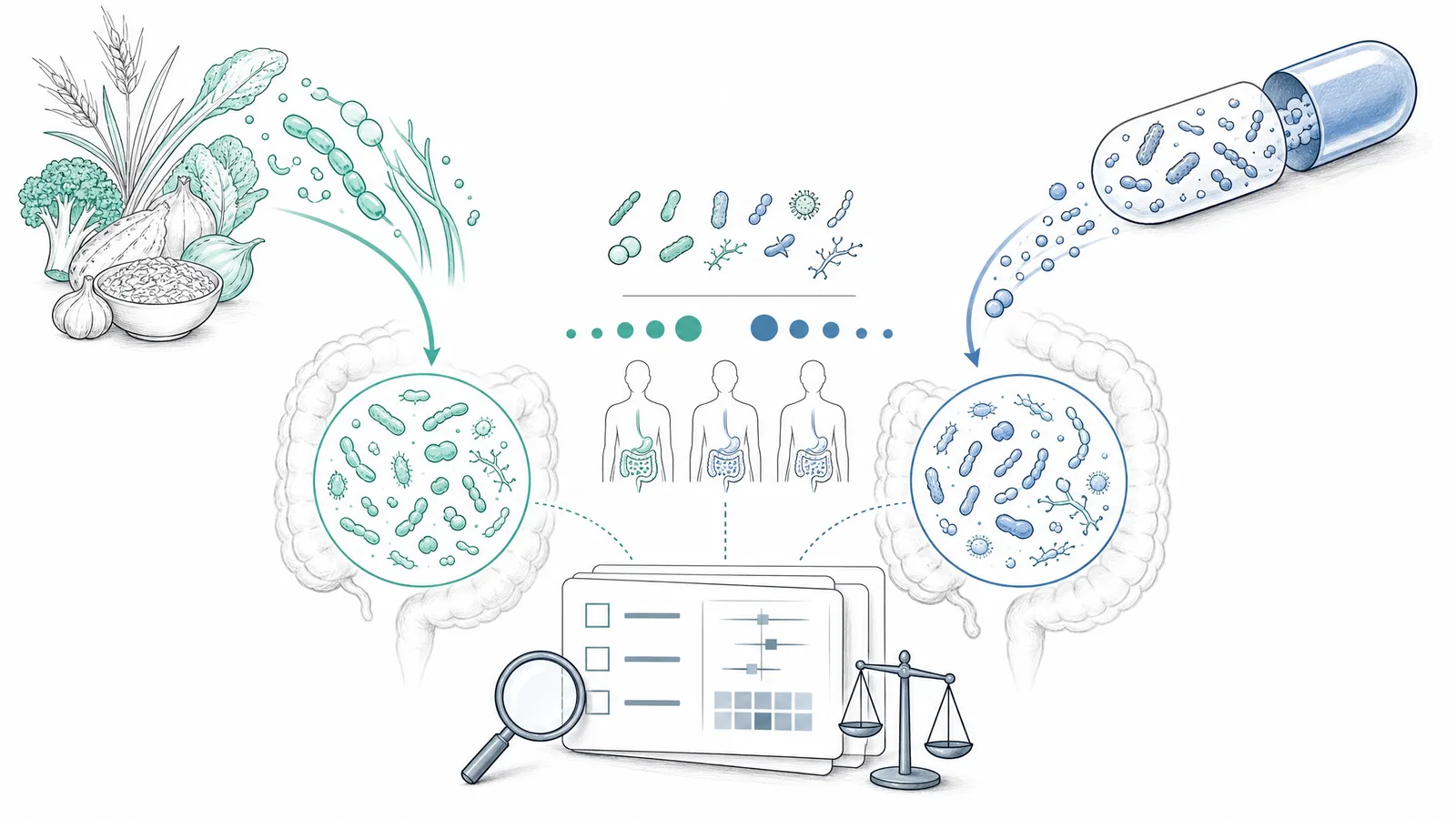
Short answer: Prebiotics are selectively used substrates, often specific fibers, that feed beneficial microbes. Probiotics are live microorganisms that may confer a health benefit when taken in adequate amounts. Both can help in the right context, but neither is a universal gut-health upgrade, and a microbiome test usually cannot tell you exactly which product you need.
Prebiotics vs. Probiotics: What Is the Key Difference?
The cleanest difference is simple. A prebiotic is food for selected microbes already living in or on the host. A probiotic is a live microbe supplied from outside the body. That distinction matters because marketing often treats them as interchangeable gut-health boosters, when the evidence is more specific.
InnerBuddies has an article on prebiotics versus probiotics that covers common definitions, foods, supplements, and microbiome testing. This response uses the same search intent but applies a stricter clinical standard. The important question is not whether prebiotics and probiotics can matter. They can. The important question is what a reader can safely conclude before buying a supplement, changing treatment, or using a consumer stool report as if it were a clinical prescription.
Evidence summary
- Prebiotics and probiotics are different tools, not synonyms.
- Benefits depend on the exact fiber, strain, dose, product quality, health condition, and outcome studied.
- Fermented foods can be healthy foods, but they are not automatically proven probiotics.
- Synbiotics need evidence for the combined product, not just separate evidence for each ingredient.
- Consumer microbiome tests can generate diet hypotheses, but they are not validated to prescribe most probiotic or prebiotic products.
What Are Prebiotics Clinically?
The ISAPP consensus definition describes a prebiotic as a substrate selectively utilized by host microorganisms that confers a health benefit. That definition is narrower than “any fiber” and broader than one fashionable ingredient. Some nondigestible carbohydrates, especially fructans and galactans such as inulin, fructooligosaccharides, and galactooligosaccharides, have the best human evidence as dietary prebiotics.
Clinically, prebiotics work through ecology. They can change which microbes have fuel, influence fermentation, and increase production of metabolites such as short-chain fatty acids. That does not mean every prebiotic food treats constipation, IBS, leaky gut, anxiety, diabetes, or immunity. The health effect has to be shown for the substrate, dose, population, and endpoint being claimed.
For many people, increasing tolerated fiber-rich foods is a reasonable dietary direction. But the practical details matter. A person with IBS may react badly to rapidly increasing fermentable fibers. Someone with strict low-FODMAP guidance may need careful reintroduction. Someone with inflammatory bowel disease, unexplained weight loss, bleeding, or severe symptoms should not use a prebiotic supplement as a substitute for clinical evaluation.
What Are Probiotics Clinically?
The consensus definition of a probiotic is a live microorganism that, when administered in adequate amounts, confers a health benefit on the host. This is not the same as “contains bacteria.” A food may contain live cultures without proving a specific health effect. A supplement may list a genus such as Lactobacillus or Bifidobacterium, but clinical evidence often depends on the strain, dose, formulation, and condition.
That strain specificity is the part many consumer articles blur. Some probiotic strains have supportive evidence for specific endpoints, such as selected forms of antibiotic-associated diarrhea, some IBS symptom trials, or particular pediatric diarrhea contexts. Other products use broad gut-health language with little direct evidence for the promised outcome. If a claim says “probiotics reduce anxiety,” “probiotics fix bloating,” or “probiotics boost immunity,” the next question should be: which strain, at what dose, in which population, for which measured outcome?
Safety also matters. Healthy adults usually tolerate many probiotic foods and common supplements, but live microbes are not risk-free for everyone. People who are severely immunocompromised, critically ill, have central venous catheters, have major barrier disruption, or are medically fragile should discuss probiotic supplements with a clinician.
Are Prebiotic Foods Better Than Probiotic Supplements?
There is no single winner. Prebiotic-rich foods are usually part of a broader healthy dietary pattern because they bring fiber, polyphenols, minerals, and food structure. Fermented foods can be nutritious and may introduce microbial metabolites or live organisms, depending on how they are made and stored. Supplements can be useful when a product has evidence for a specific indication and the person can tolerate it.
The mistake is comparing categories as if one is always better. A bowl of oats, lentils, onions, or asparagus does not have the same evidence question as a capsule containing a named strain. Yogurt with live cultures is not the same as a registered clinical trial product. Kefir, kimchi, sauerkraut, miso, and kombucha vary widely in live organisms, salt, sugar, alcohol traces, histamine load, and processing.
For everyday gut support, diet quality usually deserves first attention. For a narrow problem such as antibiotic-associated diarrhea risk or a trial of IBS symptom support, a clinician may consider a product with condition-specific evidence. For persistent symptoms, the goal should be diagnosis and management, not guessing between categories.
Do Prebiotics and Probiotics Work Better Together?
Sometimes, but the word synbiotic is often used too casually. A synbiotic combines a live microorganism with a substrate selectively used by microorganisms. ISAPP distinguishes combinations where each component has independent evidence from combinations designed to work together. Either way, a product marketed as a synbiotic should be supported by appropriate human evidence for the combination or at least honest evidence for the separate components.
The common “seeds and fertilizer” analogy is useful but incomplete. If probiotics are seeds and prebiotics are fertilizer, the garden still depends on soil, climate, watering, pests, and the plant species. In humans, that means baseline diet, medications, gut transit, inflammation, age, immune state, and the resident microbiome. A synbiotic may change stool frequency, symptoms, or microbial markers in one group and do little in another.
Can a Microbiome Test Tell You Which Prebiotic or Probiotic to Take?
Usually not with clinical certainty. Stool microbiome testing can describe microbial DNA patterns in a sample. It may show relative abundances, diversity metrics, or functional predictions. Those outputs can be educational, and in research they are extremely valuable. But for most consumers, the test has not been clinically validated to prescribe a specific probiotic strain, prebiotic fiber, dose, or duration with proven outcome benefit.
This is where the marketing boundary matters. A low abundance of one organism does not automatically mean you need a named supplement. A diversity score does not diagnose a disease. A food recommendation based on a stool profile may be plausible, but plausible is not the same as outcome-tested. Better questions are whether the recommendation is safe, whether it fits the person’s symptoms and medical history, and whether acting on the result has been shown to improve a meaningful outcome.
What Claims Go Beyond the Evidence?
Several claims need caution. “Prebiotics strengthen immunity” is too broad unless the immune outcome is defined. “Probiotics treat IBS” hides the fact that IBS trials are strain-specific and symptom-specific. “Synbiotics maximize gut health” can be true for a tested product and endpoint, but not for any random combination. “Fermented foods are probiotics” is not always technically correct, because probiotic status requires documented health benefit from adequate live microorganisms.
Another overreach is the idea that everyone needs both every day. Many people do well by eating a diverse, fiber-containing diet and using fermented foods according to preference and tolerance. Others need medical evaluation because symptoms come from celiac disease, inflammatory bowel disease, bile acid diarrhea, infection, medication effects, endocrine disease, pelvic floor dysfunction, or another cause that a wellness supplement cannot diagnose.
When Should You See a Clinician?
Seek medical care promptly for blood in the stool, black stools, unexplained weight loss, persistent vomiting, fever, anemia, severe abdominal pain, dehydration, waking at night with diarrhea, new bowel changes after age 50, or symptoms after travel or antibiotic exposure that are severe or prolonged. Also get advice before probiotic supplements if you are immunocompromised, critically ill, pregnant with complications, medically fragile, or caring for a premature infant.
For non-urgent bloating, constipation, loose stools, or discomfort, a food and symptom diary can be useful. Introduce fiber gradually. Avoid starting several products at once, because then you cannot tell what helped or harmed. If symptoms persist, the next step is not a more elaborate supplement stack. It is better clinical context.
Bottom Line
Prebiotics feed selected microbes. Probiotics supply live microbes. Both can be useful, but the evidence is not category-wide magic. The strongest claims name the exact ingredient or strain, dose, population, endpoint, and safety context. Food-first gut support is reasonable for many people, while targeted supplements should be chosen for a specific reason, not because a stool report or marketing article says more microbes are always better.
Educational Disclaimer
This article is for educational purposes only and does not diagnose, treat, or prevent disease. It is not a substitute for care from a qualified clinician. If you have persistent, severe, or worrying digestive symptoms, seek medical advice.
Evidence Notes and Sources
- Sanders et al. (2019). Probiotics and prebiotics in intestinal health and disease: from biology to the clinic. Nature Reviews Gastroenterology & Hepatology.
- Hill et al. (2014). ISAPP consensus statement on the scope and appropriate use of the term probiotic. Nature Reviews Gastroenterology & Hepatology.
- Gibson et al. (2017). ISAPP consensus statement on the definition and scope of prebiotics. Nature Reviews Gastroenterology & Hepatology.
- Swanson et al. (2020). ISAPP consensus statement on the definition and scope of synbiotics. Nature Reviews Gastroenterology & Hepatology.
- Merenstein et al. (2024). Design and reporting of prebiotic and probiotic clinical trials in the context of diet and the gut microbiome. Nature Microbiology.
- Suez et al. (2019). The pros, cons, and many unknowns of probiotics. Nature Medicine.
- Sun et al. (2018). The effect of Clostridium butyricum on symptoms and fecal microbiota in diarrhea-dominant irritable bowel syndrome. Scientific Reports.