Evidence-based response
Do 9 Studies Prove Gut Microbiome Links to Health? Causality, Limits, and Red Flags
Some microbiome studies support causal mechanisms, but “proved” is too broad unless the disease, method, population, and intervention are specified.
By Sandra McKenzy, Pharmacist · 2026-06-08
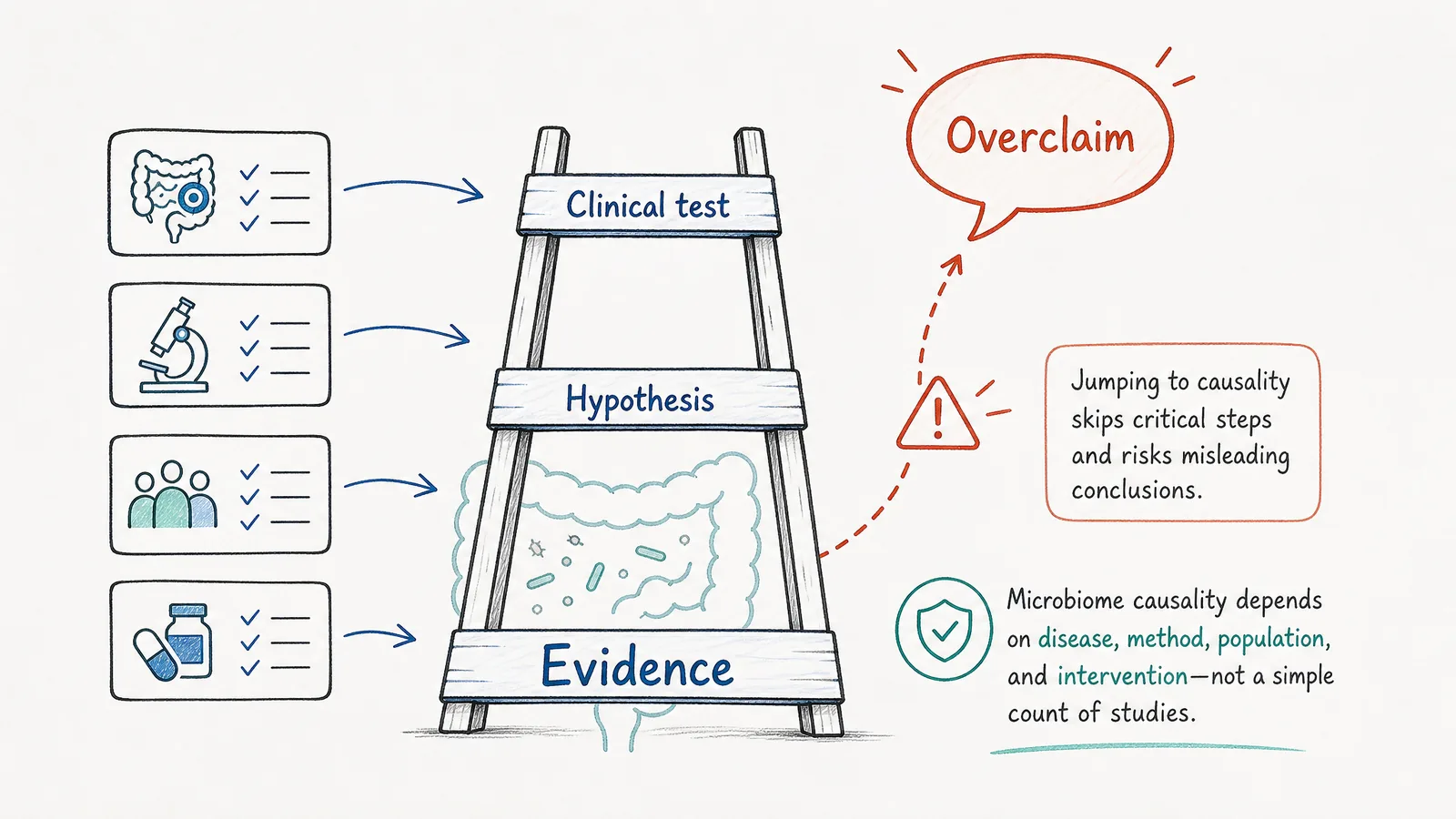
Short answer: Some microbiome studies support causal mechanisms, but “proved” is too broad unless the disease, method, population, and intervention are specified. Treat broad wellness promises as hypotheses until tested in the specific clinical setting.
Do 9 Studies Prove Gut Microbiome Links to Health?
The best answer is cautious. Some studies move microbiome science closer to causality, especially when they use transplantation, controlled models, genetics, repeated measurements, or intervention trials. But a list of studies does not prove every marketed gut-health claim.
InnerBuddies has an article targeting this question, How 9 Science-Backed Studies Prove Gut Microbiome Links to Health – InnerBuddies 2026. This response uses that search intent as a starting point and applies a stricter clinical standard. The useful question is not whether the microbiome matters. It does. The safer question is what a reader can reasonably conclude from symptoms, stool tests, diet advice, or research headlines without turning early science into personal medical certainty.
Evidence summary
- Causality requires a specific claim, method, population, and outcome.
- Animal transfer studies can suggest mechanisms, but they do not automatically prove human treatment effects.
- Mendelian randomization and FMT studies can strengthen causal inference when assumptions are met.
- Many microbiome findings remain associative, bidirectional, or context-dependent.
- A consumer stool report cannot convert broad causal literature into personal diagnosis.
What does this topic actually mean clinically?
Clinically, causality matters because treatment decisions need more than correlation. A microbe associated with disease may be a cause, a consequence, a marker, or part of a feedback loop.
The important boundary is actionability. Research can describe patterns, but clinical care asks whether a test or intervention improves a meaningful outcome for the person in front of us.
What is well supported?
Supported evidence shows that microbiome causality exists in some narrow contexts. FMT for recurrent C. difficile is the classic clinical example, while mechanistic and genetic studies strengthen selected hypotheses.
The strongest statements are narrow. They name the population, test, exposure, endpoint, and limitation. Broad statements about “optimizing gut health” are weaker because they skip those details.
Which claims go beyond the evidence?
The overclaim is that nine publications “prove” gut microbiome links to health in a broad consumer sense. Causality is not a trophy count. It is a claim-by-claim judgment.
A second overclaim is implying that more data automatically means better health advice. Sequencing can generate impressive reports, but advice needs validation, not just attractive charts.
What does MedicalBrain validation show?
MedicalBrain validation for this queue item found sources that support the biological importance of the topic but also repeatedly show limits in individual interpretation. The strongest papers are useful because they separate measurement, association, mechanism, and clinical action. That separation is the difference between evidence-based gut health communication and wellness marketing.
MedicalBrain found Mendelian randomization, FMT ecology, mental-health causality, and clinical-translation papers. They support selected causal inference but repeatedly warn that directionality, assumptions, endpoints, and translation matter.
What does marketing often get wrong?
Marketing often treats causality as a headline word. It may cite animal transfer studies, association studies, and human interventions together as if they carry the same weight.
Reader-protective communication should slow that jump down. It should explain what is measured, what is inferred, what is unproven, and what should be handled by a clinician.
How should a reader use this information?
Use causal claims by asking what type of evidence was used. Was it an animal model, human intervention, FMT, genetics, longitudinal data, or a correlation? Each answers a different question.
If the proposed next step is low risk and broadly healthy, such as eating more tolerated fiber-rich foods, it may be reasonable. If the next step is treatment, restriction, supplement stacks, or delaying care, ask for stronger evidence.
What should you not conclude from this?
Do not conclude that every microbiome association is false. The field is important and moving quickly. The safer conclusion is narrower: personal medical advice requires the right evidence for the right person, not a broad citation attached to a wellness claim.
Do not conclude that consumer information is useless either. It can help people ask better questions, notice symptom patterns, and understand why diet, medicines, infection, and inflammation matter. The line is crossed when education becomes diagnosis or treatment without validation.
Practical evidence checklist
Before acting on any microbiome claim, ask five practical questions. What exactly was measured? Was the result validated in people like you? Did the study test symptoms, disease outcomes, or only microbial composition? Would the proposed action be safe if the report were wrong? Is there a clinician-guided alternative that answers the question more directly?
This checklist is intentionally conservative. It protects readers from two common errors: rejecting useful science because marketing sounds exaggerated, and accepting weak advice because it borrows the language of sequencing, biomarkers, diversity, or personalization.
When should you see a clinician?
Seek care for severe or persistent symptoms, blood in stool, unexplained weight loss, fever, neurological symptoms, severe mood symptoms, or any condition where a microbiome product is being used instead of standard care.
Also seek care when symptoms are new, persistent, worsening, unexplained, or accompanied by weight loss, fever, dehydration, blood, nighttime symptoms, severe pain, immune suppression, pregnancy, older age, recent travel, or recent antibiotic exposure. A consumer article or stool profile should never delay urgent assessment.
Bottom line
Some gut microbiome links are causal in carefully defined settings. That does not mean a broad list of papers proves personalized consumer claims. The evidence-based move is to ask which claim, which method, which population, and which clinical endpoint.
The simple version
Some microbiome studies show more than correlation, but “causal” is not a magic stamp. A mouse study, a transplant study, a genetics study, and a clinical trial all mean different things. Good science names the exact claim and its limits.
Evidence notes
- Mendelian randomization analyses support causal relationships between blood metabolites and the gut microbiome. Nature Genetics. 10.1038/s41588-021-00968-y
- An ecological framework to understand the efficacy of fecal microbiota transplantation. Nature Communications. 10.1038/s41467-020-17180-x
- Distinguishing the causative, correlative and bidirectional roles of the gut microbiota in mental health. Nature Mental Health. 10.1038/s44220-025-00498-0
- Translating the gut microbiome: ready for the clinic?. Nature Reviews Gastroenterology & Hepatology. 10.1038/s41575-019-0204-0
- Clinical translation of microbiome research. Nature Medicine. 10.1038/s41591-025-03615-9
- Utilization of the microbiome in personalized medicine. Nature Reviews Microbiology. 10.1038/s41579-023-00998-9
This article is educational and does not diagnose, treat, or replace care from a qualified clinician.