Evidence-based response
Microbiome Testing and Personalized Nutrition: Evidence-Based Answer Without the Hype
Microbiome data may help personalize nutrition in research and selected programs, but routine consumer reports are not yet a complete clinical diet prescription.
By Sandra McKenzy, Pharmacist · 2026-06-03
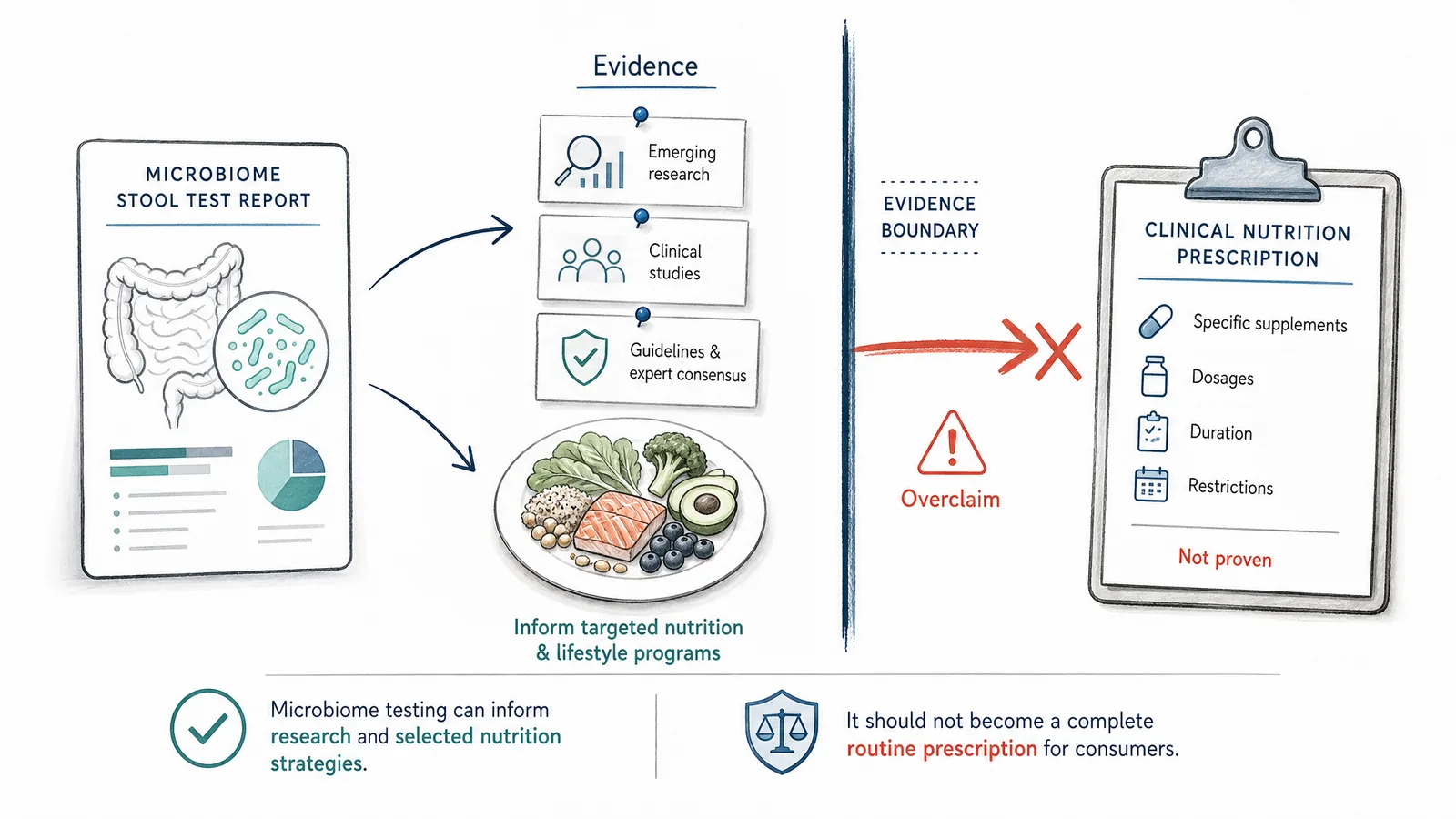
Short answer: Microbiome testing is likely to be part of the future of personalized nutrition, but it is not the whole future and it is not a mature clinical prescription for most consumers today. The strongest programs combine diet, clinical markers, lifestyle, sometimes glucose responses, and microbiome data. A stool report alone should not be treated as a personalized medical diet.
Why is the microbiome promising for nutrition?
People respond differently to the same foods. Host factors, genetics, baseline diet, sleep, activity, medications, metabolism, and gut microbes may all contribute. That makes the microbiome scientifically interesting as one layer in personalized nutrition.
Evidence summary
- Diet-microbiome interactions are real and clinically promising.
- Personalized nutrition works best when multiple data streams are integrated.
- Microbiome-only recommendations remain less clinically validated than general dietary foundations.
- RCTs support some personalized programs, but not every consumer report is equivalent.
- Red flags and disease-specific diets require clinician or dietitian oversight.
What have studies actually shown?
Research supports the idea that microbiome features can help explain different responses to foods. Recent personalized nutrition trials show cardiometabolic benefits from structured programs. However, those programs are not simply a stool test plus generic supplement list. They usually involve broader phenotyping, coaching, and validated outcome tracking.
What marketing gets wrong
The leap from “microbes influence nutrition” to “this kit can prescribe your ideal diet” is too large. A report may suggest hypotheses about fiber tolerance, fermentation patterns, or dietary diversity. It cannot replace allergy evaluation, celiac testing, diabetes care, renal diet planning, or IBD nutrition support.
What is useful now?
Microbiome testing may be useful for motivated people who understand the limits, standardize sampling, and use results as context rather than command. For most readers, the foundations remain diverse plants, adequate fiber adjusted gradually, minimally processed foods, protein adequacy, and symptom-aware changes.
When to see a clinician or dietitian
Seek professional guidance for weight loss without trying, eating disorder risk, diabetes medication changes, kidney disease, pregnancy, IBD, celiac disease, food allergy, malnutrition, or persistent GI symptoms. Personalized nutrition should become safer, not more speculative.
Bottom line
Microbiome testing may become an important nutrition tool. Today, it is best viewed as one promising input, not a complete diet prescription.
Why personalized nutrition is more than a stool report
Personalized nutrition works best when it respects the whole person. The microbiome may help explain why one person responds better to a high-fiber food, fermented food, or carbohydrate pattern than another. But meal timing, total diet quality, medications, sleep, activity, insulin sensitivity, allergies, culture, budget, and cooking habits also matter. A report that ignores these factors can look precise while being clinically shallow.
What makes a personalized program stronger?
Stronger programs define outcomes. They may track weight, waist circumference, glucose responses, lipid markers, blood pressure, symptoms, adherence, and dietary quality. They also distinguish between a prediction model and a proven treatment. If a recommendation is based on observational associations, it should say so. If it is based on a randomized trial, the report should explain whether the studied population resembles the reader.
Where microbiome data may help
Microbiome data may be useful when it helps tailor fiber increases, interpret fermentation tolerance, identify broad dietary patterns, or support research into post-meal responses. It may also help future dietitians choose among evidence-based options. The key phrase is “may help.” The field is promising, but many consumer recommendations are ahead of clinical validation.
How to use a report without overusing it
Use microbiome results as context, not orders. If the report recommends more plant diversity, that advice is broadly aligned with nutrition evidence and can be adjusted gradually. If it recommends expensive supplements, major restriction, or disease treatment, ask for clinical evidence. If symptoms are significant, a dietitian or clinician can help separate reasonable experimentation from risky self-treatment.
How to read claims like this safely
A safer article separates three layers. The first layer is mechanism: what could happen biologically. The second layer is association: what has been observed in people or cohorts. The third layer is clinical action: what a patient should do differently. Many gut-health claims are plausible at the first layer, interesting at the second layer, and still unproven at the third. That does not make the science fake. It means the conclusion must be smaller than the sales pitch.
For readers, the practical question is not whether the microbiome matters. It does. The question is whether a claim has enough evidence to change care, justify a purchase, or delay medical evaluation. If the answer relies mainly on broad microbiome language, weak biomarkers, or personalized recommendations without validation, caution is appropriate. Good science should make uncertainty clearer, not hide it.
What a more evidence-based recommendation looks like
A responsible recommendation states who it applies to, what outcome it targets, how strong the evidence is, and when it should not be used. It also distinguishes general wellness advice from diagnosis. For example, increasing plant-food diversity gradually is different from claiming that a report can identify the exact cause of symptoms. Seeing a clinician for red flags is different from saying every symptom needs advanced testing. The most useful microbiome guidance is specific, modest, and connected to outcomes people can actually monitor.
One final check is proportionality. A claim should not become stronger just because it mentions sequencing, artificial intelligence, or personalization. The evidence standard should rise when the advice becomes more specific, more expensive, or more likely to affect medical decisions. That is the reader-protective standard used here.
Evidence notes
- Diet-microbiota interactions and personalized nutrition. Nature Reviews Microbiology. 10.1038/s41579-019-0256-8
- Utilization of the microbiome in personalized medicine. Nature Reviews Microbiology. 10.1038/s41579-023-00998-9
- Effects of a personalized nutrition program on cardiometabolic health: a randomized controlled trial. Nature Medicine. 10.1038/s41591-024-02951-6
- Microbiome-based interventions to modulate gut ecology and the immune system. Mucosal Immunology. 10.1038/s41385-022-00564-1
- The promise of the gut microbiome as part of individualized treatment strategies. Nature Reviews Gastroenterology & Hepatology. 10.1038/s41575-021-00499-1
- Clinical translation of microbiome research. Nature Medicine. 10.1038/s41591-025-03615-9
This article is educational and does not diagnose, treat, or replace care from a qualified clinician.