Evidence-based response
Male vs Female Gut Microbiome Differences: Evidence-Based Answer Without the Hype
Sex, hormones, menopause, diet, medication, and lifestyle can correlate with microbiome differences, but sex alone is not a precise diagnostic or nutrition-prescription tool.
By Sandra McKenzy, Pharmacist · 2026-06-03
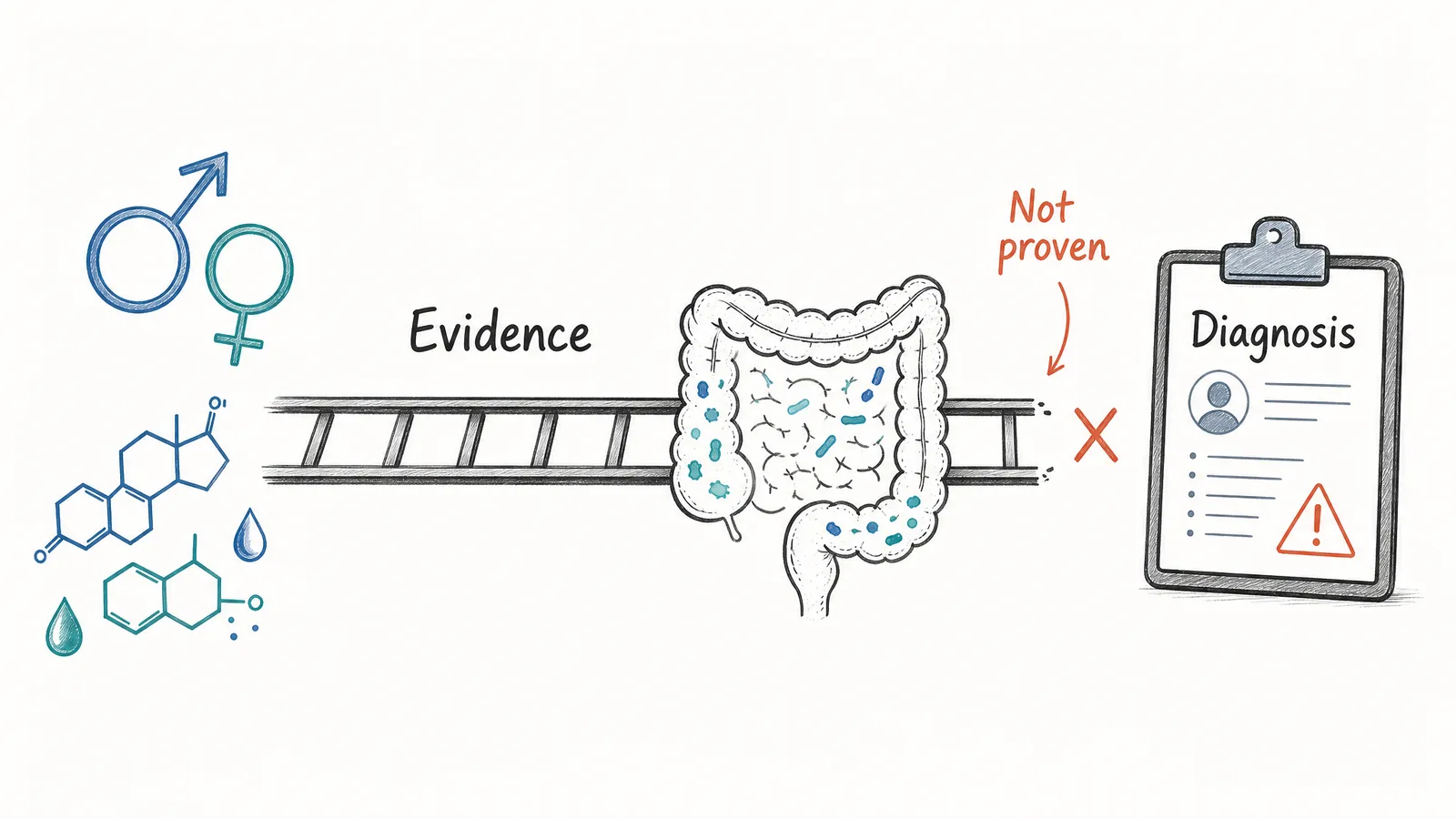
Short answer: Male and female gut microbiomes can differ, but the differences are usually modest, population-dependent, and shaped by age, menopause, diet, medications, body composition, and disease context. Sex is an important research variable. It is not enough by itself to diagnose gut problems or generate a precise personal nutrition plan.
Are male and female gut microbiomes different?
Several studies report sex-associated microbial features, but results are not perfectly consistent. Large cohorts suggest that models can sometimes distinguish sex or menopausal status from microbiome data, yet performance is modest. That means the signal is real enough to study, not strong enough to treat as a personal diagnostic shortcut.
Evidence summary
- Sex-associated gut microbiome patterns have been reported in humans and animal models.
- Effects are influenced by age, menopause, hormones, diet, medications, and population background.
- Some findings are inconsistent across cohorts.
- Group differences do not prove what one individual should eat or supplement.
- Microbiome tests should not use sex alone as a clinical diagnosis.
What role do hormones play?
Estrogens, progesterone, testosterone, immune tone, and bile-acid metabolism can interact with microbial ecology. Menopause is especially important because it changes hormone exposure, medication patterns, and cardiometabolic risk. Still, hormone-microbiome links are complex and rarely map to one simple bacterium.
What marketing gets wrong
Marketing can turn cautious group-level research into a promise of sex-specific optimization. That jumps ahead of the evidence. A report may compare your sample with reference groups, but it cannot prove that a difference is harmful or that a supplement will correct it.
What should readers do?
The best-supported basics are not sex-exclusive: diverse fiber sources, adequate protein, sleep, physical activity, prudent alcohol intake, and appropriate medical care. Sex and life stage matter most when they change clinical context, such as pregnancy, menopause, PCOS, endometriosis, IBD, or medication use.
When to see a clinician
Seek care for GI bleeding, weight loss, persistent diarrhea, severe pain, anemia, suspected IBD or celiac disease, or symptoms during pregnancy. Hormonal stage may help the clinician interpret symptoms, but it does not replace targeted evaluation.
Bottom line
Sex is a valuable biological variable in microbiome science. It is not a stand-alone gut-health algorithm.
Why group differences are not personal instructions
A common mistake is confusing a group association with an individual recommendation. If a study finds that one taxon is more common in one sex in one cohort, that does not mean every person of that sex should try to increase or decrease that organism. Microbiome composition is influenced by diet, stool consistency, age, medications, geography, body size, immune status, and disease. Two women can be more different from each other than one woman and one man. Two men can have completely different microbial patterns if their diets, medications, and health histories differ.
What about the estrobolome?
The estrobolome is a useful concept for microbes and enzymes involved in estrogen metabolism. It is scientifically interesting, especially for menopause, metabolic health, and hormone-related disease research. It is not yet a consumer diagnosis. A test should not imply that a single bacterial pattern can precisely explain estrogen symptoms, fertility, mood, weight, or cancer risk without clinical context.
Where sex can matter clinically
Sex and life stage can still be important. Pregnancy, menopause, endometriosis, PCOS, IBD, autoimmune disease, eating patterns, iron status, and medication use can all affect digestive symptoms or microbiome interpretation. In those settings, sex is one part of context, not the whole answer. The clinician still needs symptoms, history, exam findings, labs, and targeted tests when appropriate.
What should a good microbiome report say?
A careful report should state uncertainty. It can compare findings with reference groups, explain methods, and note that sex-associated patterns are not diagnostic. It should avoid claiming that male or female microbiomes require fixed supplement stacks. It should also avoid using hormones as a simple explanation for every symptom. Readers deserve nuance: biology matters, but current microbiome science is not a binary blueprint.
How to read claims like this safely
A safer article separates three layers. The first layer is mechanism: what could happen biologically. The second layer is association: what has been observed in people or cohorts. The third layer is clinical action: what a patient should do differently. Many gut-health claims are plausible at the first layer, interesting at the second layer, and still unproven at the third. That does not make the science fake. It means the conclusion must be smaller than the sales pitch.
For readers, the practical question is not whether the microbiome matters. It does. The question is whether a claim has enough evidence to change care, justify a purchase, or delay medical evaluation. If the answer relies mainly on broad microbiome language, weak biomarkers, or personalized recommendations without validation, caution is appropriate. Good science should make uncertainty clearer, not hide it.
What a more evidence-based recommendation looks like
A responsible recommendation states who it applies to, what outcome it targets, how strong the evidence is, and when it should not be used. It also distinguishes general wellness advice from diagnosis. For example, increasing plant-food diversity gradually is different from claiming that a report can identify the exact cause of symptoms. Seeing a clinician for red flags is different from saying every symptom needs advanced testing. The most useful microbiome guidance is specific, modest, and connected to outcomes people can actually monitor.
One final check is proportionality. A claim should not become stronger just because it mentions sequencing, artificial intelligence, or personalization. The evidence standard should rise when the advice becomes more specific, more expensive, or more likely to affect medical decisions. That is the reader-protective standard used here.
Evidence notes
- Machine learning analysis of sex and menopausal differences in the gut microbiome in the HELIUS study. npj Biofilms and Microbiomes. 10.1038/s41522-024-00628-z
- A genome-wide association study for gut metagenome in Chinese adults illuminates complex diseases. Cell Discovery. 10.1038/s41421-020-00239-w
- Individual diet has sex-dependent effects on vertebrate gut microbiota. Nature Communications. 10.1038/ncomms5500
- High-fat diet and estrogen modulate the gut microbiota in a sex-dependent manner in mice. Communications Biology. 10.1038/s42003-022-04406-5
- Sex differences in lipid metabolism are affected by presence of the gut microbiota. Scientific Reports. 10.1038/s41598-018-31695-w
This article is educational and does not diagnose, treat, or replace care from a qualified clinician.