Evidence-based response
Liver-Healthy Fungus: How Gut Mycobiome Protects Your Liver, What Science Actually Says
Gut fungi may influence liver inflammation through the gut-liver axis, but consumer stool tests cannot prove liver protection or personalize liver-prevention advice.
By Sandra McKenzy, Pharmacist · 2026-05-25
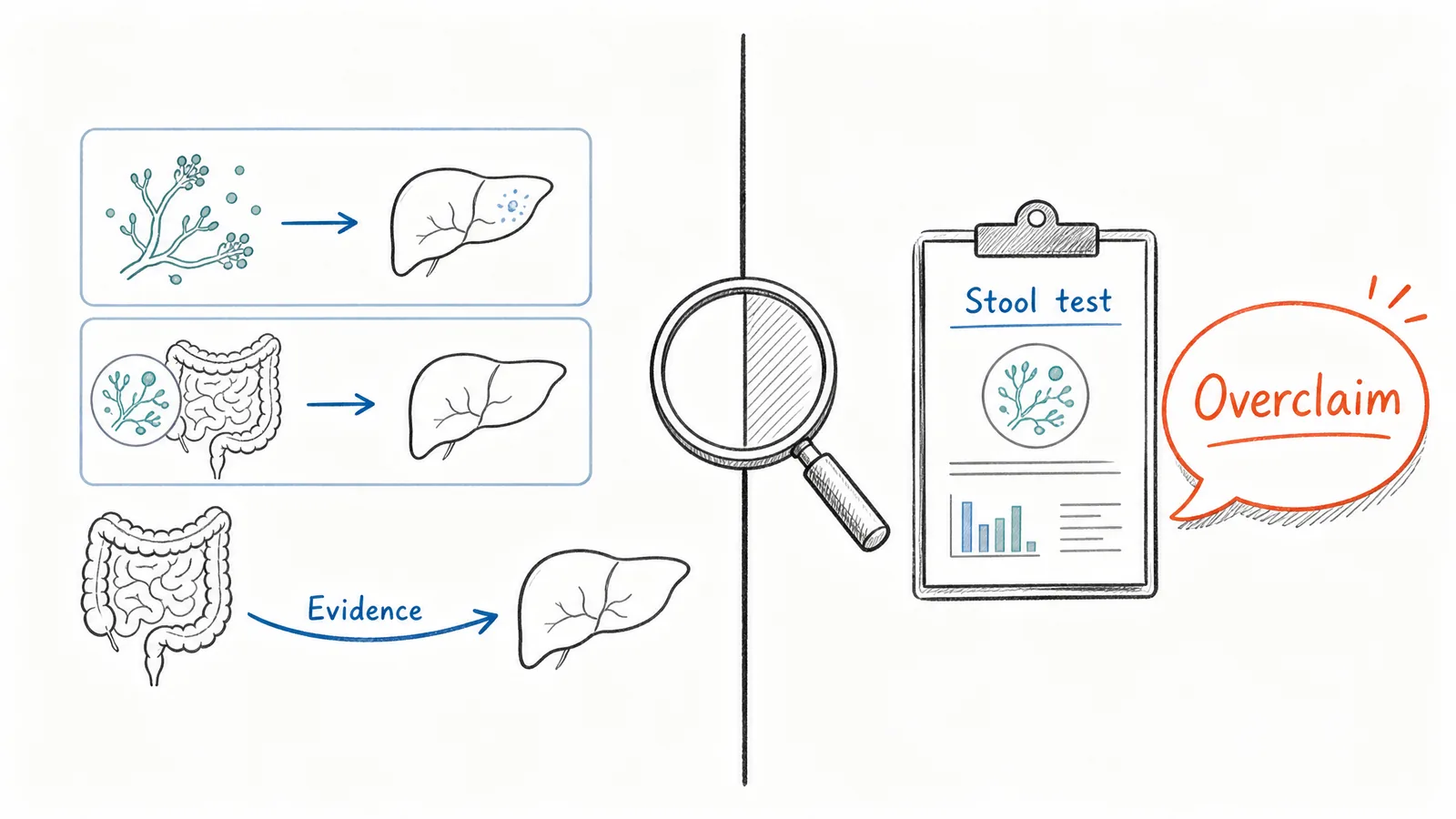
Short answer: The gut mycobiome probably matters for liver health, but the evidence does not show that a consumer microbiome test can prove your fungi are “protecting” your liver or generate personalized liver-prevention advice. Research links fungal imbalance, especially Candida expansion and fungal products crossing a leaky gut barrier, with chronic liver disease. That is not the same as a validated screening tool or treatment plan.
Can gut fungi affect the liver?
Yes, plausibly. The gut and liver are connected by the portal vein, which carries nutrients, microbial metabolites, and inflammatory signals from the intestine to the liver. Most gut-liver research has focused on bacteria, but fungi are part of the same ecosystem. Reviews of chronic liver disease now describe fungal dysbiosis in alcohol-related liver disease, metabolic dysfunction-associated steatotic liver disease, cirrhosis, and primary sclerosing cholangitis.
The strongest clinical message is cautious: fungi may contribute to liver inflammation when the gut barrier is disturbed and fungal components reach immune cells. This helps explain why altered Candida, Saccharomyces, and other fungal patterns are studied in liver disease. It does not mean every person needs a fungal stool profile, or that a favorable-looking profile proves liver protection.
What does the evidence actually show?
Several lines of evidence support a mycobiome-liver connection. In chronic liver disease, researchers have reported altered fungal diversity, Candida expansion, and immune responses against fungal organisms. In NAFLD and NASH, fecal mycobiome studies have associated more advanced disease with fungal shifts, including Candida-related signals. Experimental work also suggests that fungal products can aggravate liver inflammation through immune pathways such as Dectin-1 and CARD9.
A newer Nature summary also highlighted a mouse study where a gut fungus produced a metabolite that protected against metabolic disease. That is scientifically interesting, but it is not a consumer instruction. Mouse data can identify mechanisms. It cannot by itself tell a healthy person that a specific fungus in a stool test protects the liver.
Evidence summary
- Gut fungi are biologically connected to the liver through the gut-liver axis.
- Candida expansion and fungal immune signals are associated with several liver disease states.
- Some mechanisms are supported by animal and translational studies, not routine clinical decision tools.
- Consumer stool testing is not validated to diagnose liver disease or predict liver protection from fungi.
- Diet, alcohol, weight, viral hepatitis risk, medication exposure, and metabolic health remain more clinically established liver-health levers.
What does marketing get wrong?
The overreach begins when “fungi influence the liver” becomes “your stool test can reveal how to protect your liver.” Those are different claims. A stool test may describe detectable organisms in one sample. It usually cannot measure portal-vein exposure, liver inflammation, fibrosis, alcohol-related injury, insulin resistance, or whether a fungal pattern is a cause rather than a consequence of disease.
Diet advice such as eating more fiber, reducing excess sugar, limiting ultra-processed foods, sleeping well, and avoiding unnecessary antibiotics is broadly reasonable for gut and metabolic health. But these recommendations do not become personalized liver-fungal therapy because a test report names Candida, Saccharomyces, or another fungus.
Can you support the gut mycobiome for liver health?
You can support general gut and liver health with low-risk, evidence-aligned habits: limit alcohol, maintain a healthy waist circumference, treat diabetes or insulin resistance when present, eat a fiber-rich dietary pattern, and discuss abnormal liver enzymes with a clinician. These steps have stronger clinical grounding than trying to “optimize” specific fungi.
Fermented foods, prebiotic fibers, and diverse plant foods may help the broader microbiome. The exact fungal response varies by person, baseline microbiome, medication history, and disease state. For liver outcomes, there is not yet a proven diet protocol that safely manipulates the mycobiome in a predictable way for the average consumer.
When should liver symptoms be checked clinically?
Do not use a microbiome test as a substitute for medical evaluation. Seek care for yellowing skin or eyes, dark urine, pale stools, persistent right upper abdominal pain, unexplained swelling, vomiting blood, confusion, severe fatigue, or abnormal liver blood tests. People with heavy alcohol use, obesity, diabetes, viral hepatitis risk, or known fatty liver need standard clinical follow-up, not stool-test reassurance.
Bottom line
The gut mycobiome is a real and promising liver-research field. The cautious interpretation is that fungal imbalance may participate in liver inflammation and disease progression, especially when the gut barrier is compromised. The unsupported leap is claiming that consumer mycobiome testing can prove liver protection or personalize prevention. For now, fungal stool data should be treated as hypothesis-generating, not diagnostic or prescriptive.
Educational disclaimer: This article is for general education and does not diagnose, treat, or prevent liver disease. If you have liver symptoms or abnormal blood tests, speak with a qualified clinician.
Evidence notes and sources
- Yang et al. (2026). The role and possible mechanism of intestinal fungi in the progression of chronic liver diseases. npj Biofilms and Microbiomes. https://doi.org/10.1038/s41522-026-00961-5
- Albillos et al. (2020). Gut microbiota and human NAFLD: disentangling microbial signatures from metabolic disorders. Nature Reviews Gastroenterology & Hepatology. https://doi.org/10.1038/s41575-020-0269-9
- Demir et al. (2022). The fecal mycobiome in non-alcoholic fatty liver disease. Journal of Hepatology. https://doi.org/10.1016/j.jhep.2021.11.024
- Yang et al. (2024). Gut mycobiome alterations and implications for liver diseases. PLOS Pathogens. https://doi.org/10.1371/journal.ppat.1012377
- Nature Reviews Microbiology (2025). A gut fungus protects the liver. https://doi.org/10.1038/s41579-025-01194-7