Evidence-based response
Latest Breakthroughs in Gut Microbiome Research: What Science Actually Says
Gut microbiome research is advancing quickly, but consumer claims about prediction, prevention, and personalized advice often go beyond what is clinically validated.
By Sandra McKenzy, Pharmacist · 2026-06-03
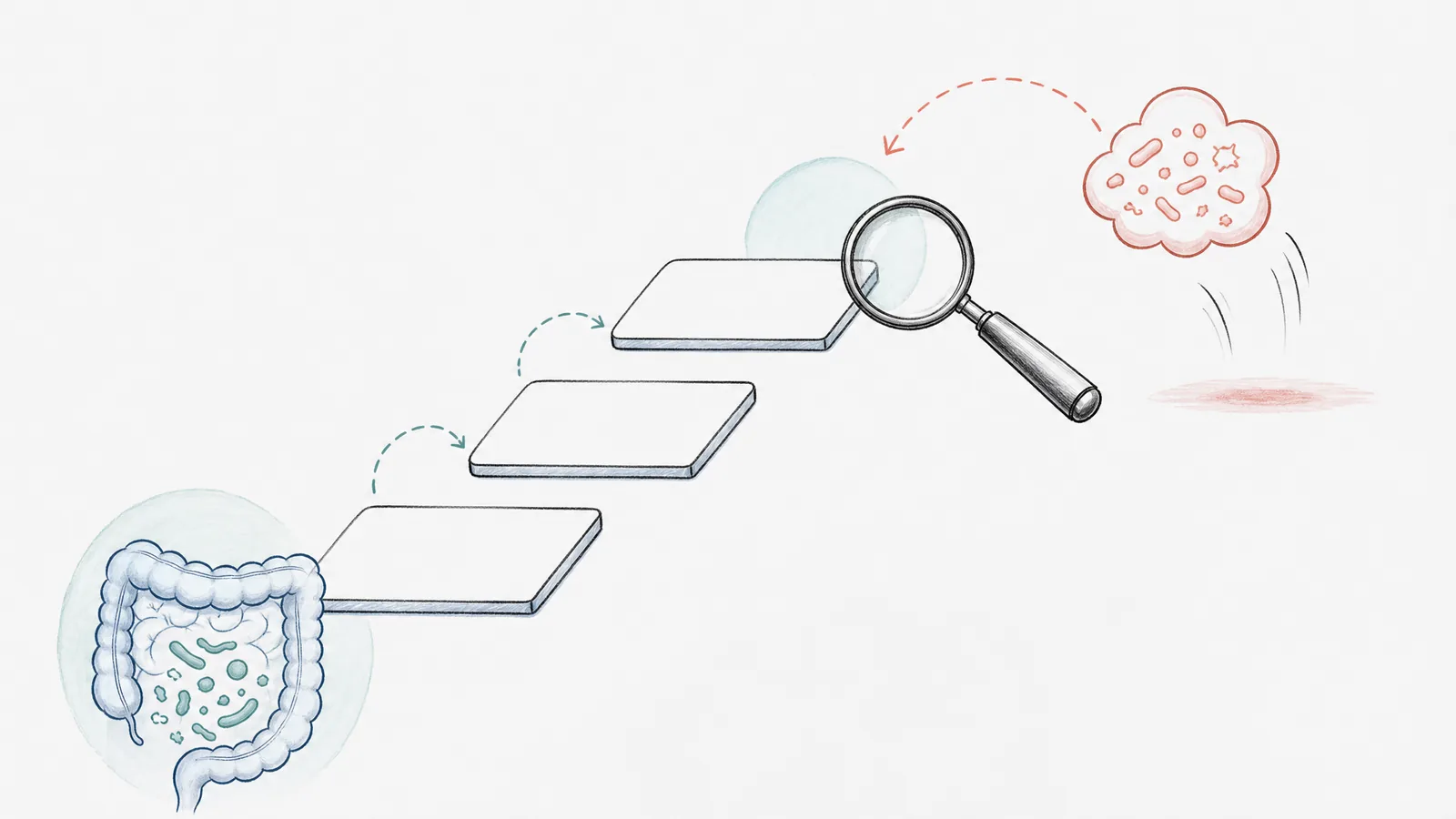
Short answer: The latest gut microbiome breakthroughs are real, but their clinical meaning is narrower than many wellness articles imply. Sequencing, multi-omics, artificial intelligence, and personalized nutrition research are improving science, yet most consumer microbiome results still cannot predict disease years in advance or prescribe a precise prevention plan for an individual.
What are the real breakthroughs in gut microbiome research?
The strongest breakthroughs are technical and translational. Researchers can now measure microbial DNA, metabolites, diet interactions, and host factors at a scale that was impossible a decade ago. That is changing how scientists study inflammatory bowel disease, cancer therapy response, nutrition, infections, and metabolic health. It does not mean that a single home report can read a person’s future health trajectory.
Evidence summary
- Microbiome science is moving toward clinical translation, but routine consumer interpretation remains limited.
- Personalized nutrition is plausible because diet responses differ between people, yet validated advice still requires outcome data.
- Disease prediction models can work in research cohorts, but reference ranges vary by population and method.
- Sequencing finds associations and functional potential; it does not automatically prove causation.
- The safest use of new microbiome information is as context, not as a stand-alone diagnosis.
Can the microbiome predict future disease risk?
Sometimes it can contribute to risk models, especially in research settings where samples, populations, and outcomes are tightly defined. The problem is portability. A model trained in one geography, age group, diet pattern, or sequencing pipeline may not perform the same way elsewhere. A prediction that looks impressive in a publication can become much less reliable when sold as a universal health score.
Can sequencing personalize diet and supplements?
Microbiome-informed nutrition is one of the most exciting areas. Studies support the idea that people respond differently to foods and that microbial metabolism can influence those responses. The careful conclusion is not that every supplement recommendation is proven. It is that microbiome data may become one input among diet history, symptoms, medications, labs, and clinical goals.
What marketing gets wrong
Marketing often compresses a long scientific chain into one promise: sequence the stool, identify the problem, receive the solution. Current evidence does not support that level of certainty for most healthy consumers. Breakthroughs are not the same as validated medical workflows.
When should you see a clinician?
Seek clinical care for blood in stool, unexplained weight loss, fever, persistent diarrhea, severe pain, anemia, nocturnal symptoms, or symptoms after antibiotics or travel. A microbiome report should not delay calprotectin, stool pathogen testing, colonoscopy referral, or other targeted evaluation when red flags are present.
Bottom line
The microbiome is a serious scientific frontier. The reader-protective message is simple: welcome the breakthroughs, but ask whether a claim has moved from association to validated clinical action before changing care.
How should readers interpret new microbiome breakthroughs?
The safest way to read a breakthrough headline is to ask three questions. Was the finding observed in humans, or only in cells, animals, or a small exploratory cohort? Was the result replicated in an independent group? Did the study test a clinical outcome that matters to patients, such as fewer symptoms, lower inflammation, fewer infections, or better response to treatment? Many exciting microbiome discoveries answer the first question but not the second or third. That does not make them useless. It means they are early signals, not instructions.
This distinction is especially important for consumer testing. A new paper may show that a microbial pathway is associated with a disease, a medication response, or a dietary metabolite. That does not mean a home stool report can measure that pathway accurately enough to guide personal treatment. The analytic pipeline, reference population, sample handling, medication history, and diet record all change interpretation. A responsible article should explain those layers before making a recommendation.
What would make a breakthrough clinically actionable?
For a microbiome finding to become clinically useful, it usually needs a validated test, a defined decision threshold, and evidence that acting on the result improves outcomes. A biomarker that separates groups in a research dataset is not automatically a medical test. A microbial signature linked with risk is not automatically prevention. A diet response model is not automatically a prescription. Clinical usefulness depends on whether the result changes a decision in a way that helps more than it harms.
That is why the strongest current claims are modest. Microbiome research can help explain mechanisms, generate hypotheses, stratify patients in research, and identify promising therapies such as defined live biotherapeutics in narrow settings. It is not yet a general-purpose health oracle. Readers should be skeptical of articles that turn broad research momentum into personalized certainty.
How to use this information safely
If you are interested in microbiome science, follow the evidence without turning every association into a self-treatment plan. Diet quality, fiber variety, sleep, medication review, and appropriate clinical testing remain more actionable than chasing a single bacterial score. If symptoms are persistent, severe, or new, the next useful step is usually a clinician-guided evaluation, not another broad microbiome report. The real breakthrough is not a promise that every stool sample contains a complete answer. It is a more careful understanding of when microbial data can help and when it can mislead.
What a cautious evidence-based answer looks like
A cautious answer does not dismiss microbiome science. It separates established biology from clinical promises. Established biology can say that microbial communities interact with diet, immune signaling, metabolites, medications, and intestinal barrier function. Clinical promises need more. They need studies showing that a specific test or intervention improves a specific outcome for a defined group of people. Without that bridge, the correct wording is possible, plausible, associated, or still being studied.
For readers, this wording is not academic nitpicking. It protects decisions. If a claim is only plausible, it may still support general habits such as eating enough fiber, avoiding unnecessary antibiotics, sleeping well, and discussing persistent symptoms with a clinician. It should not be used to self-diagnose disease, stop prescribed medication, start antimicrobial protocols, or ignore red flags.
Evidence notes
- Diet-microbiota interactions and personalized nutrition. Nature Reviews Microbiology. 10.1038/s41579-019-0256-8
- Utilization of the microbiome in personalized medicine. Nature Reviews Microbiology. 10.1038/s41579-023-00998-9
- Clinical translation of microbiome research. Nature Medicine. 10.1038/s41591-025-03615-9
- Gut microbiome-mediated transformation of dietary phytonutrients is associated with health outcomes. Nature Microbiology. 10.1038/s41564-025-02197-z
- Gut microbiome as a clinical tool in gastrointestinal disease management: are we there yet?. Nature Reviews Gastroenterology & Hepatology. 10.1038/nrgastro.2017.29
- Translating microbiota analysis for clinical applications. Nature Microbiology. 10.1038/s44222-024-00168-3
This article is educational and does not diagnose, treat, or replace care from a qualified clinician.