Evidence-based response
Unlock Gut & Skin Health with Lactobacillus Reuteri Benefits: What Science Actually Says
Lactobacillus reuteri has strain-specific evidence, but it is not a universal gut, skin, and oral-health upgrade.
By Sandra McKenzy, Pharmacist · 2026-05-29
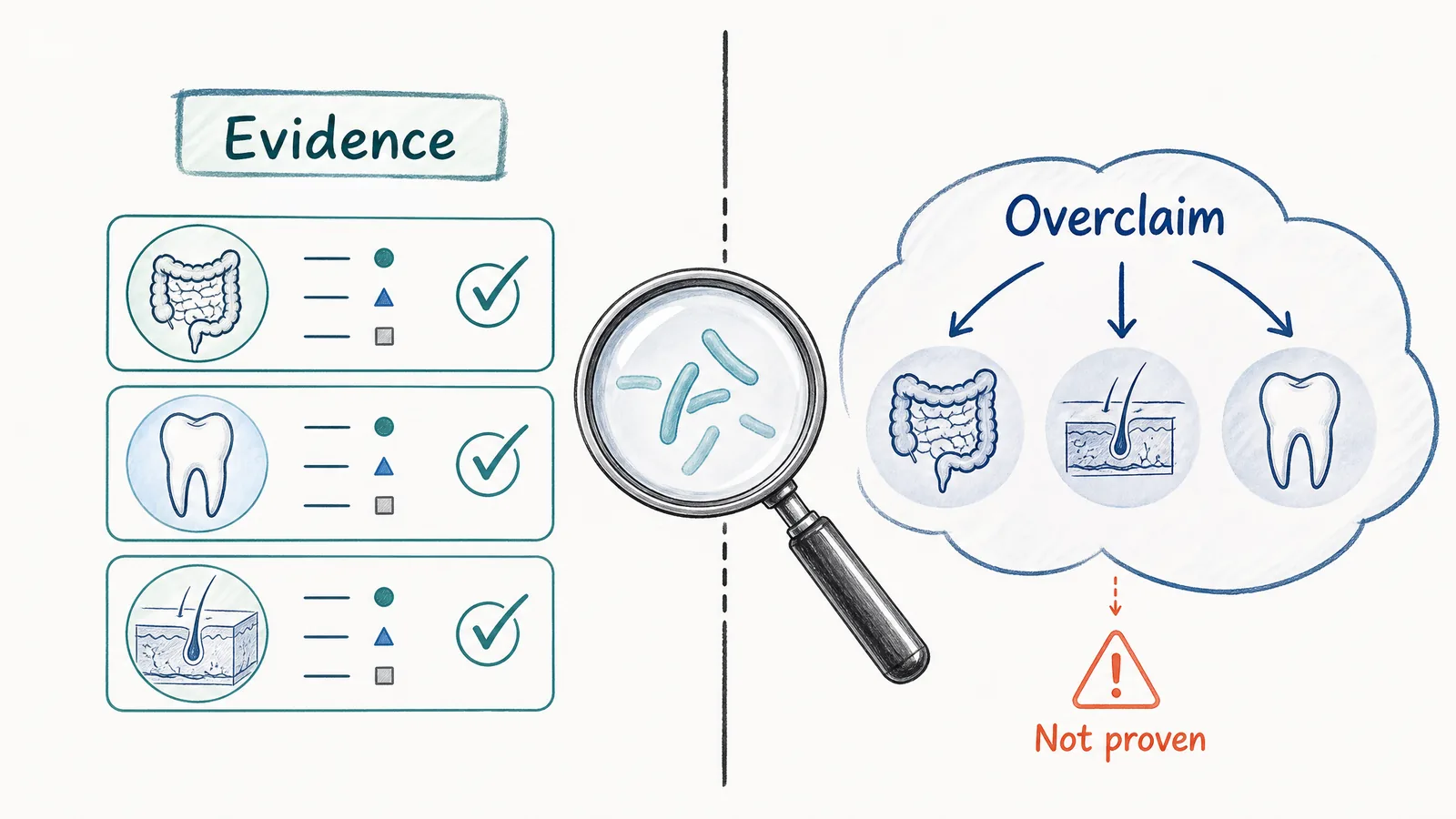
Short answer: Lactobacillus reuteri is a real probiotic species with interesting strain-specific evidence, especially for selected digestive and oral-health outcomes. It is not proven to broadly “unlock” gut, skin, and oral health for everyone, and a consumer microbiome test cannot reliably choose the best probiotic supplement for a person’s whole body health.
What is Lactobacillus reuteri?
Lactobacillus reuteri, now often classified as Limosilactobacillus reuteri, is a bacterial species found in some humans and in certain probiotic products. Some strains can produce antimicrobial compounds such as reuterin and can interact with immune and barrier pathways. That biology is real, but probiotic evidence is not judged at the species level alone.
The key clinical point is strain specificity. A study of L. reuteri DSM 17938 in infant colic does not prove that every L. reuteri capsule improves adult bloating, acne, gum disease, or nutrient absorption. The product strain, dose, delivery method, population, and outcome all matter.
Can Lactobacillus reuteri improve gut health?
The best-supported gut claims are narrower than many wellness articles suggest. L. reuteri DSM 17938 has been studied for infantile colic, with meta-analysis suggesting benefit mainly in breastfed infants. It has also been studied in pediatric functional abdominal pain, where reviews suggest modest symptom improvement but not a universal recommendation for all digestive complaints.
That does not mean L. reuteri restores a “balanced microbiome” in a broad, measurable way. Bloating, constipation, diarrhea, and abdominal pain can come from IBS, infection, inflammatory bowel disease, celiac disease, medication effects, pelvic floor dysfunction, food intolerance, or other causes. A probiotic may be reasonable in some low-risk contexts, but it is not a diagnostic shortcut.
Does Lactobacillus reuteri help oral health?
Oral-health evidence is plausible and more condition-specific. Reviews of probiotic trials report that some probiotic lozenges, including L. reuteri preparations, may improve plaque, gingival inflammation, or periodontal measures when used alongside normal dental care. The signal is not the same as replacing brushing, flossing, professional cleaning, fluoride, or periodontal treatment.
Claims about “fighting bad bacteria” are partly grounded in laboratory and clinical observations, but they can become misleading when they imply a simple mouth disinfectant effect. The oral microbiome is an ecosystem. The goal is not to sterilize it, but to support health while treating dental disease with validated care.
Can Lactobacillus reuteri improve skin or acne?
The gut-skin axis is a legitimate research area, yet direct evidence for oral L. reuteri as a skin-clearing supplement remains limited. Skin microbiome reviews describe mixed probiotic and prebiotic findings across atopic dermatitis, acne, and other inflammatory skin conditions. A small proof-of-concept study of topical L. reuteri DSM 17938 in adults with atopic dermatitis is interesting, but it is not proof that taking any L. reuteri supplement clears acne or reduces redness through gut changes.
What does the evidence actually support?
- Probiotic benefits should be evaluated by strain, dose, population, and clinical outcome.
- L. reuteri DSM 17938 has some evidence for infant colic and selected pediatric abdominal pain outcomes.
- Oral-health probiotic data are promising, but mostly adjunctive to dental care, not a replacement for it.
- Skin-health claims are biologically plausible but not proven as broad oral-supplement benefits.
- Consumer microbiome tests cannot reliably prescribe the best L. reuteri supplement for gut, skin, and oral health.
What marketing often gets wrong
InnerBuddies and similar articles often collapse several separate ideas into one simple wellness story: beneficial species, balanced microbiome, better digestion, healthier gums, clearer skin, and personalized supplement advice. Each step needs its own evidence. A species being beneficial in one setting does not prove that more of it is always better, or that a stool profile can identify the right product.
A safer way to read probiotic claims is to ask four questions: which strain, tested in whom, for which outcome, and compared with what? If those answers are missing, the claim is more marketing than clinical guidance.
When should symptoms be checked by a clinician?
Seek medical or dental care for blood in stool, unexplained weight loss, fever, persistent diarrhea, severe abdominal pain, anemia, night-time symptoms, immune suppression, worsening eczema, painful acne, bleeding gums, loose teeth, oral swelling, or persistent bad breath. A probiotic should not delay diagnosis or treatment.
Bottom line
Lactobacillus reuteri is scientifically interesting and may be useful in specific contexts. The evidence does not support treating it as a universal gut-skin-mouth upgrade or as something a consumer microbiome test can personalize with high confidence. Choose probiotic products by strain-specific human evidence, not by broad species-level promises.
Evidence notes
- Hill et al. (2014). International Scientific Association for Probiotics and Prebiotics consensus statement on the scope and appropriate use of the term probiotic. Nature Reviews Gastroenterology & Hepatology. 10.1038/nrgastro.2014.66
- Sung et al. (2018). Lactobacillus reuteri to Treat Infant Colic: A Meta-analysis. Pediatrics. 10.1542/peds.2017-1811
- Żółkiewicz et al. (2021). Use of probiotics in the treatment of functional abdominal pain in children: a systematic review and meta-analysis. European Journal of Pediatrics. 10.1007/s00431-020-03809-y
- Vives-Soler and Chimenos-Küstner (2021). Are probiotics a possible treatment of periodontitis? British Dental Journal. 10.1038/s41415-021-3624-5
- Scribante et al. (2023). The Benefits of Probiotics on Oral Health. Journal of Clinical Medicine. 10.3390/jcm12206591
- Ellis et al. (2021). Mechanisms of microbe-immune system dialogue within the skin. Experimental & Molecular Medicine. 10.1038/s41435-021-00133-9
- Butler et al. (2020). Lactobacillus reuteri DSM 17938 as a Novel Topical Cosmetic Ingredient. Microorganisms. 10.3390/microorganisms8071026
This article is educational and does not diagnose, treat, or replace care from a qualified clinician, dentist, or dermatologist.