Evidence-based response
How to Test Your Gut Flora in 2026: Science-Based Methods and Limits
Stool microbiome tests can describe microbial DNA patterns, diversity and possible functional clues. They can be useful for education and research context, but they usually cannot diagnose digestive disease, identify the root cause of symptoms, or prescribe a personalized probiotic plan without clin
By Sandra McKenzy, Pharmacist · 2026-07-25
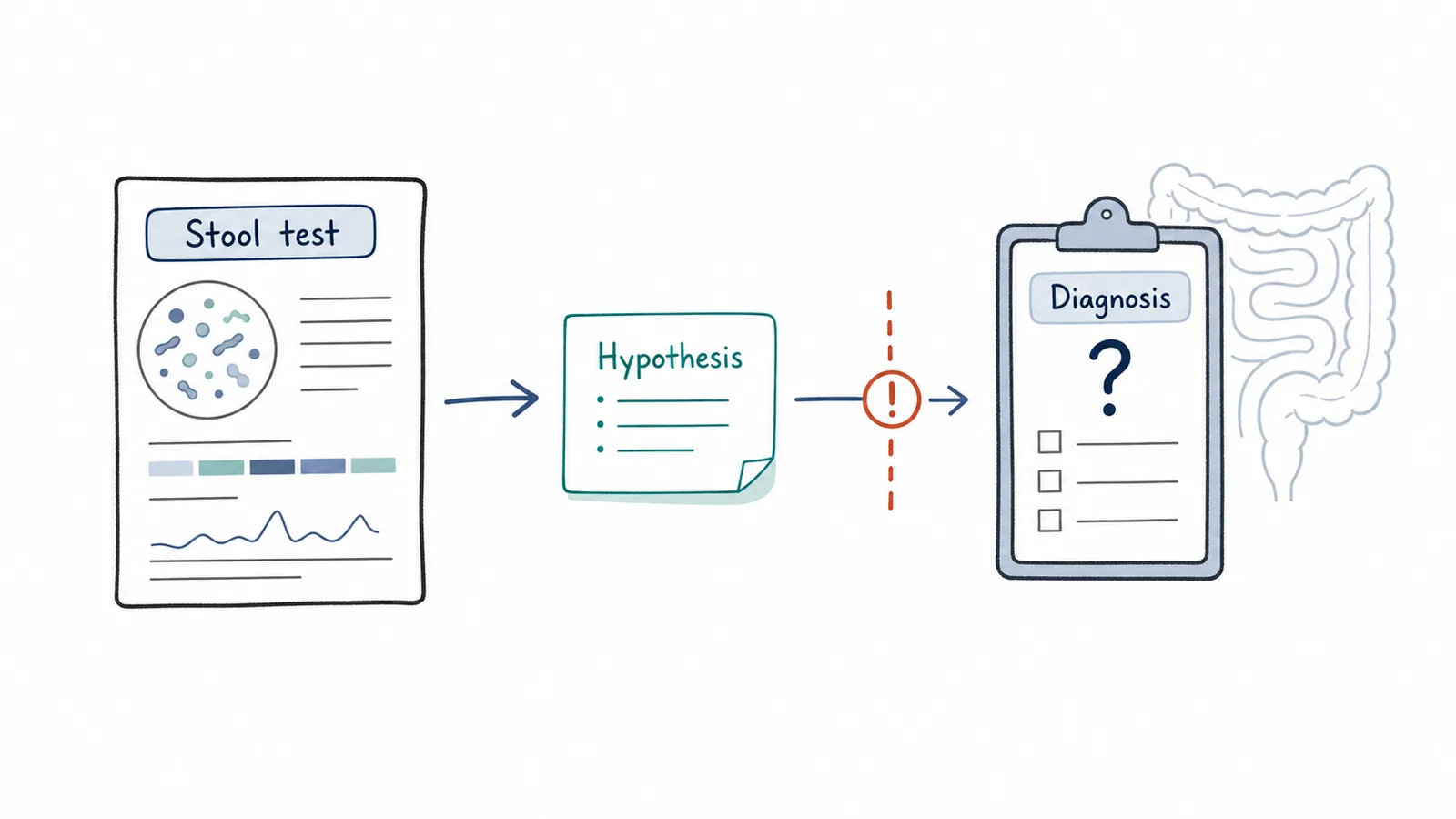
Short answer: Stool microbiome tests can describe microbial DNA patterns, diversity and possible functional clues. They can be useful for education and research context, but they usually cannot diagnose digestive disease, identify the root cause of symptoms, or prescribe a personalized probiotic plan without clinical evidence and medical context.
Modern gut flora testing is real laboratory science. The problem is not the existence of stool sequencing, 16S profiling or shotgun metagenomics. The problem is the leap from a report about microbial DNA to confident claims about diagnosis, root causes and personalized treatment. That leap is often bigger than the evidence allows.
How Do You Test Your Gut Flora in 2026?
The usual consumer route is a stool sample collected at home, sent to a laboratory and analyzed with DNA-based methods. The report may describe bacterial groups, diversity, relative abundance, predicted functions or diet-related suggestions. Some clinical laboratories also use stool tests for specific medical questions, but those tests are not the same as general wellness microbiome dashboards.
The source article correctly explains that stool samples are common and that different laboratory methods can produce different outputs. That is a useful starting point. The safer evidence-based answer adds a boundary: a gut flora test describes what was detected in one sample under one method. It does not directly see the small intestine, gut lining, immune activity, motility, pain signaling or all possible causes of symptoms.
A good report should tell you what method was used, what organisms or genes were measured, how the sample was stored, what database and pipeline interpreted it, and what the result can and cannot mean. Without those details, a score can feel precise while hiding a lot of uncertainty.
Evidence summary
Evidence summary
- Stool microbiome tests can profile microbial DNA in a sample, but stool is not a complete map of every gut site or disease process.
- 16S sequencing gives broad bacterial community information, while shotgun metagenomics can add species-level and functional clues, with method and pipeline limits.
- Microbiome patterns are associated with health and disease, but association is not the same as a diagnosis for one person.
- Research translation is improving, yet routine consumer reports still need cautious interpretation, standardization and clinical validation.
- Symptoms, medication history, diet, inflammatory markers and conventional medical tests remain essential when digestive symptoms persist or red flags appear.
What Is the Difference Between 16S and Shotgun Metagenomics?
16S rRNA sequencing targets a bacterial marker gene. It is widely used because it is relatively affordable and can show broad bacterial community patterns. Its weakness is resolution. It may not distinguish closely related species well, it usually tells less about microbial functions, and results can vary by primer choice, database and analysis pipeline.
Shotgun metagenomics sequences a broader set of genetic material from the sample. It can provide more detailed taxonomic information and can infer functional genes or pathways. Scientific Reports work on shotgun sequencing notes that this approach can reduce some technical variation and add functional information, but it still requires careful design and interpretation. More data does not automatically mean a consumer can self-diagnose.
Culture-based methods are different again. They try to grow selected organisms in the laboratory. Culture can be valuable for targeted infection questions, but many gut microbes are difficult to culture and the method is not a full ecosystem survey. No single method is best for every purpose.
Can a Gut Flora Test Diagnose Digestive Disease?
For most routine consumer use, no. A microbiome profile can show patterns that may be interesting, and some patterns are being studied as biomarkers. But a wellness stool report should not be used to diagnose irritable bowel syndrome, inflammatory bowel disease, celiac disease, SIBO, food intolerance, cancer, infection or immune dysfunction.
Nature Reviews Gastroenterology and Hepatology has repeatedly warned that microbiome research has moved faster than routine clinical translation. The field is powerful, but many findings are still associations, population-level models or research tools. Clinical diagnosis usually needs symptoms, history, examination, medication review, blood or stool markers, imaging, endoscopy or validated disease-specific tests.
This matters because digestive symptoms overlap. Bloating, pain, diarrhea, constipation, fatigue or food reactions can arise from many causes. A microbiome dashboard may appear to explain them, but that appearance can be misleading if the report has not been validated for that exact clinical decision.
Can Testing Tell You Which Probiotic or Diet You Need?
Sometimes a report can support general education about fiber, fermented foods, dietary diversity or broad microbiome concepts. That is different from proving that one person needs a specific probiotic strain, supplement stack or restrictive diet. Personalized nutrition based on microbiome data is an active research area, not a universal consumer-ready prescription system.
The cautious wording is that results may generate hypotheses. For example, a low reported abundance of fiber-associated microbes might encourage a discussion about fiber intake if the person tolerates fiber. It does not prove that a supplement is required, that symptoms are caused by one missing organism or that a recommended product will treat disease.
What Do Microbiome Scores and Diversity Numbers Mean?
Diversity metrics summarize patterns in a sample. They can be useful in research, where groups are compared under controlled methods. At the individual consumer level, diversity is not a universal health grade. Age, geography, diet, medication, recent illness, antibiotic exposure, stool consistency and laboratory method can all influence the result.
A 2024 Nature Communications wellness-index paper illustrates both promise and caution. Microbiome profiles can improve health-status prediction models, but even advanced models include uncertainty and do not make every aspect of health explainable solely by gut microbes. A good clinical interpretation must leave room for uncertainty rather than turning every value into a lifestyle command.
What Marketing Gets Wrong About Gut Flora Testing
Marketing often blends three things that should stay separate: education, risk prediction and diagnosis. Education is reasonable. Risk prediction may be possible for selected questions when a model is validated. Diagnosis requires a different standard. A consumer report should not blur these categories.
Another problem is calling every imbalance dysbiosis, as if dysbiosis were a single disease. Dysbiosis means a departure from a chosen reference pattern. It does not identify the cause, location, severity or treatment. It also does not prove that the microbiome is the primary driver of symptoms.
A third problem is underplaying method variation. Different providers can use different extraction methods, sequencing depth, databases and statistical pipelines. That means two reports from the same sample may not fully agree. If a company makes strong claims, it should show validation data for that exact claim, not just cite general microbiome science.
When Is Testing Potentially Useful?
Testing can be useful when the goal is learning, tracking broad patterns under the same method, joining a research program or discussing questions with a clinician who understands the limits. In specialized medical contexts, microbiome methods are also being studied and adopted for selected purposes, such as infection risk, colorectal cancer screening research, inflammatory disease biomarkers and microbiome-derived therapeutics.
The key word is selected. Clinical translation is uneven. Some applications are moving toward practice, while general wellness dashboards remain much less clinically proven. A responsible report should make that difference obvious.
When Should You See a Clinician Instead of Relying on a Test?
Seek medical care for blood in stool, black stools, persistent fever, severe or worsening abdominal pain, persistent vomiting, dehydration, fainting, unexplained weight loss, anemia, symptoms after travel, symptoms during pregnancy, symptoms in infants or older adults, or symptoms in someone who is immunocompromised. Also get help when diarrhea, constipation, pain or appetite changes persist or affect daily life.
These red flags can point to infection, inflammatory bowel disease, celiac disease, medication problems, bile acid disorders, endocrine disease, cancer or other conditions. A gut flora report cannot safely rule these out.
Bottom Line
The best way to test gut flora depends on the question. For broad microbiome profiling, stool-based 16S or shotgun sequencing can describe microbial DNA patterns. For clinical symptoms, the best test may not be a microbiome test at all. It may be a medical evaluation, targeted stool pathogen testing, inflammatory markers, celiac testing or another validated workup.
Use gut flora testing as context, not as a final answer. Ask what method was used, what the result has been validated to predict, what it cannot measure, and whether the recommendation is supported by human clinical evidence. That approach respects the science without letting the dashboard become a diagnosis.
Educational disclaimer: This article is for general science education. It does not diagnose, treat, prescribe supplements, interpret a personal test result or replace care from a licensed clinician.
Evidence Notes and Sources
- Gut microbiome as a clinical tool in gastrointestinal disease management: are we there yet? (2017). Nature Reviews Gastroenterology & Hepatology. DOI: 10.1038/nrgastro.2017.29
- Clinical translation of microbiome research (2025). Nature Medicine. DOI: 10.1038/s41591-025-03615-9
- Translating the gut microbiome: ready for the clinic? (2019). Nature Reviews Gastroenterology & Hepatology. DOI: 10.1038/s41575-019-0204-0
- Hype or hope? (2019). Nature Reviews Microbiology. DOI: 10.1038/s41579-019-0283-5
- Shallow shotgun sequencing reduces technical variation in microbiome analysis (2023). Scientific Reports. DOI: 10.1038/s41598-023-33489-1
- Gut Microbiome Wellness Index 2 enhances health status prediction from gut microbiome taxonomic profiles (2024). Nature Communications. DOI: 10.1038/s41467-024-51651-9
- On the robustness of inference of association with the gut microbiota in stool, rectal swab and mucosal tissue samples (2021). Scientific Reports. DOI: 10.1038/s41598-021-94205-5