Evidence-based response
How Can I Know if I Have Bacteria in My Gut? Evidence-Based Answer Without the Hype
Everyone has bacteria in the gut. Symptoms can suggest a digestive problem, but they do not prove harmful dysbiosis without clinical context and testing.
By Sandra McKenzy, Pharmacist · 2026-06-03
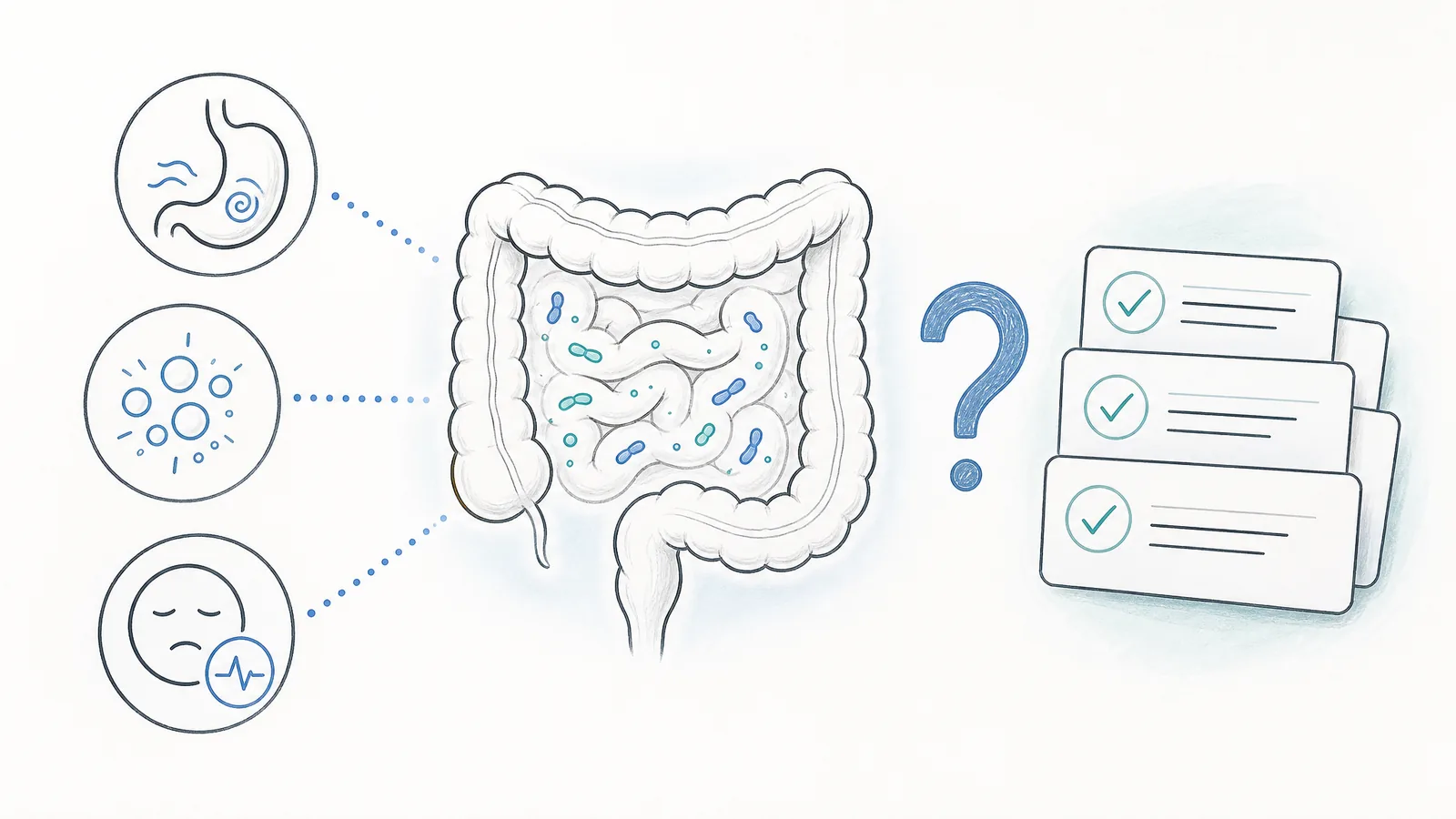
Short answer: You do have bacteria in your gut. Everyone does. The useful question is not whether bacteria are present, but whether symptoms, medical history, and targeted tests suggest infection, inflammation, small intestinal bacterial overgrowth, or another condition that needs clinical evaluation.
How can you know if you have bacteria in your gut?
A healthy gut contains bacteria, fungi, viruses, and other microbes. Bacteria are not automatically harmful. Many help with fermentation, barrier function, immune signaling, and metabolic by-products. A stool microbiome test can show bacterial DNA in a sample, but it cannot by itself prove that a symptom is caused by “bad bacteria”.
Evidence summary
- Bacteria in the gut are normal, not a disease finding.
- Symptoms such as bloating, diarrhea, constipation, fatigue, or skin flares are nonspecific.
- Dysbiosis is a research and clinical-association term, not a simple home diagnosis.
- Targeted clinical tests are needed when infection, inflammation, bleeding, malabsorption, or SIBO is suspected.
- Probiotics or supplements should not be treated as instant fixes for unexplained symptoms.
Do symptoms prove a gut bacteria imbalance?
No. Bloating, stool changes, abdominal pain, nausea, fatigue, mood changes, and skin symptoms can overlap with microbiome research findings, but they also occur in IBS, IBD, celiac disease, infections, medication effects, endocrine disorders, food intolerances, and many non-gut conditions. Symptoms are a reason to ask better questions, not proof of one microbial cause.
What tests are clinically different?
A stool pathogen test looks for defined infectious organisms. Calprotectin can support evaluation for intestinal inflammation. Breath tests may be used in selected cases for SIBO or carbohydrate malabsorption. Blood tests, celiac testing, imaging, endoscopy, or colonoscopy may be appropriate depending on the pattern. These are not interchangeable with a consumer microbiome diversity report.
What marketing gets wrong
The common mistake is turning normal microbial complexity into a simple good-versus-bad story. The gut is not sterile, and a chart of bacterial groups is not a diagnosis. Treating every uncomfortable symptom as dysbiosis can delay the real answer.
When should you see a clinician?
Seek care for bleeding, black stool, weight loss, fever, persistent or nocturnal diarrhea, severe pain, vomiting, anemia, dehydration, recent high-risk travel, immune suppression, or new persistent symptoms after age 50.
Bottom line
You know you have gut bacteria because a normal human gut contains them. The medical question is whether your symptoms require targeted evaluation and whether any microbiome information is clinically useful in that context.
Does everyone have bacteria in the gut?
Yes. In ordinary life, having bacteria in the gut is normal. The human intestine contains complex microbial communities that help process dietary fibers, produce metabolites, interact with the immune system, and occupy ecological niches that can make it harder for some pathogens to dominate. The question is not whether bacteria are present. The useful question is whether symptoms, risk factors, or test results suggest a specific medical problem.
This matters because marketing language sometimes treats bacteria as either good or bad in a simple way. Real microbiology is more contextual. A species may be harmless in one setting, beneficial in another, and problematic if it grows in the wrong location or in an immunocompromised person. A stool profile cannot by itself tell that whole story.
Can symptoms tell you which bacteria are present?
Symptoms can suggest patterns, but they cannot identify bacteria accurately. Bloating, gas, diarrhea, constipation, abdominal pain, fatigue, nausea, and food intolerance can come from many causes. Diet changes, irritable bowel syndrome, inflammatory bowel disease, infection, celiac disease, bile acid diarrhea, medication effects, endocrine disease, and stress-related gut-brain signaling can overlap. No symptom pattern proves that a specific bacterium is missing or overgrown.
If infection is suspected, clinicians usually use targeted stool pathogen tests, travel history, fever pattern, blood in stool, hydration status, and exposure history. If inflammation is suspected, they may use calprotectin, blood tests, imaging, endoscopy, or referral. Those pathways are different from curiosity-driven microbiome profiling.
What can a microbiome test add?
A stool microbiome test can show bacterial DNA detected in one sample. It may provide broad context about diversity or relative abundance. That can be interesting when interpreted cautiously, especially for tracking broad changes after diet or medication shifts. But it does not prove that bacteria are causing symptoms, and it does not replace medical evaluation when warning signs are present.
The safest answer is simple: you almost certainly have gut bacteria, because that is normal human biology. If the concern is whether those bacteria explain illness, the next step should be guided by symptoms, risk level, and clinically validated tests.
What a cautious evidence-based answer looks like
A cautious answer does not dismiss microbiome science. It separates established biology from clinical promises. Established biology can say that microbial communities interact with diet, immune signaling, metabolites, medications, and intestinal barrier function. Clinical promises need more. They need studies showing that a specific test or intervention improves a specific outcome for a defined group of people. Without that bridge, the correct wording is possible, plausible, associated, or still being studied.
For readers, this wording is not academic nitpicking. It protects decisions. If a claim is only plausible, it may still support general habits such as eating enough fiber, avoiding unnecessary antibiotics, sleeping well, and discussing persistent symptoms with a clinician. It should not be used to self-diagnose disease, stop prescribed medication, start antimicrobial protocols, or ignore red flags.
Evidence notes
- Mechanisms of inflammation-driven bacterial dysbiosis in the gut. Mucosal Immunology. 10.1038/mi.2016.75
- Small intestinal microbial dysbiosis underlies symptoms associated with functional gastrointestinal disorders. Nature Communications. 10.1038/s41467-019-09964-7
- Gut microbiome as a clinical tool in gastrointestinal disease management: are we there yet?. Nature Reviews Gastroenterology & Hepatology. 10.1038/nrgastro.2017.29
- Translating microbiota analysis for clinical applications. Nature Microbiology. 10.1038/s44222-024-00168-3
- Credible inferences in microbiome research: ensuring rigour, reproducibility and relevance in the era of AI. Nature Reviews Gastroenterology & Hepatology. 10.1038/s41575-025-01100-9
- Regional variation limits applications of healthy gut microbiome reference ranges and disease models. Nature Medicine. 10.1038/s41591-018-0164-x
- Temporal variability in quantitative human gut microbiome profiles and implications for clinical research. Nature Communications. 10.1038/s41467-021-27098-7
This article is educational and does not diagnose, treat, or replace care from a qualified clinician.