Evidence-based response
How to Heal a Leaky Gut? What Science Actually Says
Leaky gut is real barrier biology, but consumer microbiome tests cannot diagnose or heal it alone. Learn what helps, what is unproven, and when to seek care.
By Sandra McKenzy, Pharmacist · 2026-06-06
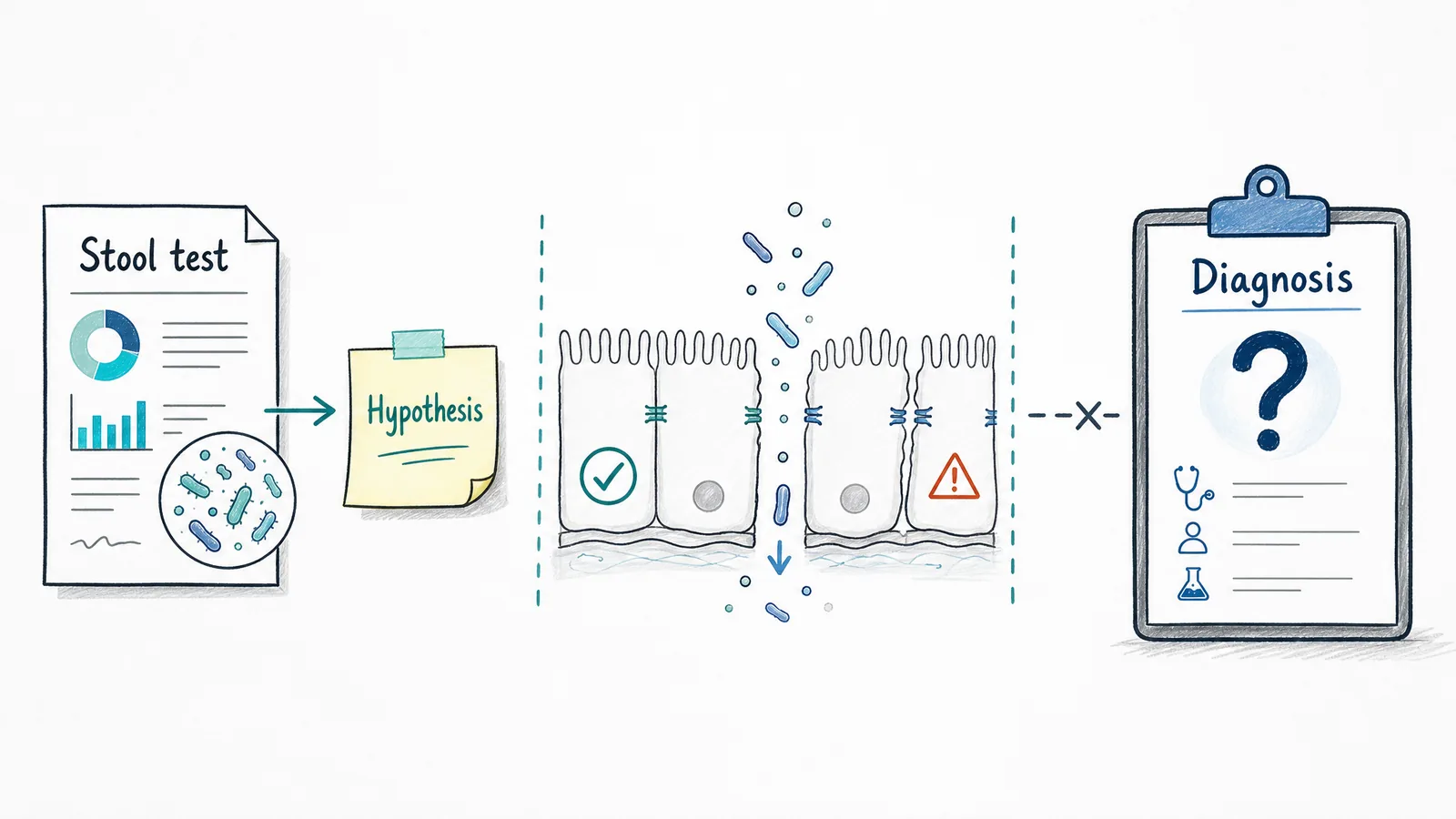
Short answer: You cannot reliably “heal a leaky gut” by using a consumer stool microbiome test alone. Increased intestinal permeability is a real barrier biology concept, but proving it, finding its cause, and treating it safely require clinical context, especially when symptoms are persistent, severe, or linked with inflammatory bowel disease, coeliac disease, infection, medication injury, or another diagnosed condition.
Can you heal a leaky gut?
The honest answer is: sometimes intestinal barrier function can improve when the underlying driver is identified and treated, but the phrase “heal a leaky gut” is often used more confidently than the evidence allows. The gut lining is not a passive wall. It is a living interface made of epithelial cells, mucus, immune signals, nerves, blood flow, diet-sensitive metabolism, and microbes. Tight junctions help regulate what passes between cells. Inflammation, infection, alcohol, non-steroidal anti-inflammatory drugs, untreated coeliac disease, active inflammatory bowel disease, severe stress physiology, and major dietary disruption can all influence this barrier.
A consumer article from InnerBuddies frames microbiome testing as a way to identify imbalances and guide gut repair. That is a reasonable marketing theme, but it needs a sharper evidence boundary. Stool microbiome data can describe organisms and inferred functions in a sample. It cannot, by itself, prove that the small intestinal or colonic barrier is leaky, identify the medical cause, or confirm that a supplement plan repaired the lining. The test may generate hypotheses. It is not a stand-alone diagnosis.
Evidence summary
- Intestinal permeability is a real biological process involving epithelial cells, mucus, immune signaling, and tight junction regulation.
- No single consumer stool microbiome test can reliably diagnose impaired intestinal barrier function in an individual.
- Akkermansia, Faecalibacterium, butyrate production, and microbial diversity are biologically relevant, but they are not simple repair meters.
- Diet quality, fiber tolerance, alcohol reduction, medication review, and treatment of diagnosed disease may support barrier health.
- Persistent diarrhoea, blood, weight loss, fever, anaemia, severe pain, or symptoms after travel or antibiotics need clinical assessment.
What does leaky gut actually mean clinically?
In research, increased intestinal permeability means that the intestinal barrier allows more passage than expected under specific test conditions. Scientists study this with methods such as sugar permeability tests, endoscopy-based assessment, tissue studies, blood markers, and experimental models. Each method has limitations. The important point is that “leaky gut” is not a single routine diagnosis like appendicitis or coeliac disease. It is a barrier phenotype that can appear in several contexts and may be a cause, a consequence, or a companion of inflammation.
This distinction matters because symptoms are nonspecific. Bloating, fatigue, skin changes, food reactions, abdominal discomfort, brain fog, and loose stools can occur with irritable bowel syndrome, inflammatory bowel disease, coeliac disease, thyroid disease, medication effects, bile acid diarrhoea, infection, endometriosis, anxiety physiology, food intolerance, or ordinary dietary mismatch. Calling all of that leaky gut may feel explanatory, but it can blur the decision that matters most: does this person need reassurance, dietary support, targeted medical testing, or urgent care?
Can a microbiome test diagnose leaky gut?
Not with current routine consumer evidence. Stool sequencing can identify bacterial DNA and estimate relative abundance. Some reports may highlight low Akkermansia muciniphila, reduced Faecalibacterium prausnitzii, low predicted short-chain fatty acid production, elevated Proteobacteria, or other dysbiosis patterns. These signals can be biologically interesting. They do not directly measure tight junction function, mucus integrity, epithelial injury, immune activation at the tissue level, or whether bacterial products are crossing into circulation.
MedicalBrain validation found a consistent pattern across peer-reviewed reviews and barrier studies. The microbiome is involved in barrier physiology, and barrier dysfunction is important in disease. At the same time, clinical translation is still limited. A test result that looks “imbalanced” does not tell you whether the lining is damaged, where the problem is located, whether the cause is diet, medication, infection, immune disease, or whether the proposed intervention will repair anything meaningful. That is why the safest wording is “may provide context,” not “measures leaky gut.”
Which leaky gut claims are best supported?
The best-supported claims are modest. The intestinal barrier is regulated by tight junction proteins, epithelial renewal, mucus, immune cells, microbial metabolites, bile acids, and diet. Short-chain fatty acids such as butyrate can support epithelial energy metabolism and immune regulation in experimental and translational research. High-fiber dietary patterns, when tolerated, can encourage fermentation pathways that are generally considered supportive of gut ecology. Alcohol excess and frequent non-steroidal anti-inflammatory drug use can impair barrier function in susceptible people. Treating active inflammatory disease, coeliac disease, infection, or medication-related injury can improve the clinical situation.
Those statements are useful because they do not promise a universal protocol. They support a practical hierarchy. First, rule out conditions that should not be missed. Second, remove obvious barrier stressors when safe to do so. Third, build a tolerable, nutrient-dense diet rather than chasing extreme restriction. Fourth, use probiotics or supplements only when the indication, strain, dose, and safety profile make sense. A person with IBS-type symptoms, for example, may benefit from dietary guidance, but that is different from proving that their gut lining has been healed.
Which claims go beyond the evidence?
Several common claims overreach. One is that low abundance of a single beneficial bacterium proves leaky gut. Another is that high abundance of a potential pathobiont proves toxins are leaking into the bloodstream. A third is that a stool test can choose the exact supplement stack needed to seal the gut lining. These claims borrow language from real science but skip validation steps in actual patients.
Akkermansia and Faecalibacterium are good examples. They are important organisms in microbiome research, and their depletion has been associated with some disease states. But an individual stool result is affected by sample handling, diet in the previous days, sequencing method, reference database, bowel transit time, and normal biological variation. It is not a direct clinical gauge. A low value may justify a discussion about fiber pattern, metabolic health, inflammation, or medication history. It should not be sold as proof of barrier failure.
What does marketing often get wrong about gut repair?
Marketing often turns a complex system into a before-and-after story. First it tells the reader that vague symptoms prove a damaged barrier. Then it says a test can reveal the exact imbalance. Then it offers a protocol of probiotics, prebiotics, collagen, glutamine, bone broth, antimicrobial herbs, or avoidance diets. Some of those interventions may be reasonable for selected people. The problem is the implied certainty.
Bone broth, glutamine, fermented foods, polyphenols, omega-3 fats, and probiotics are not automatically wrong. They are simply not interchangeable with validated treatment. A person with coeliac disease needs strict gluten avoidance after diagnosis, not a generic repair plan. A person with inflammatory bowel disease may need anti-inflammatory therapy. A person with severe diarrhoea after antibiotics may need evaluation for Clostridioides difficile. A person with unexplained weight loss or bleeding needs investigation. The more serious the symptom pattern, the less acceptable it is to hide behind wellness language.
What studies actually show
Recent reviews on tight junction regulation and intestinal barrier integrity describe a sophisticated barrier system, not a simple leak that one food can patch. Barrier injury can participate in inflammatory bowel disease and other disorders, but researchers are still working on reliable clinical markers and interpretation. A Scientific Reports study on serum proteins and small intestinal permeability in inflammatory bowel disease explicitly noted that there is no single test that reliably diagnoses mucosal barrier function across contexts. That is a key corrective point for consumer articles.
Microbiome-personalized medicine reviews reach a similar conclusion from the testing side. Microbiome data are promising, and the field is moving toward better prediction and individualized interventions. Still, reproducibility, causality, sampling, clinical endpoints, and safety remain major requirements. The strongest evidence supports careful interpretation, not instant personalization. A barrier-friendly lifestyle can be sensible, but the claim should stay proportional to what was actually measured.
When should you see a clinician for suspected leaky gut?
See a clinician if symptoms are persistent, worsening, or accompanied by red flags: blood in stool, black stool, fever, unintentional weight loss, night sweats, persistent vomiting, dehydration, anaemia, severe or localized abdominal pain, new symptoms after age 50, family history of colorectal cancer or inflammatory bowel disease, ongoing diarrhoea after antibiotics, recent travel with severe symptoms, pregnancy, immunosuppression, or symptoms that wake you at night. These patterns need conventional evaluation before microbiome optimization.
Medical review is also important before using antimicrobial herbs, aggressive elimination diets, high-dose supplements, or repeated cleanses. Natural does not mean harmless. Restrictive diets can reduce nutrient intake and worsen food fear. Antimicrobial supplements can interact with medications or irritate the gut. Probiotics are usually safe for many healthy people, but they require caution in severe illness, immunocompromise, central lines, premature infants, and some post-surgical settings.
Bottom line
The best answer to “How to heal a leaky gut?” is not a product funnel. It is a careful clinical sequence. Intestinal permeability is real, but it is not diagnosed by symptoms alone and not fixed by a stool report alone. Use microbiome testing, if you use it, as context. Give priority to red flags, diagnosed conditions, medication review, diet quality, fiber tolerance, sleep, alcohol intake, and clinician-guided care when symptoms are significant.
A safe article should leave the reader more informed and less pressured. If a plan promises to identify, heal, detoxify, and personalize everything from one sample, the evidence standard has been lowered. The gut barrier deserves better than that.
The Simple Version
Your gut lining is like a smart border, not a brick wall. It lets nutrients through, keeps many unwanted things out, and talks constantly with your immune system and gut microbes. Sometimes that border can become more permeable, especially during inflammation, infection, medication injury, or certain diseases.
A stool microbiome test can show clues about bacteria in your sample. It cannot look directly at the gut lining and prove that the border is leaking. If your symptoms are mild, basic habits such as a tolerable high-quality diet, enough fiber, less alcohol, and careful medication use may help support gut health. If symptoms are strong, persistent, or include warning signs, the right next step is medical assessment, not a generic leaky gut protocol.
Evidence notes
- Paracellular permeability and tight junction regulation in gut health and disease. Nature Reviews Gastroenterology & Hepatology. 10.1038/s41575-023-00766-3
- Mechanisms regulating intestinal barrier integrity and its pathological implications. Experimental & Molecular Medicine. 10.1038/s12276-018-0126-x
- Spp24 is associated with endocytic signalling, lipid metabolism, and discrimination of tissue integrity for leaky-gut in inflammatory bowel disease. Scientific Reports. 10.1038/s41598-020-69746-w
- Utilization of the microbiome in personalized medicine. Nature Reviews Microbiology. 10.1038/s41579-023-00998-9
- Gut microbiome and health: mechanistic insights. Gut. 10.1136/gutjnl-2021-326789
- Probiotics for the prevention and treatment of gastrointestinal diseases. Nature Reviews Gastroenterology & Hepatology. 10.1038/s41575-020-0344-2
This article is educational and does not diagnose, treat, or replace care from a qualified clinician.