Evidence-based response
How to Eliminate Intestinal Microbes? Evidence-Based Answer Without the Hype
Do not try to eliminate intestinal microbes broadly. Treat proven infection carefully and protect the useful gut ecosystem.
By Sandra McKenzy, Pharmacist · 2026-07-03
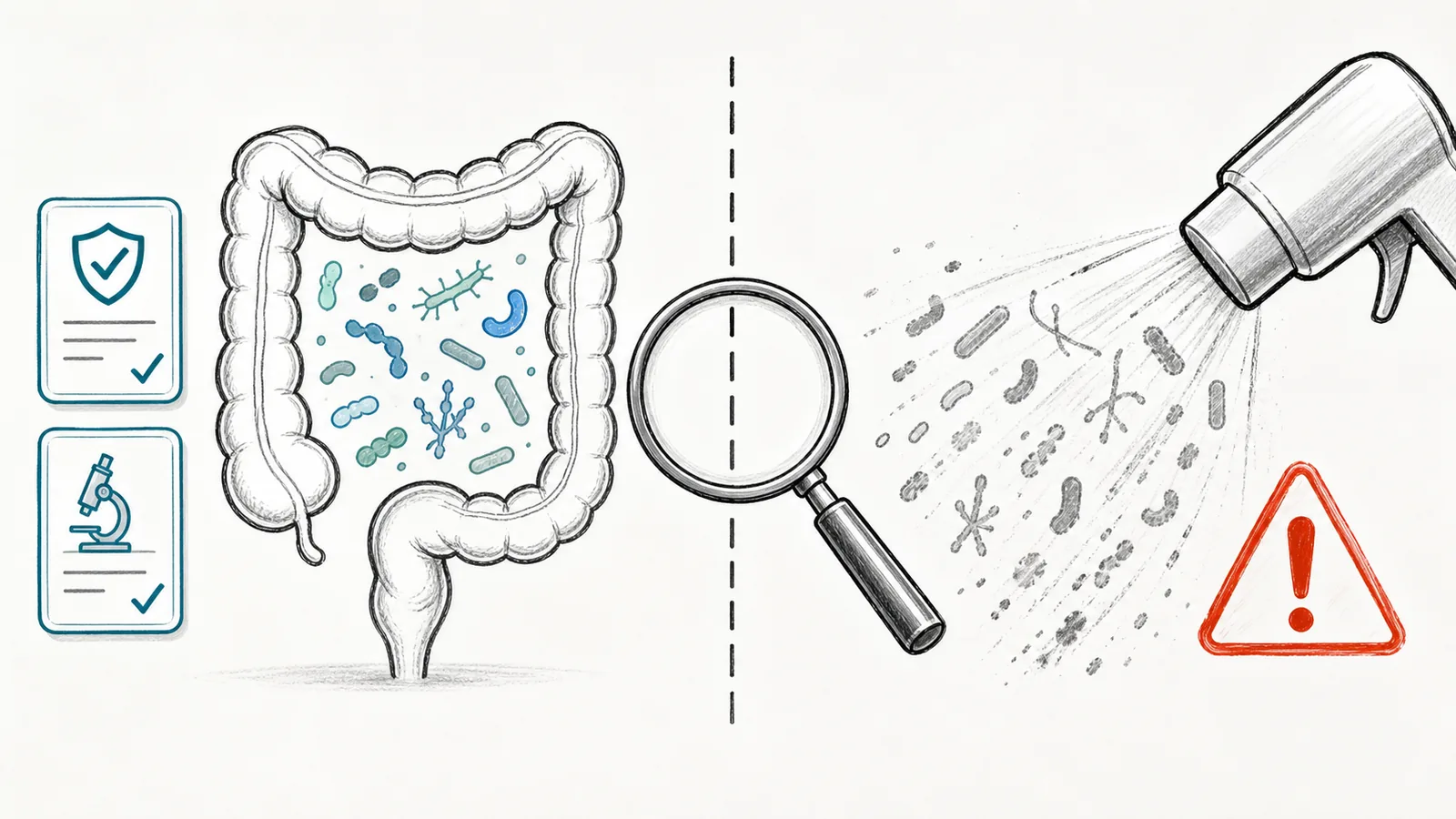
Short answer: You should not try to eliminate intestinal microbes broadly. The gut needs a living microbial ecosystem. Clinically, microbes are reduced only when there is a proven infection, overgrowth syndrome, or high-risk condition that justifies treatment. A consumer microbiome test may describe one stool sample, but it cannot safely decide which intestinal microbes to kill or replace medical diagnosis.
The source article asks a question many readers type when they feel bloated, unwell, or worried about “bad bacteria.” The safer answer is less dramatic: protect the useful microbiome, look for real disease when symptoms demand it, and avoid antimicrobial protocols based only on a wellness dashboard.
Evidence summary
- The healthy gut microbiome is not sterile; it is diverse, functional, and different from person to person.
- Broad antimicrobial use can disturb microbial ecology and may increase vulnerability to problems such as resistant organisms or Clostridioides difficile.
- Microbiome testing can generate hypotheses, but it is not a standalone diagnostic tool for deciding which microbes to eliminate.
- Probiotics, diet, and microbiome restoration strategies have condition-specific evidence, not a universal “reset” effect.
- Persistent, severe, bloody, febrile, or unexplained symptoms need clinical evaluation rather than self-directed microbe killing.
What does “eliminate intestinal microbes” mean medically?
In medicine, eliminating intestinal microbes is not a normal wellness goal. The intestine is colonized by bacteria, archaea, viruses, fungi, and other organisms that interact with the immune system, digest fiber, produce metabolites, compete with pathogens, and help maintain barrier function. Large human microbiome studies showed that healthy people can have very different microbial compositions while retaining overlapping functions. That matters because it makes a single perfect microbe list unrealistic.
The clinical question is therefore not “How do I remove microbes from my gut?” It is “Is there evidence that a specific organism or process is causing harm, and is there a validated treatment that improves outcomes?” Those are different questions. A diagnosed C. difficile infection, intestinal parasite, invasive bacterial infection, or selected small intestinal bacterial overgrowth case belongs in medical care. General bloating, fatigue, skin symptoms, or a low diversity score does not automatically prove that intestinal microbes need to be killed.
Can a microbiome test tell you which microbes to kill?
Usually, no. Stool microbiome testing can describe organisms or genes detected in a sample. Shotgun metagenomics can be technically powerful. But the result still has limits: stool is not the same as every intestinal niche, relative abundance is affected by sampling and sequencing methods, and many findings are associations rather than proven causes. A test can be useful for research, education, or discussion with a clinician, but it should not be treated as a prescription pad.
The most important distinction is clinical validation. A result is clinically useful only when it has been shown to guide a specific decision safely. For example, testing for a recognized pathogen is different from labeling a common commensal as “bad” because it is higher than an app’s reference range. Many organisms can be harmless in one context and problematic in another. Killing them without understanding the context can remove competitors, reduce diversity, and create a more unstable ecosystem.
When is reducing gut microbes actually appropriate?
Microbe reduction is appropriate when the target and reason are clear. Antibiotics can be lifesaving for bacterial infections. Antiparasitic drugs matter for confirmed parasites. Specific treatment may be used for C. difficile, some cases of SIBO, inflammatory complications, immune compromise, or perioperative situations. These decisions depend on symptoms, exam findings, standard tests, medication history, risk level, and sometimes culture, toxin, antigen, breath, blood, or stool pathogen testing.
Even then, the goal is not to sterilize the gut. It is to treat a defined problem while limiting collateral damage. Research on antibiotic-exposed adults shows that the microbiome can recover, but recovery varies and resistance genes can influence the process. Other work on antibiotic-perturbed microbiota emphasizes that probiotics may reduce some antibiotic-associated side effects in selected settings, yet evidence does not support a simple universal promise that probiotics restore the disrupted microbiome on command.
What does marketing often get wrong?
Marketing often turns a nuanced ecological question into a simple battle story: bad microbes versus good microbes. That story is easy to sell, but it is too crude for clinical use. Dysbiosis is not one disease. It is a pattern, and different studies define it differently. A species that looks undesirable in one illness may be neutral in another person. A low level of a beneficial group can suggest a dietary pattern, medication effect, infection history, or technical issue rather than a disease that needs aggressive treatment.
Another overreach is the claim that a wellness test can personalize antimicrobial, supplement, or diet steps with the same certainty as a validated clinical diagnostic. Personalized does not automatically mean proven. A recommendation can be individualized and still be speculative. Reader-protective advice should explain what is known, what is plausible, and what has not been proven to improve patient outcomes.
What can support a healthier microbial ecosystem?
For most people without red flags, the safer target is resilience rather than elimination. Dietary fiber from tolerated foods, plant variety, fermented foods when tolerated, adequate protein, sleep, movement, and careful antibiotic use are more defensible foundations than broad antimicrobial protocols. These steps do not promise to cure disease, but they support ecological conditions that beneficial microbes often use.
Prebiotics, probiotics, and live biotherapeutics should be discussed by indication. Some strains have evidence for specific outcomes, but strain, dose, population, and endpoint matter. Fecal microbiota transplantation and newer microbiota-based products are not casual “gut resets”; they are medical interventions with regulatory, safety, donor-screening, and indication-specific considerations. The fact that the microbiome can be manipulated does not mean every manipulation is safe or useful.
Should you use natural antimicrobials?
Natural does not mean harmless. Oregano oil, berberine, garlic extracts, herbal blends, high-dose essential oils, and similar products can affect microbes, medication metabolism, pregnancy safety, liver enzymes, bleeding risk, and gastrointestinal tolerance. Some may have laboratory or small-study signals, but that is not the same as proof that they should be used to eliminate intestinal microbes in a specific person.
If a clinician recommends an antimicrobial strategy, it should have a defined target, dose, duration, stop rule, and follow-up plan. If a protocol says to “kill bad bacteria” without naming a validated diagnosis or safety boundary, that is a warning sign. More aggressive protocols are not automatically more scientific.
When should you see a clinician?
Seek medical care promptly for blood in stool, black stool, unexplained weight loss, persistent fever, dehydration, anemia, severe or worsening abdominal pain, persistent vomiting, nighttime diarrhea, new bowel changes after age 50, immune suppression, pregnancy with significant symptoms, or a family history of colorectal cancer, celiac disease, or inflammatory bowel disease. Recent antibiotic use plus watery diarrhea deserves particular caution because C. difficile can be serious.
For children, older adults, and people with immune compromise, do not rely on consumer microbiome testing to decide whether microbes should be eliminated. The risk of missing infection, inflammation, medication side effects, malabsorption, or another medical cause is too high.
Bottom line
The best evidence-based answer is simple but important: do not try to eliminate intestinal microbes broadly. The gut microbiome is a working ecosystem, not dirt to be disinfected. Treat proven infections and clinically validated overgrowth problems with proper care. Use microbiome data, if you use it at all, as context rather than command.
Educational disclaimer: This article is for general information and science communication. It is not medical advice, diagnosis, or treatment. Do not use microbiome results or online articles to start, stop, or replace medical care. Persistent or severe symptoms deserve professional evaluation.
Evidence notes and sources
- Human Microbiome Project Consortium. Structure, function and diversity of the healthy human microbiome. Nature. https://doi.org/10.1038/nature11234
- Mullish et al. Gut microbiome as a clinical tool in gastrointestinal disease management: are we there yet? Nature Reviews Gastroenterology & Hepatology. https://doi.org/10.1038/nrgastro.2017.29
- Palleja et al. Recovery of gut microbiota of healthy adults following antibiotic exposure. Nature Microbiology. https://doi.org/10.1038/s41564-018-0257-9
- McFarland et al. Antibiotic-perturbed microbiota and the role of probiotics. Nature Reviews Gastroenterology & Hepatology. https://doi.org/10.1038/s41575-024-01023-x
- Khoruts and Sadowsky. Fecal microbiota transplantation: effectiveness, complexities, and lingering concerns. Mucosal Immunology. https://doi.org/10.1038/mi.2013.117
- Zeevi et al. The promise of the gut microbiome as part of individualized treatment strategies. Nature Reviews Gastroenterology & Hepatology. https://doi.org/10.1038/s41575-021-00499-1