Evidence-based response
How to Clean Your Intestinal System? Evidence-Based Answer Without Harsh Cleanses
Your intestinal system is not dirty in the way cleanse marketing implies. If you want better bowel regularity, focus on tolerated fiber, fluids, movement, sleep, medication review, and clinical evaluation for persistent or alarming symptoms.
By Sandra McKenzy, Pharmacist · 2026-06-19
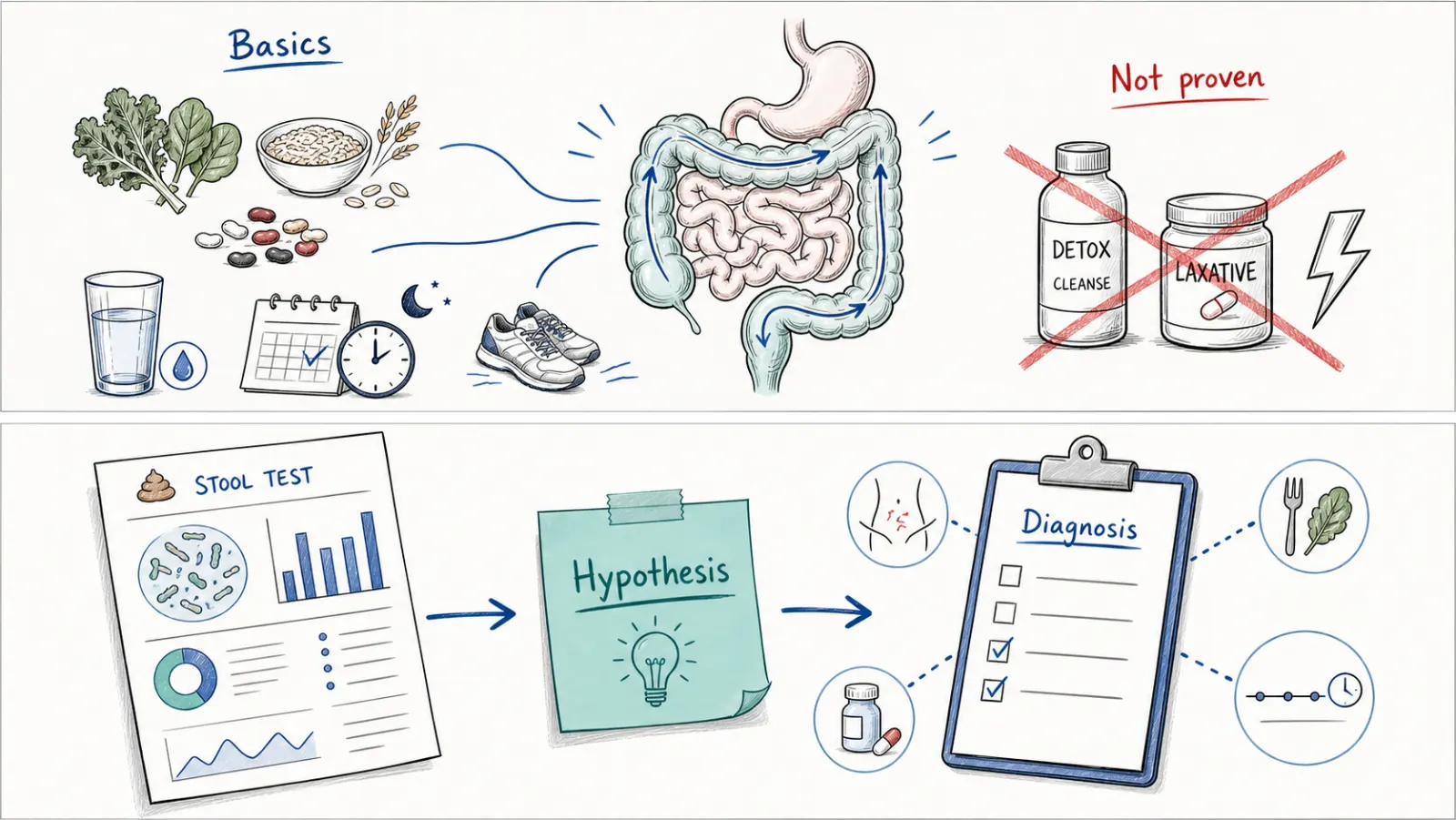
Short answer: Your intestinal system is not dirty in the way cleanse marketing implies. If you want better bowel regularity, focus on tolerated fiber, fluids, movement, sleep, medication review, and clinical evaluation for persistent or alarming symptoms.
This article responds to a common online claim about clean intestinal system. The subject is worth taking seriously because gut microbiome science is real, clinically relevant, and moving quickly. It also needs careful boundaries, because a true biological connection can easily be converted into a product promise that current evidence does not support.
How to Clean Your Intestinal System? The Evidence-Based Answer
The gut has mucus, motility, immune defenses, bile flow, epithelial turnover, and microbial ecology. It does not need routine flushing to stay clean. When people feel bloated, constipated, sluggish, or worried about toxins, the cause should be identified rather than masked. Some people need constipation treatment. Some need celiac testing, IBD assessment, infection testing, or medication changes. A cleanse can delay the right answer.
The source framing is useful as a search question, but it becomes less reliable when it treats a complex medical topic as a simple checklist, score, cleanse, detox, or product decision. A careful answer asks what has been validated, what remains plausible, and what would change a real clinical decision.
Evidence summary
Evidence summary
- Clean intestinal system is clinically meaningful only when interpreted with symptoms, duration, exposures, medication history, and risk factors.
- Consumer microbiome reports can describe detected microbial DNA, but most are not validated to diagnose disease or prescribe treatment alone.
- Peer-reviewed microbiome science supports cautious mechanisms, not one-step wellness guarantees.
- Validated medical tests and clinician assessment matter when symptoms are persistent, severe, new, or accompanied by red flags.
- The safest practical advice is cause-specific care, conservative lifestyle basics, and transparency about uncertainty.
What Clean Intestinal System Actually Means Clinically
Clinically, the gut is not a single switch. It includes diet, transit time, bile acids, mucus, immune signaling, epithelial barrier function, medications, infections, sleep, stress physiology, and microbial metabolism. That is why broad statements can be partly true and still not specific enough for a personal health decision.
For readers, the practical question is not whether the microbiome matters. It does. The practical question is whether a claim, test, supplement, consultation, or protocol can answer the particular problem in front of you. That requires analytical validity, clinical validity, and clinical utility: reliable measurement, meaningful interpretation, and an action that improves outcomes.
What Is Best Supported by Studies?
MedicalBrain searches for this article supported a cautious interpretation. The strongest evidence in microbiome medicine generally connects patterns of diet, medication exposure, infection, inflammation, metabolism, and host context with microbial communities. Those patterns can be useful for research and sometimes for clinical hypotheses.
The evidence is weaker when a claim jumps from population-level association to an individual diagnosis or from a plausible mechanism to a guaranteed intervention. Reproducibility, sampling method, sequencing pipeline, phenotype quality, and clinical endpoints all matter. A responsible article should make those limits visible rather than hiding them behind confident language.
Which Claims Go Beyond the Evidence?
Claims go too far when they promise certainty from a single symptom, stool score, organism name, cleanse, supplement, or consultation package. Microbiome data can be interesting and sometimes useful, but they do not automatically explain a person’s symptoms. They also cannot rule out disease when warning signs are present.
Be cautious when a page moves quickly from anxiety to purchase, from a broad mechanism to a personal prescription, or from preliminary science to the language of treatment. Those steps may be marketing, not medicine.
What Marketing Often Gets Wrong
Marketing often compresses a long evidence chain into a short promise. It may start with a true statement, such as the microbiome interacts with immunity, metabolism, digestion, or inflammation, then imply that a consumer product can optimize the system. The first sentence can be reasonable while the second sentence is not clinically proven.
Another common error is treating the microbiome as stable enough for definitive personal scoring. Stool microbiome composition can vary with diet, bowel transit, recent antibiotics, illness, travel, sleep, and laboratory pipeline. Responsible interpretation should include uncertainty.
When Should You See a Clinician?
Seek medical advice urgently for blood in stool, black stools, persistent fever, severe or worsening abdominal pain, dehydration, fainting, unintentional weight loss, persistent vomiting, symptoms after travel or suspected food poisoning, symptoms during pregnancy, symptoms in infants or older adults, or symptoms in someone who is immunocompromised. Also seek care if diarrhea, constipation, pain, appetite change, fatigue, or mood symptoms persist or recur.
These red flags matter because they can point to infection, inflammatory bowel disease, celiac disease, medication complications, endocrine disease, cancer, pregnancy complications, mental-health conditions, or other problems where delay is unsafe.
One more practical point matters: evidence-based gut health is usually cumulative rather than dramatic. The most useful changes are measurable, tolerable, and reviewed over time. If a claim cannot explain who it applies to, what outcome was measured, how long the effect lasted, and what risks were considered, it should be treated as a hypothesis rather than personal medical advice.
Bottom Line
The balanced answer is simple: clean intestinal system is a legitimate topic, but the strongest claims are narrower than many marketing pages suggest. Use microbiome information as context, not as a diagnosis. If symptoms are significant, persistent, new, or alarming, prioritize clinical evaluation and validated testing.
Educational disclaimer: This article is for general science education and does not diagnose, treat, or replace care from a licensed clinician. Decisions about symptoms, testing, medication, diet, supplements, pregnancy, infection risk, or inflammatory disease should be made with a qualified healthcare professional.
Evidence Notes and Sources
- Gut microbiome profiling tests propelled by customer demand (2017). Nature Biotechnology. DOI: 10.1038/nbt0117-9
- Clinical translation of microbiome research (2025). Nature Medicine. DOI: 10.1038/s41591-025-03615-9
- Utilization of the microbiome in personalized medicine (2024). Nature Reviews Microbiology. DOI: 10.1038/s41579-023-00998-9
- Microbiome-based interventions to modulate gut ecology and the immune system (2022). Mucosal Immunology. DOI: 10.1038/s41385-022-00564-1
- Structure, function and diversity of the healthy human microbiome (2012). Nature. DOI: 10.1038/nature11234
- Diet rapidly and reproducibly alters the human gut microbiome (2014). Nature. DOI: 10.1038/nature12820