Evidence-based response
How to Choose Between Saliva, Urine and Stool Tests: Benefits, Limits, and Red Flags
Choose a home test by the validated clinical question, not by convenience or broad wellness promises.
By Sandra McKenzy, Pharmacist · 2026-06-08
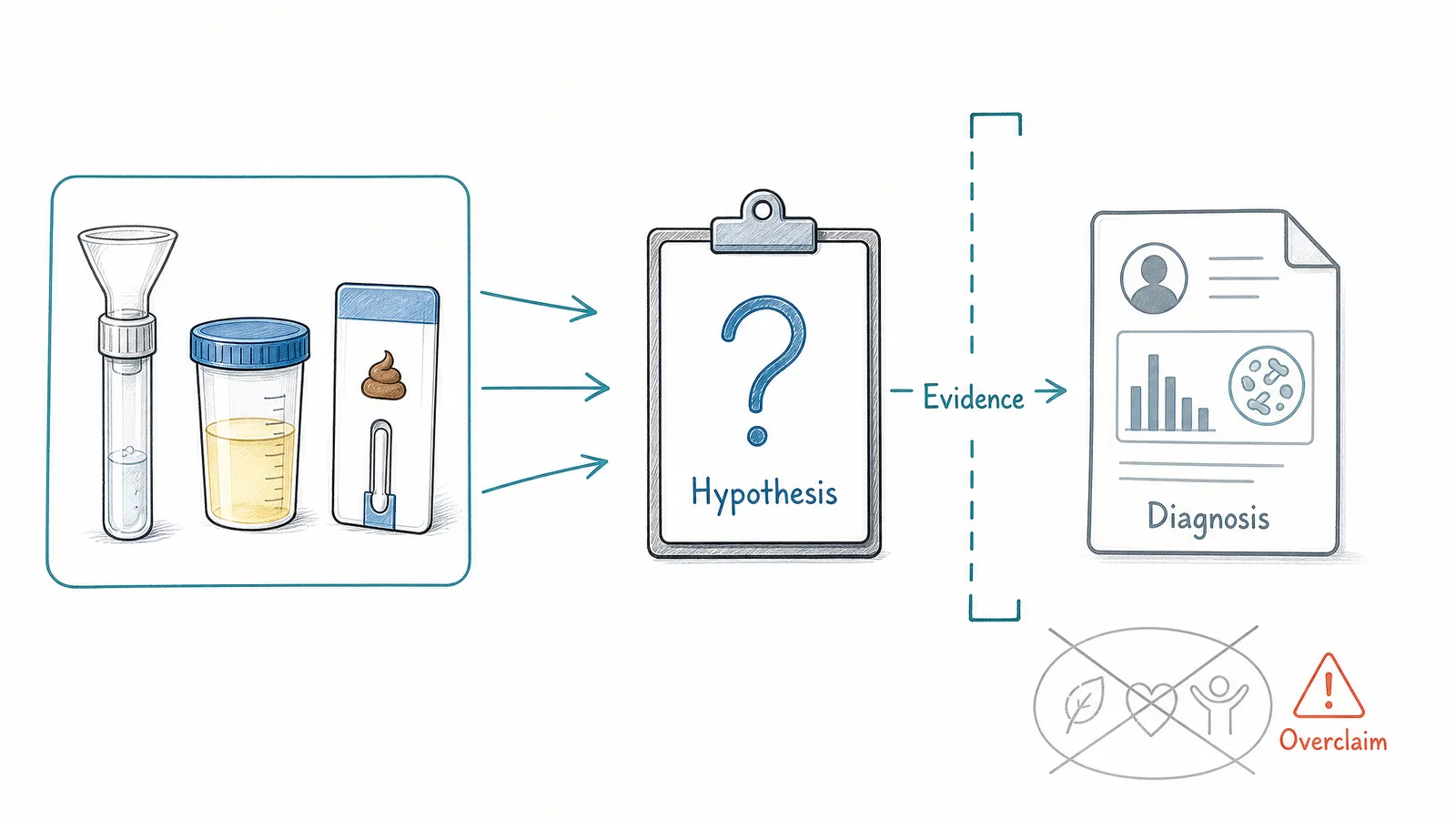
Short answer: Choose a saliva, urine, or stool test by the medical question it is validated to answer, not by convenience. Stool microbiome tests can describe gut bacteria, but they are not the same as validated stool tests for blood, infection, inflammation, or cancer screening.
How to Choose Between Saliva, Urine and Stool Tests
InnerBuddies compares saliva, urine, and stool tests while promoting microbiome testing. The safer comparison starts with clinical validity, not the easiest sample or most attractive report.
Evidence summary
- Saliva, urine, and stool tests answer different questions and are not interchangeable.
- Stool microbiome tests can describe microbial patterns, but most consumer wellness claims are not diagnostic.
- Sample handling, timing, lab method, and clinical context strongly affect interpretation.
- Validated medical tests should guide red-flag symptoms, infection concerns, cancer screening, endocrine questions, and kidney or liver concerns.
- A home test should not delay care for severe or persistent symptoms.
How should you choose between saliva, urine, and stool tests?
Start with the medical question, not the sample type. Saliva may be used for some infections or hormone-related measurements. Urine is used for kidney, metabolic, pregnancy, infection, and drug-related questions depending on the assay. Stool can be used for blood, pathogens, inflammation markers, parasites, colorectal cancer screening, and microbiome research. Each sample can be useful when the test is validated for the question.
The problem is that home-test marketing often presents convenience as clinical certainty. Easy collection does not guarantee useful interpretation. A reliable home test needs an appropriate assay, validated cutoff, quality control, clear limitations, and a plan for what happens if the result is abnormal.
Where do stool microbiome tests fit?
Stool microbiome tests describe microbial DNA or related patterns in a fecal sample. They can be educational and useful in research. They are not the same as stool tests for blood, pathogens, calprotectin, pancreatic elastase, or validated cancer screening.
A stool microbiome report should not be used to diagnose IBS, IBD, SIBO, food intolerance, liver disease, kidney disease, or hormone imbalance. Those questions require clinical history and validated testing.
What does accuracy mean for home tests?
Accuracy is not one thing. Analytical accuracy asks whether the lab measures the target correctly. Clinical validity asks whether the result predicts or identifies a condition. Clinical utility asks whether acting on the result improves outcomes. Many consumer tests emphasize the first and blur the second and third.
Timing also matters. Saliva hormones may vary by time of day. Urine markers can change with hydration, diet, medication, and collection method. Stool microbiome profiles can shift with recent diet, antibiotics, bowel pattern, and transport.
What marketing gets wrong
Marketing often says stool tests are best for gut bacteria, then slides into broad claims about immunity, mood, nutrition, and wellness. The first sentence may be reasonable. The broad conclusions may not be clinically validated.
A home test comparison should tell readers when not to test at home. Severe symptoms, pregnancy concerns, suspected infection, blood in stool, dehydration, and significant pain need care, not a shopping decision.
What did MedicalBrain validation show?
MedicalBrain found evidence that stool can be a non-invasive sample for several gastrointestinal applications and that microbiome-based disease panels are advancing in research. It also found cautionary sources on consumer demand, sample handling, and translation into clinical workflows.
The safe conclusion is not that home tests are useless. It is that the sample type must match a validated question. For consumer microbiome reports, clinical action should be modest unless a clinician is involved.
When should you see a clinician?
Seek care for blood in stool, black stool, severe pain, fever, persistent vomiting, dehydration, unexplained weight loss, anemia, new bowel changes after age 50, suspected urinary infection with fever or flank pain, pregnancy symptoms, or abnormal home results that could be medically important.
Do not repeat home tests to reassure yourself when symptoms are escalating. A normal wellness report can miss serious disease, and an abnormal wellness score can create unnecessary anxiety.
What is a safer home-test decision process?
A safer process has four steps. First, name the question in plain language. Do you want to know whether you have blood in stool, a urinary infection, ovulation timing, a respiratory virus, or a broad wellness pattern? Second, ask whether the test is validated for that exact question. Third, ask what action would follow. Fourth, decide whether a clinician should be involved before testing.
This process prevents a common mistake: buying the most detailed-looking report and then searching for a meaning. More data can create more confusion when the result is not tied to a validated decision. A stool microbiome chart with many taxa may feel more advanced than a simple fecal blood test, but the simpler test may be more clinically meaningful for the right screening question.
Home tests can reduce friction and give people useful access. They can also create false reassurance or false alarm. The difference is not the home setting itself. The difference is validation, context, follow-up, and whether the result answers the question the person actually has.
Bottom line
The right home test depends on the question and the validation behind the assay. Saliva, urine, and stool are useful in different contexts. A stool microbiome report can be educational, but it should not replace validated medical testing or clinical care for red flags.
The simple version
Do not start with “which sample is easiest?” Start with “what question am I trying to answer?” A home test is useful only when that test is validated for that question and you know what to do with the result.
Evidence notes
- A hands-free stool sampling system for monitoring intestinal health and disease. Scientific Reports. 10.1038/s41598-022-14803-9
- Gut microbiome profiling tests propelled by customer demand. Nature Biotechnology. 10.1038/nbt0117-9
- Filling the gap between collection, transport and storage of the human gut microbiota. Scientific Reports. 10.1038/s41598-019-44888-8
- A predictive index for health status using species-level gut microbiome profiling. Nature Communications. 10.1038/s41467-020-18476-8
- Noninvasive, microbiome-based diagnosis of inflammatory bowel disease. Nature Medicine. 10.1038/s41591-024-03280-4
- Translating microbiota analysis for clinical applications. Nature Reviews Bioengineering. 10.1038/s44222-024-00168-3
- Regional variation limits applications of healthy gut microbiome reference ranges and disease models. Nature Medicine. 10.1038/s41591-018-0164-x
This article is educational and does not diagnose, treat, or replace care from a qualified clinician.