Evidence-based response
How Can I Find Out If My Gut Is Damaged? Evidence-Based Answer Without the Hype
Symptoms can justify clinical evaluation, but they cannot prove gut damage. Consumer microbiome tests describe patterns, not diagnoses.
By Sandra McKenzy, Pharmacist · 2026-08-22
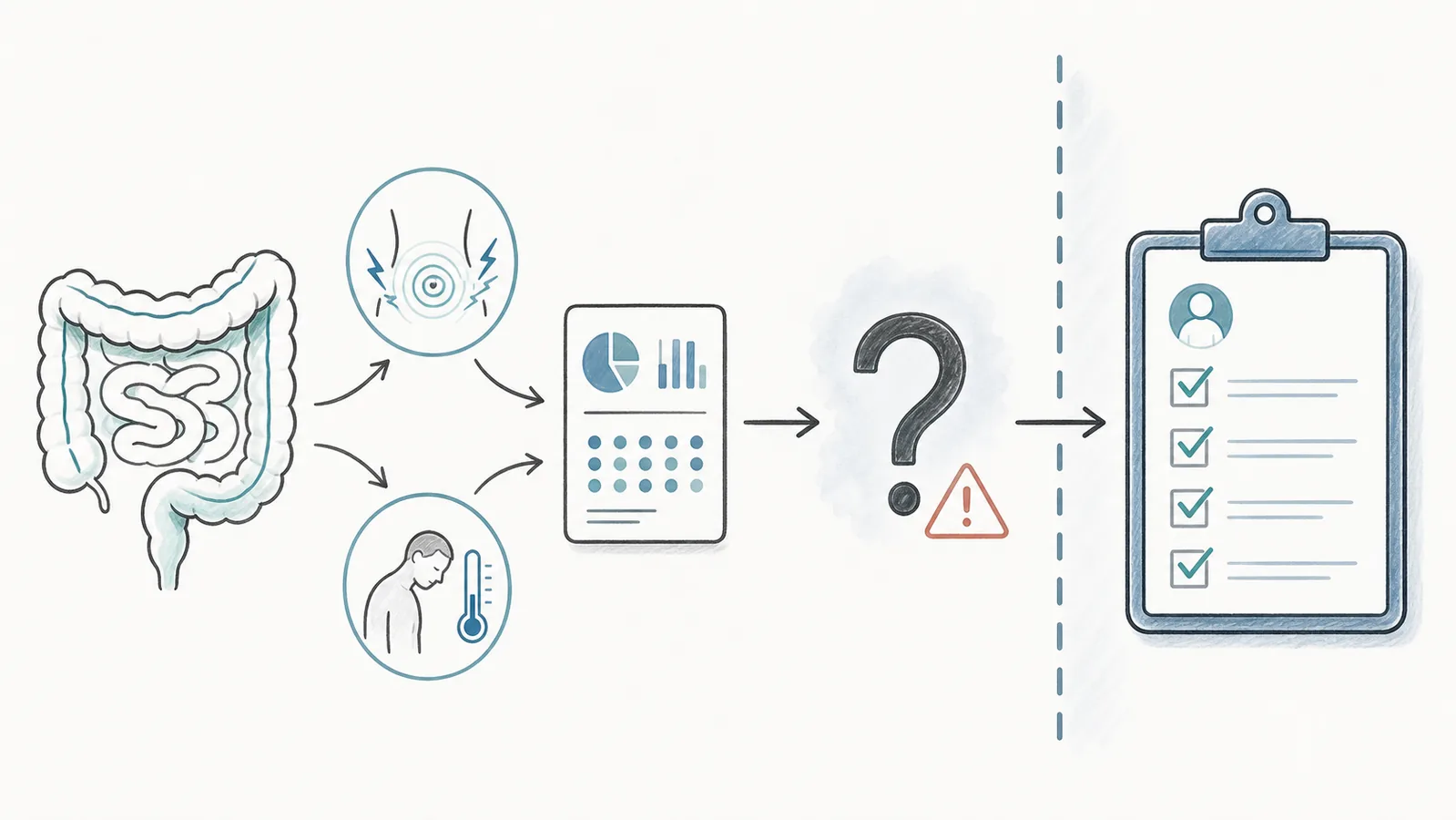
Short answer: You usually cannot find out that your gut is “damaged” from symptoms or a consumer microbiome test alone. Persistent bloating, diarrhea, constipation, reflux, pain, weight loss, blood in stool, fever, anemia, or symptoms after antibiotics can justify clinical evaluation. A stool microbiome report may describe bacterial patterns, but it cannot diagnose leaky gut, IBS, IBD, SIBO, autoimmune disease, nutrient malabsorption, or the cause of brain fog on its own.
How can I find out if my gut is damaged?
The safest answer is to start by defining what “damaged” means. In everyday gut-health marketing, the word is often used loosely. It may refer to digestive symptoms, dysbiosis, low microbial diversity, intestinal inflammation, increased intestinal permeability, food intolerance, immune activation, or simply feeling unwell after meals. Those are not the same condition, and they are not checked with one universal test.
A careful evaluation begins with the clinical pattern. How long have symptoms been present? Are they new or recurrent? Do they happen after certain foods, during stress, after infection, after antibiotics, during travel, or with a medication change? Are stool habits changing? Is there pain, fever, bleeding, vomiting, night waking, weight loss, anemia, or dehydration? These details matter more than a single microbiome score because they help separate common functional symptoms from situations where validated medical tests are needed.
An InnerBuddies article on this topic presents symptoms and microbiome testing as a route to detect gut damage. The useful part is that persistent digestive symptoms deserve attention. The overextended part is the implication that broad symptoms and stool microbiome patterns can reveal whether the gut is damaged or identify the root cause. Current microbiome science is real, but individual diagnosis from consumer stool sequencing remains much narrower than the marketing suggests.
What does “gut damage” actually mean clinically?
Clinically, gut damage can mean visible tissue injury, inflammation, infection, ulceration, impaired absorption, barrier dysfunction, or altered motility and sensitivity. Crohn’s disease, ulcerative colitis, celiac disease, infectious gastroenteritis, ischemia, medication injury, radiation injury, and some immune conditions can damage the gastrointestinal tract in ways that clinicians can evaluate with history, examination, blood tests, stool tests, imaging, endoscopy, biopsy, or specific functional tests.
Dysbiosis is different. It means a shift in the microbial community compared with a reference state or compared with another group of people. Dysbiosis can be associated with disease, diet, medication use, inflammation, geography, age, and stool consistency. It is not itself a diagnosis. A person can have symptoms with a stool profile that looks ordinary, and another person can have unusual microbial patterns without active disease. The stool microbiome is a biological signal, not a damage meter.
Increased intestinal permeability is also more specific than the popular phrase “leaky gut” implies. The intestinal barrier is normally selective, not sealed shut. Permeability changes through the day and may be altered in disease, inflammation, stress, diet, infection, or injury. Research tools and specialized tests can study permeability, but commercial claims often turn a complex barrier process into a simple explanation for fatigue, skin symptoms, autoimmunity, and mood changes. That jump is not justified for an individual reader without clinical context.
Which symptoms should make you look deeper?
Digestive symptoms are the most direct reason to look deeper. Ongoing diarrhea, constipation, abdominal pain, bloating, reflux, nausea, greasy stools, urgency, mucus, or symptoms that wake you at night deserve attention if they persist, worsen, or interfere with life. These symptoms can come from IBS, infection, celiac disease, inflammatory bowel disease, bile acid diarrhea, lactose intolerance, FODMAP sensitivity, thyroid disease, medication effects, pelvic conditions, gallbladder disease, pancreatic disease, or stress-related gut-brain signaling. The symptom list alone does not identify which one applies.
Systemic symptoms need even more caution. Fatigue, brain fog, skin flares, joint pain, food sensitivity, mood changes, and weight change can coexist with gut disorders, but they are nonspecific. They can also come from sleep problems, anemia, thyroid disease, depression, autoimmune disease, medication effects, nutrient deficiency, chronic infection, endocrine problems, or many non-gut causes. It is misleading to treat them as proof that the gut lining is damaged.
Red flags should not be routed through wellness testing. Seek medical care promptly for blood in stool, black stool, unexplained weight loss, fever, persistent vomiting, dehydration, fainting, severe or localized abdominal pain, a rigid abdomen, anemia, jaundice, symptoms after age 50 that are new, a family history of colorectal cancer or inflammatory bowel disease, immune suppression, pregnancy with significant abdominal pain, or symptoms that wake you repeatedly at night.
Can a microbiome test tell if your gut is damaged?
Not by itself. A stool microbiome test can estimate which microbial DNA is present in a stool sample. Depending on the method, it may report taxa, diversity, relative abundance, and sometimes predicted functions. Whole-genome shotgun sequencing can provide more detail than 16S sequencing, but greater detail does not automatically create clinical diagnosis. The central question is whether the result has validated sensitivity, specificity, reference ranges, and action thresholds for the condition being claimed.
For most consumer gut-health questions, that validation is not yet strong enough. Microbiome research has identified disease-associated patterns in IBS, IBD, metabolic disease, colorectal cancer, and other conditions. Yet the field still struggles with variability across geography, diet, medication exposure, sample handling, sequencing pipelines, stool consistency, and population reference groups. These sources of variation make it risky to label one person’s gut as damaged from a consumer report.
A microbiome report may be useful as a conversation starter. It can encourage a review of fiber intake, dietary diversity, recent antibiotics, recurring symptoms, constipation, diarrhea, and medication history. It may help people understand that the gut ecosystem is dynamic. It should not be used to diagnose SIBO, IBD, leaky gut, autoimmune disease, depression, nutrient deficiency, or a need for a specific supplement protocol.
What tests are more clinically meaningful?
The right test depends on the pattern. For chronic diarrhea, clinicians may consider stool culture or PCR in selected cases, ova and parasite testing when exposure fits, celiac serology, inflammatory markers, thyroid testing, medication review, and sometimes fecal calprotectin to help distinguish inflammatory from functional patterns. For suspected inflammatory bowel disease, colonoscopy, imaging, labs, stool inflammatory markers, and biopsy can matter. For suspected celiac disease, blood tests and biopsy are interpreted while the person is still eating gluten.
For suspected malabsorption, clinicians may look at weight trend, anemia, iron, B12, folate, vitamin D, albumin, pancreatic elastase, stool fat, or disease-specific tests. For reflux or upper abdominal pain, the path may involve H. pylori testing, medication review, endoscopy in selected cases, gallbladder evaluation, or pancreatic assessment. For IBS-like symptoms without red flags, the diagnosis often relies on symptom criteria plus limited targeted testing to exclude important alternatives.
Intestinal permeability testing is a specialized area, not a routine consumer shortcut. The lactulose-mannitol concept, zonulin measurements, serum markers, endoscopic imaging, and research biomarkers each have limits. Some are useful in research or selected clinical settings, but none should be sold as a simple universal answer to “is my gut damaged?”
Evidence summary
- “Gut damage” is not one diagnosis. It can mean inflammation, infection, barrier dysfunction, malabsorption, dysbiosis, or gut-brain sensitivity.
- Symptoms such as bloating, fatigue, brain fog, skin changes, and food intolerance are real but nonspecific. They do not prove microbiome damage.
- Consumer stool microbiome tests can describe microbial patterns, but they are not validated to diagnose most individual gut diseases.
- Microbiome signals vary with geography, diet, medicines, stool consistency, sampling, and analysis method, which limits simple healthy versus damaged labels.
- Red flags such as blood, fever, weight loss, anemia, severe pain, persistent vomiting, or new symptoms after age 50 need medical evaluation, not a microbiome report.
What does gut-health marketing get wrong?
The first mistake is collapsing association into diagnosis. Many studies show that people with a condition differ, on average, from controls. That does not mean a stool result can identify the cause of symptoms in a single person. Group-level research is not the same as a clinically validated diagnostic test.
The second mistake is treating “low diversity” as a universal problem. Microbial diversity can be informative in some contexts, and loss of diversity after antibiotics or in certain diseases may matter. But diversity is influenced by diet, stool consistency, geography, age, medication exposure, and analysis method. A high diversity score is not a guarantee of health, and a lower score is not proof of gut damage.
The third mistake is turning every systemic symptom into a gut-lining story. The gut-brain axis, gut-skin axis, immune signaling, and microbial metabolites are legitimate research areas. They do not allow a company to tell a person that fatigue, anxiety, acne, joint pain, or weight gain must be coming from a damaged gut. Those symptoms deserve a wider differential diagnosis.
What should you do before buying a test?
Write down the pattern for two to four weeks if symptoms are not urgent: stool frequency, stool form, pain timing, foods, alcohol, caffeine, sleep, stress, cycle timing if relevant, medication changes, antibiotics, travel, infections, and weight trend. This is often more useful to a clinician than a microbiome dashboard. If symptoms are severe, new, or include red flags, skip the diary and seek care.
Review medicines and supplements. NSAIDs, antibiotics, metformin, magnesium, iron, proton pump inhibitors, GLP-1 drugs, laxatives, antacids, herbal products, and high-dose supplements can all affect digestive symptoms. Do not stop prescribed medication without medical advice, but do bring the list to an appointment.
If you still choose a microbiome test, treat it as educational data. Ask what the lab can and cannot validate, whether it uses shotgun sequencing or 16S, how it controls sample quality, whether recommendations are evidence-graded, and whether it makes disease claims. Be especially skeptical if the report sells a fixed supplement stack as the answer to vague symptoms.
When should you see a clinician?
See a clinician urgently for severe abdominal pain, localized pain that worsens, fever, repeated vomiting, blood in stool, black stool, dehydration, fainting, jaundice, pregnancy with significant abdominal pain, immune suppression, or a hard abdomen. These situations can involve infection, bleeding, obstruction, appendicitis, gallbladder disease, inflammatory disease, ischemia, or other urgent causes.
Book a non-urgent but real evaluation for symptoms lasting more than a few weeks, recurring diarrhea or constipation, unexplained weight change, anemia, nutrient deficiencies, night symptoms, family history of colorectal cancer or inflammatory bowel disease, or symptoms that keep returning despite reasonable diet changes. That evaluation can still be calm and stepwise. It just should not be replaced by a consumer stool report.
Bottom line
You can find out whether your gut needs attention by looking at the full clinical picture: symptoms, timing, red flags, diet, medicines, infection history, family history, and targeted medical tests when indicated. You cannot reliably find out that your gut is damaged from bloating, fatigue, food reactions, or a microbiome diversity score alone.
Microbiome science is moving quickly, and stool sequencing may become more clinically useful in defined settings. Today, the evidence supports a more cautious message: symptoms are clues, microbiome data are context, and diagnosis still requires the right clinical question.
Educational note: This article is for general information and does not replace medical advice. If you have severe, persistent, new, or worsening symptoms, or any red flag symptoms, seek qualified medical care.
Evidence notes and sources
- International Scientific Association for Probiotics and Prebiotics. The definition and scope of gut health. Nature Reviews Gastroenterology and Hepatology. 10.1038/s41575-026-01176-x
- DuPont and DuPont. Gut microbiome as a clinical tool in gastrointestinal disease management: are we there yet? Nature Reviews Gastroenterology and Hepatology. 10.1038/nrgastro.2017.29
- Vujkovic-Cvijin et al. Microbiome risk profiles as biomarkers for inflammatory and metabolic disorders. Nature Reviews Gastroenterology and Hepatology. 10.1038/s41575-022-00581-2
- He et al. Regional variation limits applications of healthy gut microbiome reference ranges and disease models. Nature Medicine. 10.1038/s41591-018-0164-x
- Leite et al. Small intestinal microbial dysbiosis underlies symptoms associated with functional gastrointestinal disorders. Nature Communications. 10.1038/s41467-019-09964-7
- Enck et al. Irritable bowel syndrome. Nature Reviews Disease Primers. 10.1038/nrdp.2016.14
- Turpin et al. Spp24 is associated with endocytic signalling, lipid metabolism, and discrimination of tissue integrity for leaky-gut in inflammatory bowel disease. Scientific Reports. 10.1038/s41598-020-69746-w
- Menard et al. Multiple facets of intestinal permeability and epithelial handling of dietary antigens. Mucosal Immunology. 10.1038/mi.2010.5