Evidence-based response
How Stress Affects Your Gut: Evidence-Based Answer Without the Hype
Stress can change gut motility, sensitivity, immune tone, and possibly the microbiome, but digestive symptoms do not prove microbiome damage or require a stool test.
By Sandra McKenzy, Pharmacist · 2026-05-25
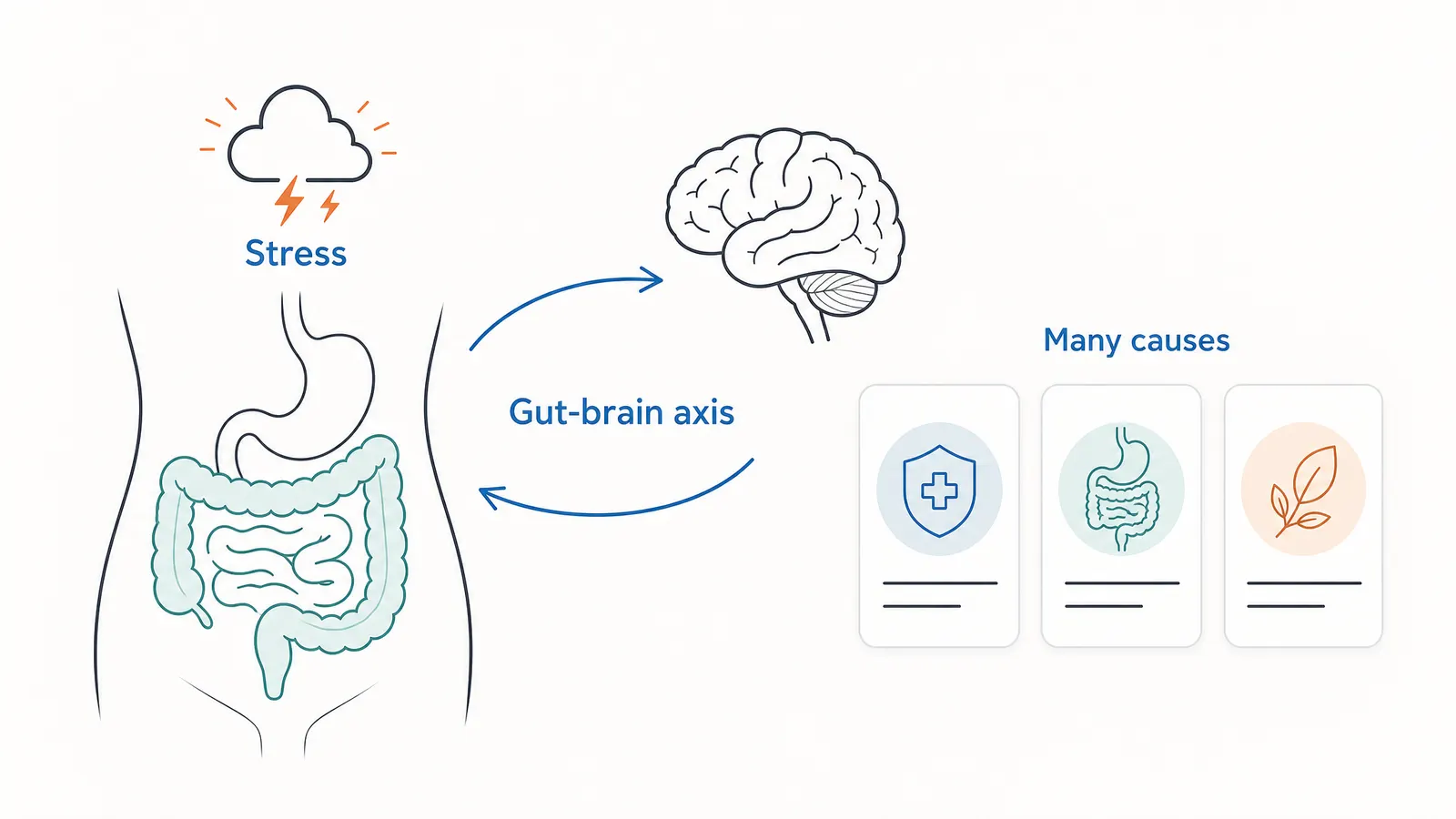
Short answer: Stress can absolutely affect your gut. It can change gut movement, pain sensitivity, appetite, immune signaling, and possibly the microbial ecosystem. But bloating, diarrhea, constipation, or stomach pain during stress do not prove that your microbiome is damaged. They are real symptoms, but they are not specific enough to diagnose dysbiosis, leaky gut, IBS, or the need for a commercial stool test.
Can stress really cause gut symptoms?
Yes. The gut and brain communicate through nerves, hormones, immune signals, microbial metabolites, and the hypothalamic-pituitary-adrenal stress system. That is why a deadline, conflict, exam, or grief can show up as nausea, cramping, urgency, constipation, reflux, or appetite changes. This is not imaginary. It is physiology.
The careful part is interpretation. A stress flare tells you that the gut-brain axis is active. It does not tell you which bacteria changed, whether inflammation is present, or whether a single probiotic, supplement, tea, or microbiome score will fix the problem. Stress-related gut symptoms need context: duration, severity, bowel pattern, medications, diet, sleep, menstrual cycle, infection history, and red flags.
What does stress do inside the gut?
Stress can affect the digestive tract in several overlapping ways. It may speed or slow motility, which can feel like diarrhea in one person and constipation in another. It can heighten visceral sensitivity, meaning normal stretching or gas feels painful. It can influence stomach acid, appetite, and food choices.
The microbiome may be part of this loop, but human evidence is still mixed. Controlled trials of probiotics or prebiotics for stress, mood, and cognition show signals in some settings, but effects are strain-specific, modest, and not universal.
Can stress damage your microbiome?
Stress can be associated with microbiome shifts, especially when it changes sleep, diet, alcohol intake, exercise, medication use, or bowel habits. But the word damage is often too strong. The microbiome is dynamic. A stressful month may shift it; that does not mean permanent injury or a single clear diagnosis.
What claims go beyond the evidence?
The strongest evidence supports a real bidirectional gut-brain connection and a relationship between stress and digestive symptoms. The weaker claims are the ones that promise precision from symptoms alone. Butterflies before a presentation are not proof of microbial imbalance. Stress diarrhea is not proof of leaky gut. Bloating after a difficult week does not automatically mean low Lactobacillus or Bifidobacterium.
Evidence summary
- The gut-brain axis is a real communication network linking stress biology with gut motility, sensitivity, immunity, and microbial signals.
- Stress can worsen IBS-type symptoms, but symptom flares do not identify a specific microbial cause.
- Human probiotic and prebiotic trials show possible stress or cognition effects, but results are heterogeneous and strain-specific.
- Stool microbiome testing may be educational, but it is not a diagnostic test for stress-related gut symptoms.
- Persistent or severe symptoms deserve clinical assessment, especially when red flags are present.
What actually helps a stressed gut?
The safest first-line approach is boring but evidence-aligned: regular meals, enough sleep, gradual fiber rather than sudden extremes, hydration, movement, and stress regulation that you can actually keep doing. Cognitive behavioral therapy, gut-directed hypnotherapy, mindfulness-based approaches, and low-FODMAP guidance can help some people with IBS-type patterns, ideally with professional support.
Probiotics can be reasonable experiments for selected people, but they should be treated as strain-specific trials, not universal gut repair. Stop if symptoms worsen.
When should you see a clinician?
Do not reduce everything to stress if you have blood in stool, black stool, unexplained weight loss, fever, persistent vomiting, anemia, nighttime diarrhea, severe or progressive pain, new symptoms after age 50, a family history of colorectal cancer or inflammatory bowel disease, or symptoms that persist despite reasonable self-care. Stress can coexist with medical disease. One does not rule out the other.
Bottom line
Stress can affect the gut through real biological pathways. The evidence supports taking stress-related digestive symptoms seriously, not dismissing them. But the same evidence also argues against overdiagnosis. Symptoms are signals, not microbiome proof. Use them to guide sensible habits and, when needed, clinical evaluation.
Evidence notes and sources
- Probiotic-mediated modulation of gut microbiome in students exposed to academic stress: a randomized controlled trial. npj Science of Food. https://doi.org/10.1038/s41522-025-00776-w
- Probiotics-induced changes in gut microbial composition and its effects on cognitive performance after stress: exploratory analyses. Translational Psychiatry. https://doi.org/10.1038/s41398-021-01404-9
- Anxiolytic effects of a galacto-oligosaccharides prebiotic in healthy females with corresponding changes in gut bacterial composition. Scientific Reports. https://doi.org/10.1038/s41598-021-87865-w
- Bifidobacterium longum 1714 as a translational psychobiotic. Translational Psychiatry. https://doi.org/10.1038/tp.2016.191
- Effects of Lactococcus lactis subsp. cremoris YRC3780 daily intake on the HPA axis response to acute psychological stress. European Journal of Clinical Nutrition. https://doi.org/10.1038/s41430-021-00978-3
Educational note: This article is for general education and does not diagnose, treat, or replace medical care.