Evidence-based response
How Often Should You Test for Gut Issues? Evidence-Based Answer Without the Hype
There is no single ideal microbiome testing frequency. The right interval depends on whether you are tracking a defined change, monitoring symptoms with a clinician, or simply buying repeat kits without a clear question.
By Sandra McKenzy, Pharmacist · 2026-06-01
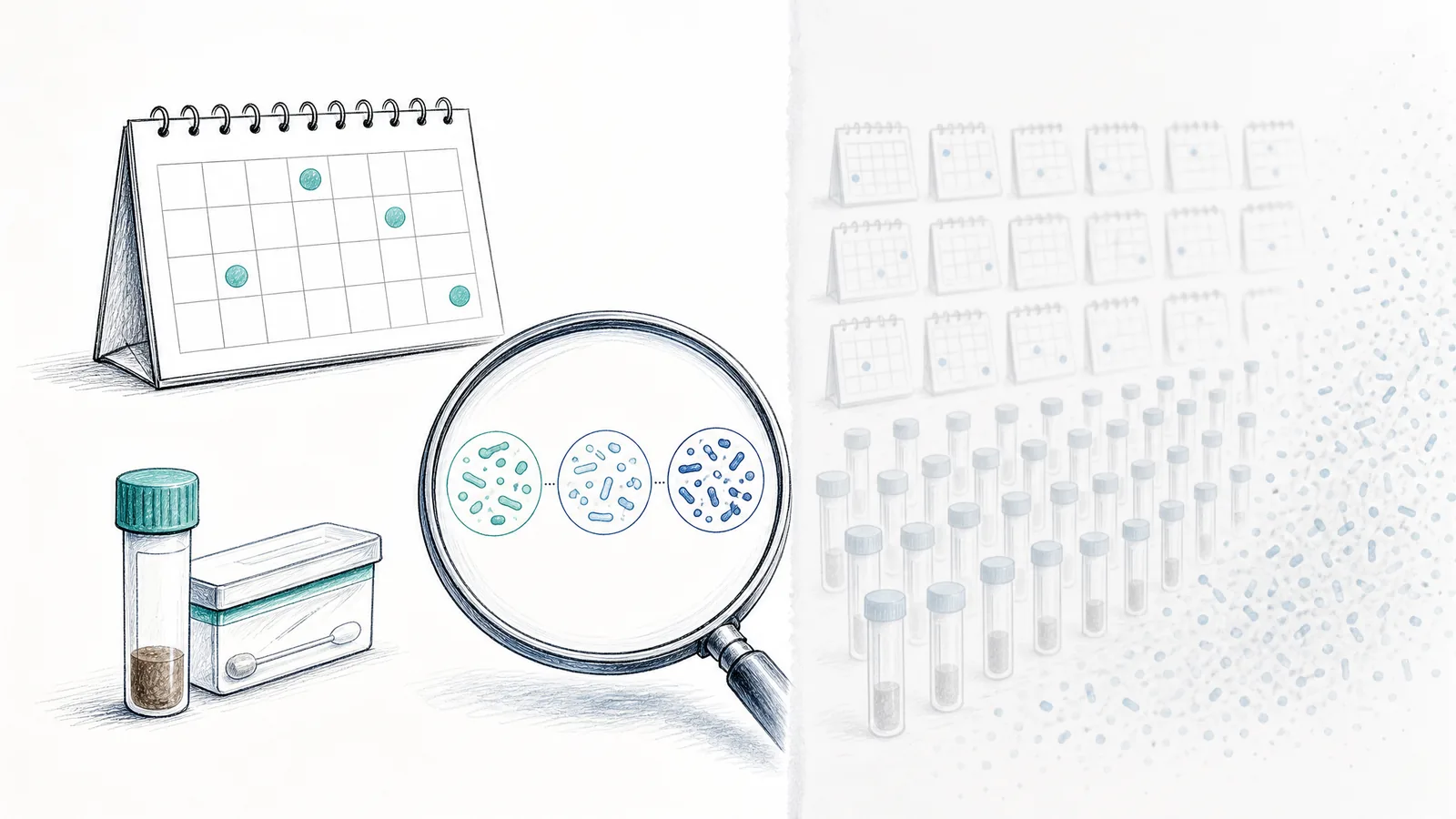
Short answer: There is no single evidence-based rule that everyone should repeat a gut microbiome test every month, quarter, or year. The sensible interval depends on the purpose. If you are tracking a defined diet, medication, or symptom change, spaced repeat testing may be informative. If you are using a microbiome kit as a substitute for real diagnosis, repeating it more often usually does not solve the underlying problem.
Why isn’t there one ideal testing frequency?
The gut microbiome is neither perfectly stable nor completely chaotic. Some features remain fairly consistent within a person over time, whereas others move with diet, bowel habits, illness, sample timing, and methodology. Because of that, the “right” retest interval depends on what you hope to learn and how much natural variability you can tolerate.
Evidence summary
- Many stool microbiome features are more stable within a person than between people, but day-to-day variation still exists.
- Sampling method, timing, and stool consistency can affect results.
- Repeat testing is more informative when the question is specific and the method is standardized.
- Frequent consumer retesting does not replace calprotectin, pathogen testing, FIT, or other targeted medical tests when symptoms warrant them.
- Without a clear question, more data can create more noise rather than more insight.
When can repeat testing make sense?
A repeat test can be reasonable after a meaningful exposure change: a course of antibiotics, a sustained dietary intervention, a supervised probiotic trial, or a longer-term recovery period after illness. Even then, a short interval may be too noisy. Testing every few days because of ordinary fluctuation rarely creates a clinically useful answer.
How often is too often?
If the same person keeps buying kits without a defined question, repeat testing can turn into false precision. Minor shifts may reflect stool consistency, collection timing, or short-lived diet changes rather than a meaningful biological trend. More frequent sampling is not automatically more scientific.
What marketing gets wrong
Some blogs imply that frequent testing is the key to “staying ahead” of gut problems. That framing treats the microbiome like a live stock ticker. In reality, interpretation depends on context, reproducibility, and what outcome matters. A new chart every month is not the same as better health care.
What if you have ongoing symptoms?
Persistent symptoms should drive the testing plan. If you have diarrhea, bleeding, weight loss, fever, severe pain, or nocturnal symptoms, the priority is targeted clinical evaluation. A repeat microbiome kit may add background information, but it should not delay testing that can detect inflammation, infection, bleeding, or structural disease.
Bottom line
The best testing frequency is question-driven, not marketing-driven. Repeat stool microbiome testing can be useful when you standardize collection and are tracking a real intervention over an appropriate interval. It becomes far less useful when it is used as a routine substitute for diagnosis or as a source of endless noisy trend lines.
Evidence notes
- Mehta et al. (2018). Stability of the human faecal microbiome in a cohort of adult men. Nature Microbiology. 10.1038/s41564-017-0096-0
- Vandeputte et al. (2021). Temporal variability in quantitative human gut microbiome profiles and implications for clinical research. Nature Communications. 10.1038/s41467-021-27098-7
- Vogtmann et al. (2021). Fecal sample collection methods and time of day impact microbiome composition and short chain fatty acid concentrations. Scientific Reports. 10.1038/s41598-021-93031-z
- Sonnenburg et al. (2021). Introduction to host microbiome symbiosis in health and disease. Mucosal Immunology. 10.1038/s41385-020-00365-4
- Roodgar et al. (2019). Rethinking gut microbiome residency and the Enterobacteriaceae in healthy human adults. The ISME Journal. 10.1038/s41396-019-0435-7
- Quigley (2017). Gut microbiome as a clinical tool in gastrointestinal disease management: are we there yet? Nature Reviews Gastroenterology & Hepatology. 10.1038/nrgastro.2017.29
This article is educational and does not diagnose, treat, or replace care from a qualified clinician.