Evidence-based response
How Long Does Gut Dysbiosis Take to Heal? Evidence-Based Timeline Without the Hype
Gut flora recovery can begin within days or weeks after a defined disruption, but full ecological recovery varies and may take months.
By Sandra McKenzy, Pharmacist · 2026-06-06
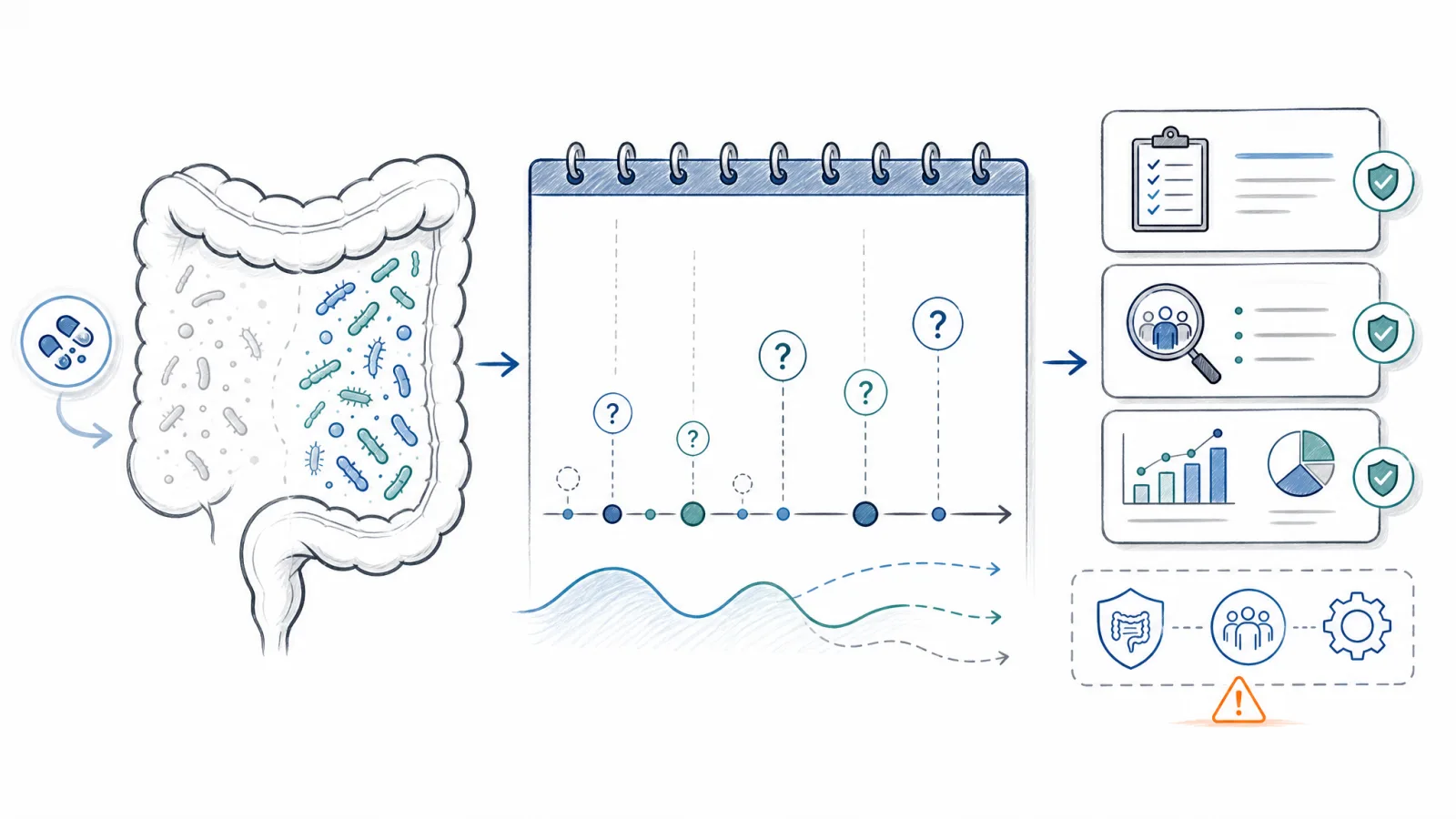
Short answer: Gut dysbiosis does not heal on one universal schedule. After a defined trigger such as antibiotics, some microbiome features may begin to rebound within days or weeks, while specific strains, diversity patterns, and resistance genes can remain altered for months. A stool microbiome test can document patterns, but it cannot prove that the gut is fully healed or prescribe a guaranteed recovery timeline.
How long does gut dysbiosis take to heal?
The most evidence-based answer is a range, not a promise. Mild, short-lived disruption after a temporary diet change, viral illness, travel, or a brief medication exposure may improve as the trigger resolves and the person returns to a stable eating pattern. Antibiotic-associated disruption is more measurable: studies in healthy adults show partial recovery after a clinically relevant antibiotic course, but also show that some taxa and functions can remain different months later. That is why a neat claim such as two weeks, six weeks, or six months is too precise unless the trigger, person, method, and definition of recovery are named.
InnerBuddies has published a consumer-facing recovery timeline article. This response uses that search intent as a starting point and narrows the standard to what current clinical microbiome evidence can support. The key correction is that microbiome recovery is personal, ecological, and context dependent. A report may show movement toward a reference range, but reference range does not equal clinical cure.
Evidence summary
- Antibiotic exposure can disturb gut microbial diversity, strain composition, and resistance genes, with partial recovery often occurring before full ecological recovery.
- Recovery varies by baseline microbiome, antibiotic type, diet, age, illness, medications, and repeated exposures.
- Microbiome testing can track composition over time, but current consumer tests do not define a validated healed state for most people.
- Diet quality, fiber patterns, and clinical context matter more than chasing a single diversity score.
- Persistent diarrhea, bleeding, fever, weight loss, dehydration, or severe pain should be evaluated clinically rather than explained as dysbiosis alone.
What does gut flora recovery actually mean clinically?
Clinically, gut flora recovery can mean several different things. It can mean the return of broad diversity, the regrowth of specific commensal organisms, improved short-chain fatty acid production, fewer opportunistic pathogens, lower carriage of resistance genes, or improvement in symptoms. Those are not identical endpoints. A person may feel better before the microbial community resembles baseline. Another person may have a report that looks more diverse while symptoms persist because the main driver is inflammatory bowel disease, bile acid diarrhea, celiac disease, medication effects, infection, or another diagnosis.
This distinction matters because the word dysbiosis is often used as if it were a precise diagnosis. In research, dysbiosis usually describes a difference from a comparator group or a disruption from a previous state. It does not automatically identify the cause of symptoms or tell a clinician which treatment will work. A safer article should separate recovery of an ecosystem from recovery of a patient.
What timelines are best supported?
The best-supported timelines are tied to antibiotic studies. In the Nature Microbiology study of healthy adults after broad-spectrum antibiotics, the gut microbiota showed substantial recovery, but not all taxa returned by the final follow-up, and the resistome remained an important part of interpretation. Later work emphasized that strain-level recovery after antibiotics can be individualized. Reviews of antibiotic-perturbed microbiota also stress that probiotic effects are not one-size-fits-all and that host context influences whether a product helps, does little, or complicates interpretation.
A cautious practical range is this: early symptom improvement may occur in days to weeks, broad compositional recovery may occur over weeks to months after a defined insult, and some microbial or functional changes may persist longer. That range should not be converted into a guaranteed personal countdown. If a person has repeated antibiotics, chronic inflammation, major dietary restriction, proton pump inhibitor use, immunosuppression, recurrent infection, or active gastrointestinal disease, the timeline becomes less predictable.
Can a microbiome test show that dysbiosis is healed?
A stool microbiome test can show what was measured in that sample at that time. It can compare taxa, diversity, functional predictions, or pathogen-associated signals depending on the platform. That can be useful for research and sometimes useful as context. It is not the same as a validated recovery certificate. Most consumer reports do not prove that the gut barrier is repaired, inflammation is absent, nutrient absorption is normal, or a disease has resolved.
Repeated testing can show direction of change, but interpretation still needs caution. Stool represents the colonic lumen more than the whole intestine. Sampling, shipping, sequencing method, database, algorithm, diet in the preceding days, and recent medications all affect results. A responsible report should describe uncertainty and should not turn a score into a medical diagnosis without conventional evaluation when symptoms or red flags are present.
Which claims go beyond the evidence?
The main overclaim is that a fixed recovery plan can reliably heal gut flora in a predictable number of weeks. Another overclaim is that low diversity or an unfavorable score always explains bloating, fatigue, skin symptoms, mood changes, or pain. Those symptoms can occur with microbiome shifts, but they are nonspecific. They can also reflect infection, inflammatory disease, endocrine disease, anemia, food intolerance, medication effects, stress physiology, or disorders of gut-brain interaction.
Advice about fiber, plants, fermented foods, sleep, activity, and avoiding unnecessary antibiotics is generally sensible when matched to tolerance and medical context. It becomes misleading when framed as a guaranteed cure for dysbiosis. People with active IBD flares, strictures, severe IBS, histamine sensitivity, small intestinal bacterial overgrowth concerns, or malnutrition may need tailored guidance rather than generic high-fiber escalation.
What does marketing often get wrong?
Marketing often compresses three layers into one claim. The first layer is biological plausibility: microbes can change after antibiotics, diet, illness, and stress. The second layer is measurement: stool sequencing can detect some of those changes. The third layer is action: a specific person should buy a test, supplement, or membership because it will restore balance on schedule. The first two layers can be true while the third remains unproven.
Good microbiome communication protects the reader by making the boundary visible. It says what was studied, what was measured, what population was included, and what outcome changed. It also says when the evidence is animal-based, indirect, mechanistic, or not yet validated for clinical decision-making. Diet and microbiome research is important, but importance is not the same as certainty.
What studies actually show
MedicalBrain validation for this article found peer-reviewed evidence that antibiotic exposure can perturb gut microbial ecology and that recovery is measurable but variable. It also found newer work on antibiotic-perturbed microbiota and probiotics, studies of diarrheal recovery, and diet-microbiota interaction papers. The pattern is consistent: the microbiome can recover, but the recovery path is shaped by the starting ecosystem, the insult, and the surrounding clinical environment.
The strongest sources support modest conclusions. Antibiotics can reduce susceptible organisms and select for resistant ones. Some community features rebound; some strain-level features may not return quickly. Diet can influence microbiome structure and metabolites, but a mouse recovery model or a metabolic trial should not be oversold as a simple human gut-healing timetable. Translation into routine care requires defined outcomes and careful interpretation.
When should you see a clinician?
Do not wait for a microbiome recovery plan to work if you have blood in stool, black stools, unexplained weight loss, persistent fever, severe or worsening abdominal pain, dehydration, ongoing vomiting, nighttime diarrhea, anemia, new symptoms after age 50, recent hospitalization, recent antibiotic exposure with significant diarrhea, pregnancy-related concerns, immunosuppression, or symptoms that keep recurring despite basic care. These signs need clinical evaluation because infections, inflammatory bowel disease, colorectal disease, medication complications, and other conditions can look like ordinary gut trouble at first.
Also seek medical advice if you are considering probiotics while immunocompromised, critically ill, using a central venous catheter, caring for a premature infant, or dealing with severe chronic disease. Probiotics are not automatically harmless in every context.
Bottom line
Gut dysbiosis recovery is real, but it is not a stopwatch. The most defensible answer is that recovery may begin within days or weeks after a defined disruption, broader recovery may take weeks to months, and some microbial or functional changes can persist longer. A microbiome test may help track patterns, but it does not by itself prove healing or replace medical evaluation.
The reader-protective approach is practical: avoid unnecessary antibiotics, rebuild diet gradually around tolerated plant diversity and fiber, sleep consistently, manage triggers, and seek care for red flags. Be skeptical of any article, product, or report that turns a complex ecological process into a guaranteed recovery date.
Evidence notes
- Recovery of gut microbiota of healthy adults following antibiotic exposure. Nature Microbiology. 10.1038/s41564-018-0257-9
- Individualized recovery of gut microbial strains post antibiotics. npj Biofilms and Microbiomes. 10.1038/s41522-019-0103-8
- Antibiotic-perturbed microbiota and the role of probiotics. Nature Reviews Gastroenterology & Hepatology. 10.1038/s41575-024-01023-x
- The impact of antibiotics on the gut microbiota of children recovering from watery diarrhoea. Nature Microbiology. 10.1038/s44259-024-00030-x
- Diet outperforms microbial transplant to drive microbiome recovery in mice. Nature. 10.1038/s41586-025-08937-9
- Diet-microbiota interactions and personalized nutrition. Nature Reviews Microbiology. 10.1038/s41579-019-0256-8
- Clinical translation of microbiome research. Nature Medicine. 10.1038/s41591-025-03615-9
This article is educational and does not diagnose, treat, or replace care from a qualified clinician.