Evidence-based response
How Is the Gut Microbiome Studied? Evidence-Based Answer Without the Hype
Gut microbiome studies use sequencing, culture, metabolomics, and bioinformatics, but a test result is not a diagnosis without clinical context.
By Sandra McKenzy, Pharmacist · 2026-05-31
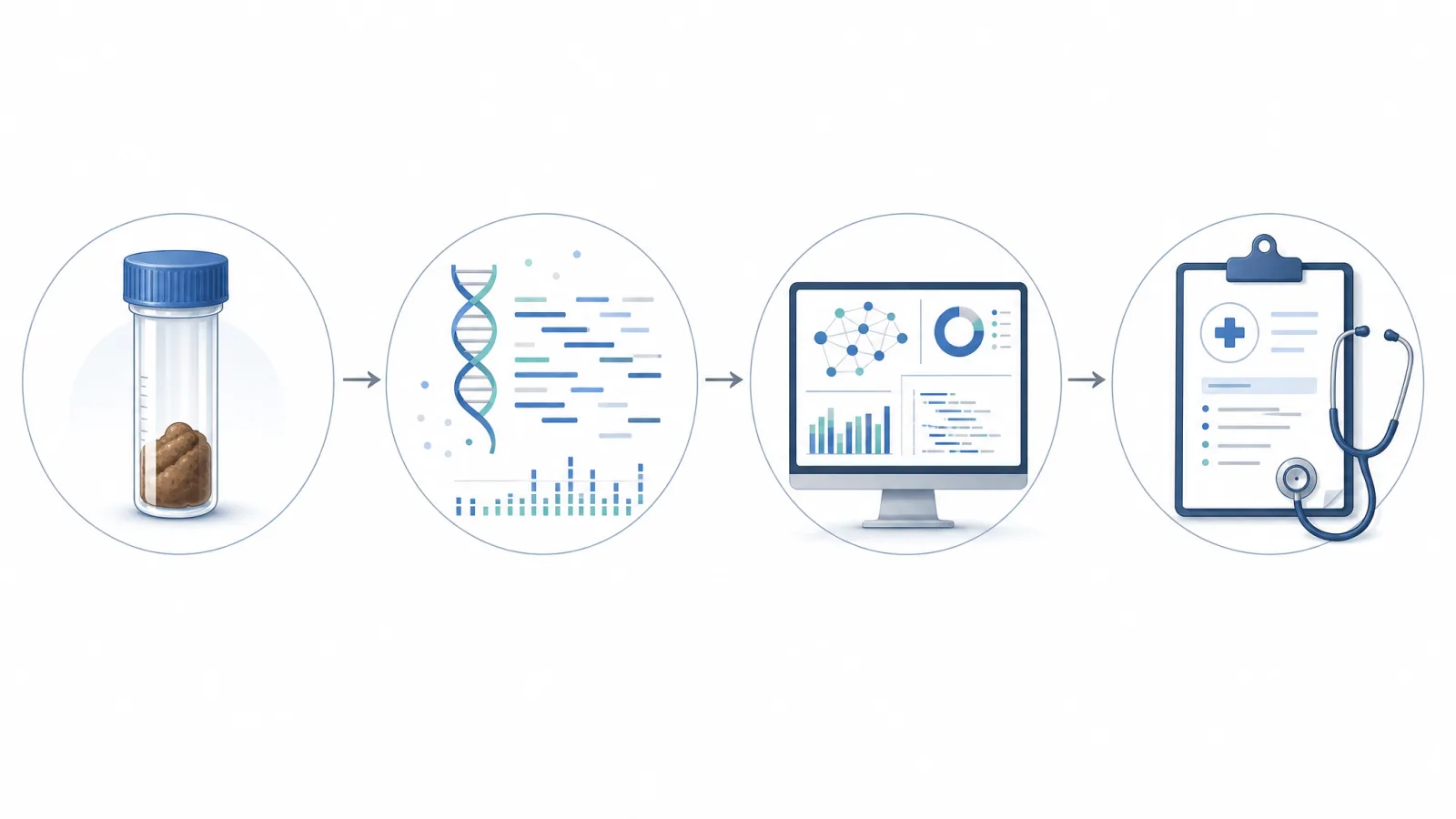
Short answer: Scientists study the gut microbiome with stool sampling, culture, 16S rRNA sequencing, shotgun metagenomics, metatranscriptomics, metabolomics, and bioinformatics. These tools can describe microbial patterns and generate useful hypotheses, but a consumer microbiome test is not the same as a diagnosis, and results depend heavily on sampling, laboratory method, reference database, and clinical context.
How is the gut microbiome studied?
The gut microbiome is studied by collecting biological samples, usually stool for large human studies, then measuring microbial DNA, RNA, proteins, metabolites, or cultured organisms. Each method answers a different question. A stool sample can show which microbial DNA fragments were present in that sample. A culture experiment can show how a living organism behaves in the laboratory. Metabolomics can show chemical products such as short-chain fatty acids or bile acid derivatives. Clinical research then asks whether these measurements relate to symptoms, medications, diet, disease risk, or treatment response.
That distinction matters because popular summaries often make the workflow sound more direct than it is. A sequencing report is not a window into every living microbe in the gut. It is a processed signal produced by collection, storage, DNA extraction, sequencing chemistry, bioinformatics, and a reference database. Good research treats each step as a possible source of bias and documents it clearly.
What is 16S rRNA sequencing used for?
16S rRNA gene sequencing targets a marker gene found in bacteria and archaea. Because parts of that gene vary between groups, researchers can use it to estimate broad bacterial composition. It is relatively affordable, scalable, and useful for comparing many samples across diet, geography, disease status, or treatment groups.
Its limit is resolution. 16S usually does not identify all organisms to strain level, does not directly measure genes outside that marker, and does not profile viruses or fungi well. It can tell researchers that a bacterial group appears more or less abundant, but it does not prove that group caused a symptom or that changing it will treat a disease.
What does shotgun metagenomics add?
Shotgun metagenomics sequences many DNA fragments from the sample instead of one marker gene. This can improve taxonomic resolution, include non-bacterial organisms when enough signal is present, and support functional profiling. In research, shotgun metagenomics can help identify microbial genes involved in carbohydrate metabolism, drug metabolism, bile acids, or other pathways.
More detail is not the same as automatic medical certainty. Shotgun data are still affected by sampling, sequencing depth, host DNA, contamination, databases, and analytic choices. A laboratory can generate millions of reads and still produce a report that is exploratory rather than diagnostic.
Evidence summary
- 16S sequencing is useful for broad bacterial community profiling, but it has limited species and strain resolution.
- Shotgun metagenomics can add functional and strain-level information, yet still depends on reference databases and analysis pipelines.
- Stool samples are convenient, but collection, storage, stool consistency, and DNA extraction can change measured composition.
- Microbiome diversity is often associated with health, but diversity alone is not a diagnosis.
- Clinical interpretation requires symptoms, medications, diet, geography, disease history, and validated clinical endpoints.
Can a microbiome test tell you if your gut is healthy?
A microbiome test can describe features that may be relevant to health, such as diversity, dominant taxa, and predicted functions. It cannot by itself define whether a person is healthy. There is no single universal healthy microbiome that applies to every age, diet, geography, medication pattern, and clinical condition.
Low diversity, unusual dominance of one group, or a dysbiosis score may justify a careful look at diet, medication history, recent antibiotics, or symptoms. Those findings do not prove a disease cause. They should not replace tests for inflammation, infection, bleeding, malabsorption, celiac disease, inflammatory bowel disease, or colorectal cancer when those are clinically relevant.
What marketing gets wrong about microbiome research methods
The common mistake is to treat research-grade measurement as instant personalized medicine. Researchers can find associations between microbiome patterns and inflammatory bowel disease, metabolic disease, medication exposure, or diet. Turning those associations into a reliable recommendation for one person is harder. It requires validation, reproducibility, clinically meaningful outcomes, and evidence that acting on the result improves health.
Another mistake is to imply that more sequencing automatically means better advice. Better methods can improve resolution, but advice still depends on whether the measured feature has a validated interpretation. A report that ends with generic advice to eat more fiber, diversify plants, sleep well, and move regularly may still be sensible, but that advice does not prove the test was medically necessary.
When is microbiome testing most useful?
Microbiome testing is strongest in research, longitudinal tracking, population studies, and carefully designed clinical investigations. It is also useful educationally when a report is transparent about uncertainty. It becomes risky when it claims to diagnose vague symptoms, prescribe supplements with high confidence, or explain anxiety, fatigue, skin changes, bloating, or immune problems without a medical workup.
When should you see a clinician instead of relying on a microbiome result?
Seek medical care for blood in stool, black stools, persistent diarrhea, fever, unexplained weight loss, anemia, severe or worsening abdominal pain, nighttime symptoms, dehydration, immune suppression, recent antibiotic-associated watery diarrhea, inflammatory bowel disease, or family history of colorectal cancer. In those situations, the first question is not which bacteria appear in a stool profile. The first question is which validated clinical test is needed.
Bottom line
The gut microbiome is studied with powerful methods, but each method has boundaries. 16S sequencing, shotgun metagenomics, metabolomics, culture, and bioinformatics are research tools that can reveal patterns. They do not remove the need for clinical context. A careful microbiome article should explain both the technology and the uncertainty, because the science is impressive precisely when it is not oversold.
Evidence notes
- Knight et al. (2018). Best practices for analysing microbiomes. Nature Reviews Microbiology. 10.1038/s41579-018-0029-9
- Quince et al. (2017). Shotgun metagenomics, from sampling to analysis. Nature Biotechnology. 10.1038/nbt.3935
- Franzosa et al. (2018). Species-level functional profiling of metagenomes and metatranscriptomes. Nature Methods. 10.1038/s41592-018-0176-y
- Costea et al. (2019). Stool sampling and DNA isolation kits affect DNA quality and bacterial composition. Scientific Reports. 10.1038/s41598-019-49520-3
- Human Microbiome Project Consortium (2012). Structure, function and diversity of the healthy human microbiome. Nature. 10.1038/nature11234
- Vandeputte et al. (2016). Stool consistency is strongly associated with gut microbiota richness and composition. Gut. 10.1136/gutjnl-2015-309618
- Mizuno et al. (2017). Gut microbiome as a clinical tool in gastrointestinal disease management: are we there yet?. Nature Reviews Gastroenterology & Hepatology. 10.1038/nrgastro.2017.29
This article is educational and does not diagnose, treat, or replace care from a qualified clinician.