Evidence-based response
How Is Microbiome Metabolic Potential Measured? Evidence-Based Answer Without the Hype
Metagenomic pathway analysis can estimate microbial capacity, but it does not prove real-time activity, diagnosis, or personalized treatment need by itself.
By Sandra McKenzy, Pharmacist · 2026-05-29
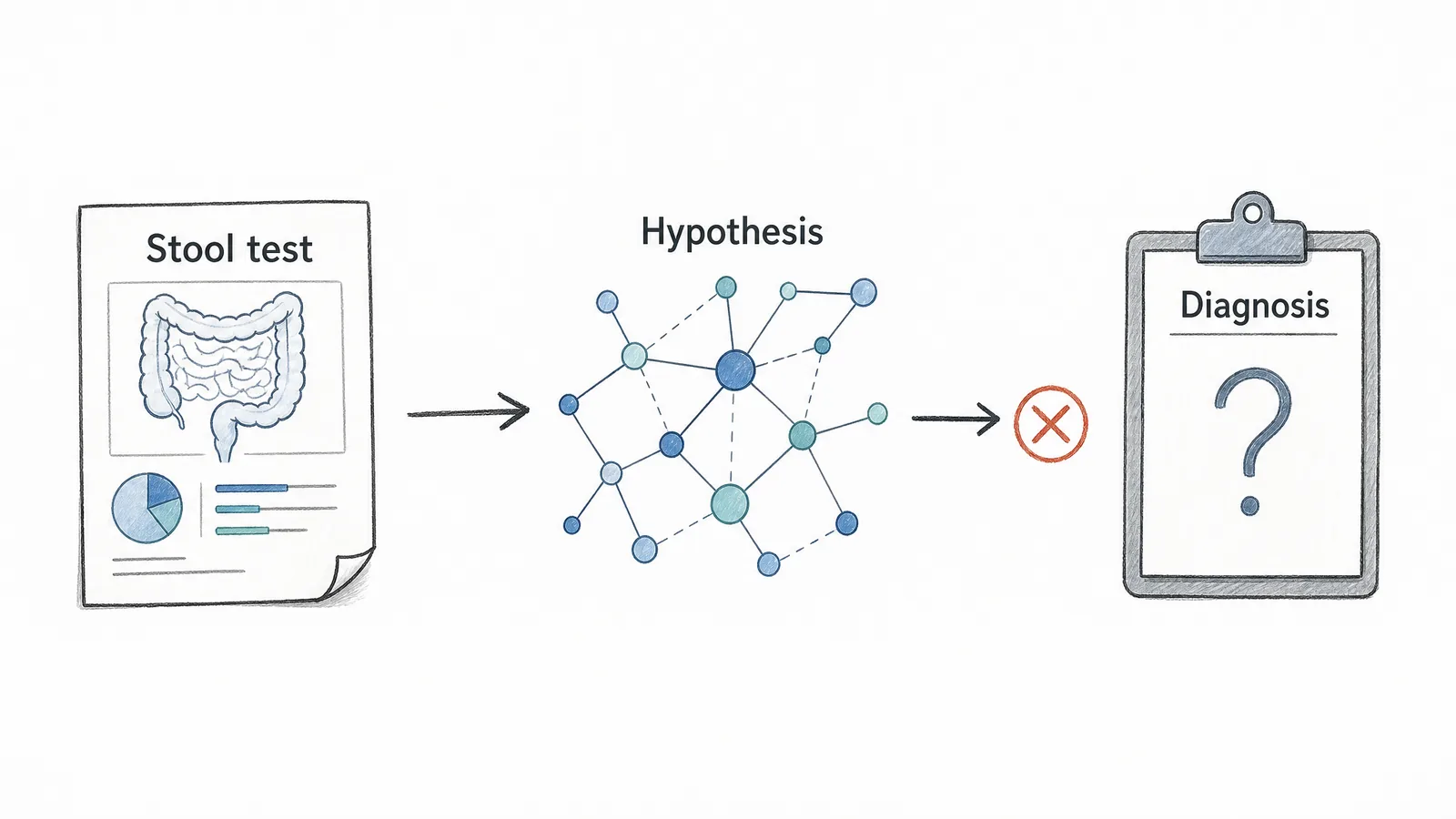
Short answer: Measuring a microbiome's “metabolic potential” can be scientifically meaningful, especially with shotgun metagenomic sequencing and pathway analysis. But potential is not the same as real-time activity, clinical diagnosis, or a personalized treatment prescription. A stool result can suggest what microbes may be capable of doing, not prove what they are doing inside your gut today.
What does metabolic potential mean in microbiome testing?
Metabolic potential usually refers to genes or inferred pathways found in microbial DNA. Instead of only asking which organisms are present, metagenomic analysis can ask whether the community carries genes linked to fiber fermentation, short-chain fatty acid production, bile acid transformation, vitamin synthesis, amino acid metabolism, or other biochemical functions.
That is a real advance over a simple species list. The same broad bacterial group can behave differently depending on strain, genes, diet, medication exposure, transit time, and host context. Functional pathway analysis gives a more mechanistic view of the ecosystem.
What can pathway analysis tell you?
It can estimate capacity. For example, a report may infer that a stool community has more or fewer genes associated with carbohydrate breakdown, butyrate production, or plant-compound transformation. In research, those patterns can be linked with diet, inflammation, cardiometabolic markers, or disease states.
The key word is estimate. DNA-based analysis cannot automatically measure actual metabolite concentrations, enzyme activity, mucosal immune response, nutrient absorption, or symptom causality. For that, researchers often need metatranscriptomics, metabolomics, clinical phenotyping, dietary records, repeated sampling, and controlled intervention studies.
Can metabolic potential personalize diet and supplements?
It can support cautious hypotheses. If a report suggests low fiber-fermentation capacity, a clinician or dietitian might consider a gradual fiber strategy, symptom context, constipation or diarrhea pattern, and medical history. If a pathway is associated with bile acid metabolism, that may be scientifically interesting but still not enough to prescribe supplements or diagnose a bile acid disorder.
Personalized nutrition based on the microbiome is promising, and large studies show links between gut microbes, habitual diet, and metabolic responses. But most consumer reports are not validated as medical decision tools. The distance between “your stool sample contains pathway genes” and “you should take this product” is where overclaiming often happens.
What is actually supported?
- Shotgun metagenomics can provide species-level and functional pathway information beyond many 16S tests.
- Functional pathways describe potential capacity, not guaranteed real-time activity.
- Microbiome features are associated with diet and metabolic markers, but associations do not equal prescriptions.
- Sample type, methods, databases, and bioinformatics pipelines can change interpretation.
- Consumer microbiome reports are best read as educational hypotheses unless clinically validated for a specific use.
What marketing often gets wrong
The phrase “metabolic potential” sounds more precise than it is for an individual consumer. It can imply that a test sees the gut working in real time. Most DNA-based stool analysis does not. It sees genetic material in stool and uses databases to infer what functions might be possible.
Another common leap is calling recommendations personalized when the evidence is still probabilistic. A pathway score may align with general advice to eat more tolerated plant foods, diversify fiber sources, or reduce ultra-processed foods. Those are useful recommendations, but they are not always unique to the person, and they should not be presented as proven correction of a specific metabolic defect.
Can a stool sample represent the whole gut?
Stool is practical and valuable, but it is not the entire gut. The small intestine, mucus layer, rectal mucosa, and stool can show different microbial signals. A single stool sample is also affected by recent diet, transit time, antibiotics, bowel habits, storage, extraction methods, sequencing depth, and database choices.
This does not make testing useless. It means interpretation should be modest. The stronger the clinical claim, the stronger the validation should be. A wellness insight requires less proof than a diagnostic or treatment recommendation.
When should metabolic testing not delay care?
Do not use pathway results to explain away red flags: blood in stool, persistent diarrhea, fever, unexplained weight loss, anemia, severe abdominal pain, jaundice, recurrent vomiting, dehydration, new bowel changes after age 50, or symptoms in pregnancy or immune suppression. Those situations need conventional medical evaluation.
Bottom line
Microbiome metabolic potential is a legitimate research concept and can make stool reports more informative than organism lists alone. But it remains a map of possible functions, not a live readout of your health. Treat it as a hypothesis generator, then anchor decisions in symptoms, diet, medical history, validated tests, and clinician guidance when symptoms are significant.
Evidence notes
- Quigley (2017). Gut microbiome as a clinical tool in gastrointestinal disease management: are we there yet? Nature Reviews Gastroenterology & Hepatology. 10.1038/nrgastro.2017.29
- Asnicar et al. (2021). Microbiome connections with host metabolism and habitual diet from 1,098 deeply phenotyped individuals. Nature Medicine. 10.1038/s41591-020-01183-8
- Heinken et al. (2021). Metabolic modelling reveals broad changes in gut microbial metabolism in inflammatory bowel disease patients with dysbiosis. NPJ Systems Biology and Applications. 10.1038/s41540-021-00178-6
- Budding et al. (2021). On the robustness of inference of association with the gut microbiota in stool, rectal swab and mucosal tissue samples. Scientific Reports. 10.1038/s41598-021-94205-5
- Sepich-Poore et al. (2025). Clinical translation of microbiome research. Nature Medicine. 10.1038/s41591-025-03615-9
- Huang et al. (2026). Gut microbiome-mediated transformation of dietary phytonutrients is associated with health outcomes. Nature Microbiology. 10.1038/s41564-025-02197-z
- Claesen and Xavier (2025). Credible inferences in microbiome research: ensuring rigour, reproducibility and relevance in the era of AI. Nature Reviews Gastroenterology & Hepatology. 10.1038/s41575-025-01100-9
This article is educational and does not diagnose, treat, or replace care from a qualified clinician.