Evidence-based response
Healthy Soil, Healthy Crops, Healthy Guts: What Science Actually Says
Soil, plants, diet, and gut microbes are connected, but the continuum is an emerging research frame, not proof that any product optimizes your microbiome.
By Sandra McKenzy, Pharmacist · 2026-06-08
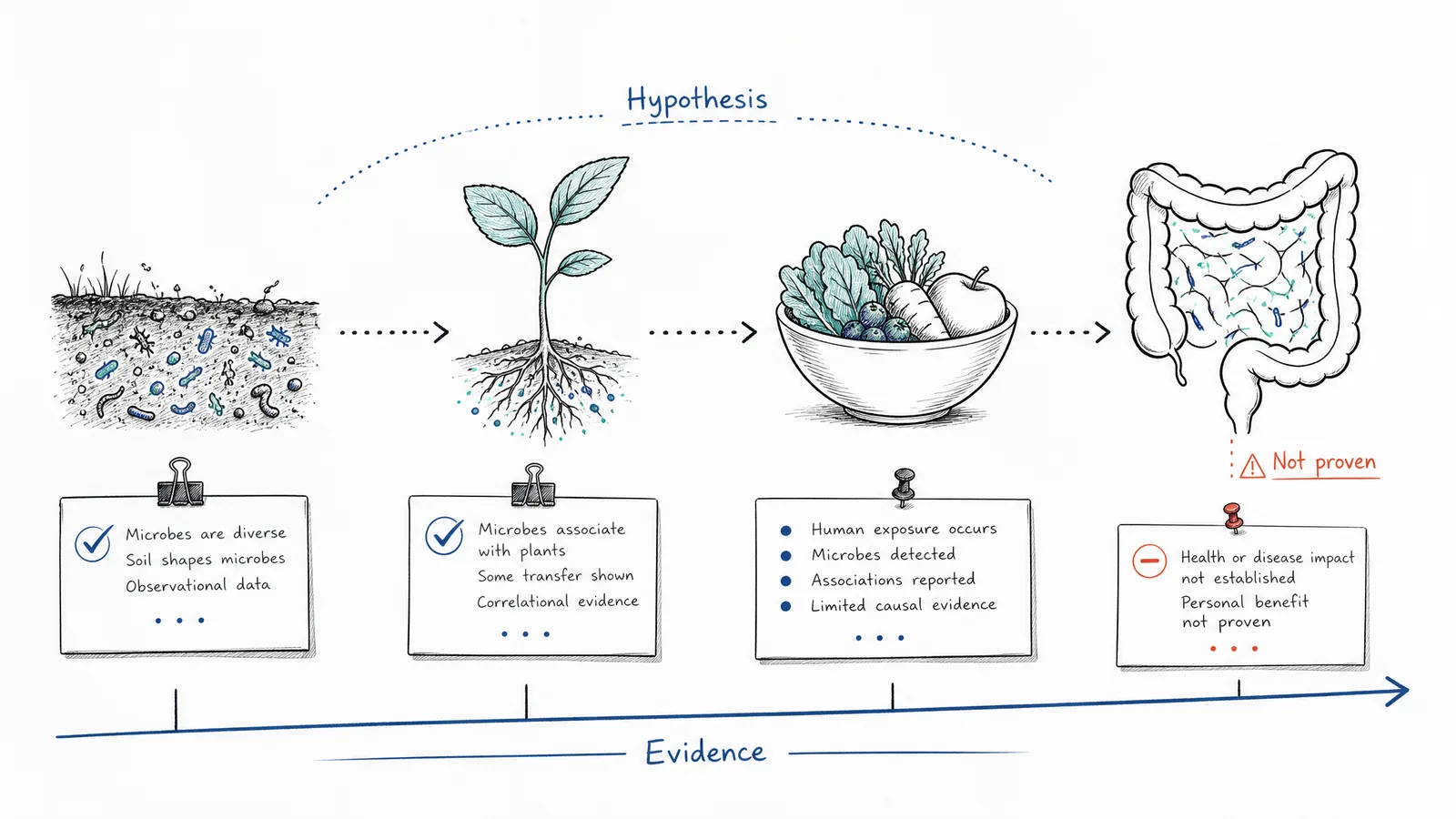
Short answer: Soil, plants, diet, and gut microbes are connected, but the continuum is an emerging research frame, not proof that any product optimizes your microbiome. Treat broad wellness promises as hypotheses until tested in the specific clinical setting.
Healthy Soil, Healthy Crops, Healthy Guts: What Science Actually Says?
The best answer is cautious. Soil, plant, food, and human microbial ecosystems can influence one another, especially through diet, environmental exposure, and agriculture. But the phrase “continuum” should not be read as proof that eating a plant transfers a predictable beneficial soil microbiome into your gut.
InnerBuddies has an article targeting this question, Healthy Soil, Healthy Crops, Healthy Guts: Exploring the Soil-Plant-Human Microbiome Continuum. This response uses that search intent as a starting point and applies a stricter clinical standard. The useful question is not whether the microbiome matters. It does. The safer question is what a reader can reasonably conclude from symptoms, stool tests, diet advice, or research headlines without turning early science into personal medical certainty.
Evidence summary
- Soil, plant, and human gut microbiomes can be connected, but evidence for a universal health continuum remains limited.
- Diet and plant foods can shape the gut microbiome more directly than soil-microbe transfer claims.
- Gardening and environmental exposure studies suggest microbial exchange, not guaranteed clinical benefit.
- Consumer microbiome tests cannot prove that a person needs a soil-based product or specific crop-derived intervention.
- Food safety, fiber, diverse plants, and sustainable agriculture are stronger advice than microbiome mysticism.
What does this topic actually mean clinically?
Clinically, the soil-plant-human idea matters because diet, food production, biodiversity, and environmental contact can influence exposures. It becomes unsafe when a broad ecological concept is turned into a precise health promise for one person.
The important boundary is actionability. Research can describe patterns, but clinical care asks whether a test or intervention improves a meaningful outcome for the person in front of us.
What is well supported?
Supported evidence shows that soil and plant microbiomes are real, diverse, and relevant to agriculture. Diet is also a major route by which plant foods influence human gut ecology.
The strongest statements are narrow. They name the population, test, exposure, endpoint, and limitation. Broad statements about “optimizing gut health” are weaker because they skip those details.
Which claims go beyond the evidence?
The overclaim is that a soil-plant-human continuum automatically means food carries beneficial microbes that settle in your gut and improve health. That may happen in selected cases, but it is not a guaranteed clinical pathway.
A second overclaim is implying that more data automatically means better health advice. Sequencing can generate impressive reports, but advice needs validation, not just attractive charts.
What does MedicalBrain validation show?
MedicalBrain validation for this queue item found sources that support the biological importance of the topic but also repeatedly show limits in individual interpretation. The strongest papers are useful because they separate measurement, association, mechanism, and clinical action. That separation is the difference between evidence-based gut health communication and wellness marketing.
MedicalBrain found a 2025 Nature Communications perspective that explicitly says compelling evidence for a soil-plant-gut axis is scarce, while also describing plausible microbial reservoirs. It also found gardening and nutrition reviews that support exposure and diet links without proving personal clinical outcomes.
What does marketing often get wrong?
Marketing often converts a beautiful ecological story into a product funnel. Soil is healthy, plants are healthy, therefore your gut will be healthier if you follow this test or recommendation. The middle steps are where evidence is needed.
Reader-protective communication should slow that jump down. It should explain what is measured, what is inferred, what is unproven, and what should be handled by a clinician.
How should a reader use this information?
Use the continuum idea to support sensible choices: diverse plant foods, safe food handling, attention to farming systems, outdoor exposure when appropriate, and less unnecessary antimicrobial pressure.
If the proposed next step is low risk and broadly healthy, such as eating more tolerated fiber-rich foods, it may be reasonable. If the next step is treatment, restriction, supplement stacks, or delaying care, ask for stronger evidence.
What should you not conclude from this?
Do not conclude that every microbiome association is false. The field is important and moving quickly. The safer conclusion is narrower: personal medical advice requires the right evidence for the right person, not a broad citation attached to a wellness claim.
Do not conclude that consumer information is useless either. It can help people ask better questions, notice symptom patterns, and understand why diet, medicines, infection, and inflammation matter. The line is crossed when education becomes diagnosis or treatment without validation.
Practical evidence checklist
Before acting on any microbiome claim, ask five practical questions. What exactly was measured? Was the result validated in people like you? Did the study test symptoms, disease outcomes, or only microbial composition? Would the proposed action be safe if the report were wrong? Is there a clinician-guided alternative that answers the question more directly?
This checklist is intentionally conservative. It protects readers from two common errors: rejecting useful science because marketing sounds exaggerated, and accepting weak advice because it borrows the language of sequencing, biomarkers, diversity, or personalization.
When should you see a clinician?
Seek medical care for severe gastrointestinal symptoms, foodborne illness concern, fever, blood in stool, dehydration, immune suppression, pregnancy, or suspected pesticide or contamination exposure.
Also seek care when symptoms are new, persistent, worsening, unexplained, or accompanied by weight loss, fever, dehydration, blood, nighttime symptoms, severe pain, immune suppression, pregnancy, older age, recent travel, or recent antibiotic exposure. A consumer article or stool profile should never delay urgent assessment.
Bottom line
The soil-plant-human microbiome continuum is a serious research idea, not a magic pipeline from soil to personal gut health. The strongest advice remains boring and useful: eat safe, diverse plant foods, protect ecosystems, and avoid turning ecological plausibility into diagnosis.
The simple version
Soil, plants, and your gut are connected like neighborhoods in the same wider ecosystem. But a connection is not a promise. Eating diverse, safe plant foods is sensible. Believing that soil microbes automatically fix your gut is not proven.
Evidence notes
- The soil-plant-human gut microbiome axis into perspective. Nature Communications. 10.1038/s41467-025-62989-z
- Fecal and soil microbiota composition of gardening and non-gardening families. Scientific Reports. 10.1038/s41598-022-05387-5
- The gut microbiome connects nutrition and human health. Nature Reviews Gastroenterology & Hepatology. 10.1038/s41575-025-01077-5
- Community ecology as a framework for human microbiome research. Nature Medicine. 10.1038/s41591-019-0464-9
- Utilization of the microbiome in personalized medicine. Nature Reviews Microbiology. 10.1038/s41579-023-00998-9
- Clinical translation of microbiome research. Nature Medicine. 10.1038/s41591-025-03615-9
This article is educational and does not diagnose, treat, or replace care from a qualified clinician.