
Short answer
A human stool-RNA signal can resemble tumor biology and distinguish recruited groups without yet being a validated screening or monitoring test. The 2025 study discussed here reports an internally evaluated AUC of 0.86 in a cohort of 54 colorectal cancer patients and 24 healthy controls. It does not establish an individual cancer probability or a replacement for a clinical pathway.
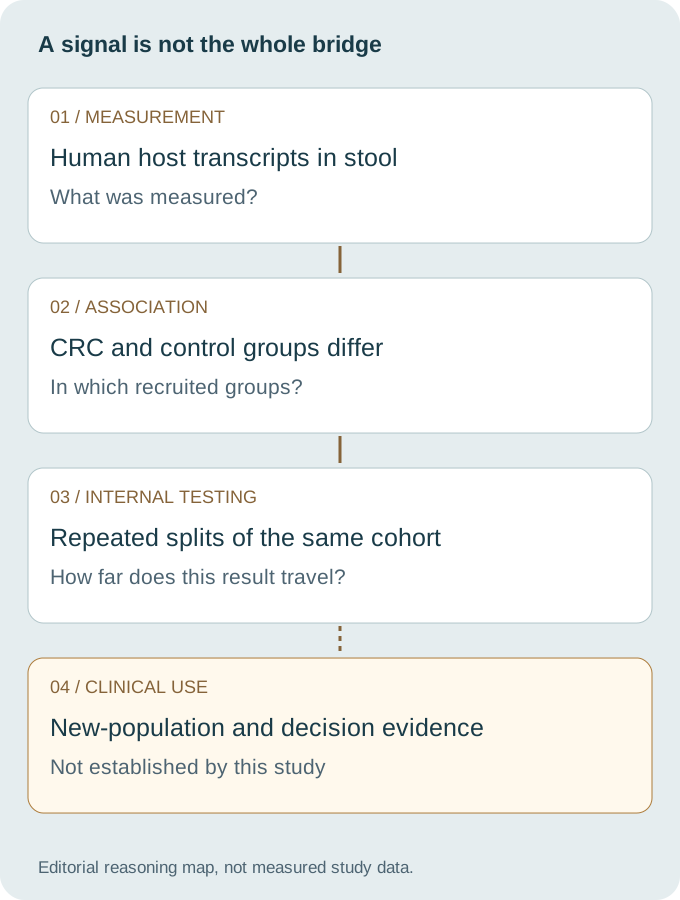
Read it by crossing four separate questions: what was measured, which groups differed, how the model was tested, and whether using it improves a defined decision. The final bridge remains a research question, not an entitlement created by a promising number.
The first correction: whose RNA is this?
The word “stool” describes the material, not the biological source of every signal in it. In this paper, the main target is human gene expression from shed host cells. Bacterial ribosomal RNA is an abundant background that the researchers reduce to make human transcripts easier to detect. Calling the result a complete map of the microbiome’s activity would change the scientific question.
This matters for a clinical microbiome readership. Host tissue signals and microbial signals can occupy the same specimen while answering different questions. A method designed to reveal human transcripts should not acquire a claim about every organism merely because the sample came from the gut. Keep the measured target attached to the conclusion throughout the article, the headline and any discussion of possible use.
The selected original is Stool shed cell transcriptomics mirrors tumor biology and enables colorectal cancer diagnosis, published in Scientific Reports on 2 October 2025. Its title is ambitious. A critical reading can recognize the method-development result while distinguishing the authors’ translational hopes from uses demonstrated by the study design.
What the recruited cohort lets us ask
The investigators studied 54 patients with colorectal cancer and 24 healthy controls. Patients were recruited around surgery at Sheba Medical Center in Israel. Tissue comparisons linked the stool analysis to tumor and adjacent non-malignant tissue. Eleven patients also supplied paired stool samples after surgery. These are complementary forms of evidence, not interchangeable participant counts.
The methods report a mean age of 64.2 years in patients and 39.8 years in controls. That difference is important when interpreting a case-control comparison. The groups differ on more than the disease label, and a method that separates them internally still needs evaluation in the population where a future test is intended to operate. This is a limitation to investigate, not proof that the observed molecular signal is false.
Think about the recruitment doorway. People undergoing cancer surgery are not the same sampling frame as an unselected screening population. Neither are healthy volunteers automatically an adequate stand-in for every person who would receive a negative result in practice. Before applying the estimate elsewhere, specify the clinical setting rather than assuming all people who provide stool belong to one population.
| Evidence in this study | Reasonable reading | Not established by it |
|---|---|---|
| Human transcripts detected after reducing bacterial rRNA background | The method reveals a host-cell signal in stool. | All microbial activity has been measured. |
| Stool expression differences track tissue differences | Biological correspondence supports the host-signal interpretation. | The signal alone determines a person’s diagnosis. |
| Stool classifier AUC 0.86 in repeated internal splits | The recruited groups can be discriminated under the reported procedure. | 86% individual cancer risk or independent screening validation. |
| Eleven paired postoperative samples shift toward control-like profiles | The signal changes after resection in this subset. | Cure certification or validated recurrence surveillance. |
Why an AUC is not a clinical instruction
The classifier used repeated splits of the available dataset into 50% training and 50% test sets, over 100 iterations. Marker selection was performed within the training data for each iteration. This is more informative than describing performance only on the material used to select markers. But the participants still come from the same recruited study, so repetition does not create new independent populations.
The reported stool AUC is 0.86. AUC summarizes how well a model ranks the two groups across thresholds. It does not by itself provide one operating threshold, the number of missed cases at that threshold, or the consequences of acting on a positive result. It is not the same quantity as sensitivity, and it should not be compared with a sensitivity percentage as though the two numbers measured identical things.
Nor is AUC a personal probability. A clinical pathway requires an intended population, a decision rule and a response to each possible result. A model may be scientifically useful while those practical questions remain unanswered. Avoid turning “the groups were distinguishable here” into “this test tells you whether you have cancer.” The narrower wording preserves the result without inventing a use.
Another detail worth noticing is the method’s handling of analytical quality. The main text excludes samples below a human-gene detection threshold. That is an analysis rule, not a boundary between health and disease. A clinical validation should explain how unusable samples and repeat requests enter its performance accounting; a quality-filtered research estimate is not automatically the experience of every person initially tested.
The postoperative result is a biological clue
After tumor resection, the paired stool profiles moved toward the control-like expression pattern in eleven participants. The tissue comparisons and the paired changes make the biological story more persuasive than an isolated classifier number. They help connect the sample signal to a change in the disease setting rather than leaving it as an unexplained statistical difference.
Nevertheless, a before-and-after observation is not a recurrence-monitoring trial. It does not tell us how early a future recurrence would be detected, how often a reassuring result would be wrong, or what action should follow a changed profile. Those questions require a design that follows the relevant clinical decisions over time. “Changed after surgery” and “validated for surveillance” are different claims.
It is also important not to turn “control-like” into a declaration of cure. A molecular resemblance is a description of the measured expression profile. The study does not establish that this resemblance rules out residual disease or replaces follow-up. The distinction applies even when a figure makes the groups look visually clean: graphical separation is evidence to interpret, not a substitute for the clinical endpoint.
| Design question | What a future evaluation should specify | Why it changes interpretation |
|---|---|---|
| Intended population | Who is eligible, in which setting, and with which comparator groups? | Surgical cases versus volunteers do not define every screening use. |
| Independent evaluation | Newly recruited participants and a fixed analysis rule. | Repeated internal splits are not independent recruitment. |
| Operating decision | A pre-specified threshold, unusable results and follow-up actions. | AUC alone does not specify a patient pathway. |
| Monitoring question | Repeated follow-up, recurrence outcomes and timing of decisions. | A postoperative shift does not establish surveillance performance. |
| Clinical utility | Consequences of using the result compared with the relevant care pathway. | Biological discrimination is not proof of better outcomes. |
INTERACTIVE / RESEARCH READING ONLY
Explore the validation gap
Choose one actual study observation, then the kind of claim you want to examine. The explorer separates what that observation supports from the extra evidence the proposed use would need. It never produces a health score or a judgment about a person.
Only the predefined choices are processed in this page. No symptoms, identifiers or test values are requested; the widget sends no data. The site’s existing privacy-friendly analytics policy remains unchanged. The output is an educational reading note, not advice to obtain or avoid a test.
What a careful next study would need to settle
Start with the intended use before choosing a larger sample. A screening study and a postoperative surveillance study would not answer the same question merely by recruiting more participants. Each needs its own population, timing, reference outcome and decision pathway. A locked method evaluated on new participants would address a different uncertainty from running another split of the original data.
For screening, the important issue is not only whether known cancer cases look different from healthy volunteers. It is how the method behaves among the people actually entering that pathway, including results that cannot be interpreted and decisions triggered by a positive result. For surveillance, it is the relationship between repeated measurements, subsequent recurrence and useful timing of action. These are proposed validation questions, not outcomes already demonstrated here.
Clinical utility adds another layer. Even a reliably discriminating test needs an explanation of how its use changes care, compared with an appropriate alternative. The study does not demonstrate improved outcomes from using this transcriptomic method. That does not diminish its value as a discovery and method-development contribution; it locates that contribution on the correct evidence layer.
Read declarations with the same discipline. The paper reports a company co-founder among its authors and provisional patents covering aspects of the findings. These interests do not invalidate the work. They do make independent evaluation especially valuable when considering translation. Treat both the result and the interests as relevant context rather than using either as a shortcut to acceptance or dismissal.
A practical three-sentence reading note
First state the observation without a clinical leap: “This study found a measurable human stool-cell transcriptomic signal that differed between its recruited groups.” Then identify the evaluation: “The stool classifier’s AUC of 0.86 came from repeated internal splits, not an independently recruited screening cohort.” Finally state the open bridge: “Whether a fixed version supports a specified screening or monitoring decision needs direct evaluation in that setting.”
Those sentences leave room for promise without calling promise a product. They also prevent two common substitutions: treating human transcripts as a survey of all microbial function, and treating an internally successful classifier as an instruction for an individual. For personal testing or follow-up decisions, this research explainer does not replace the clinician and the relevant established care pathway.
Questions that change the interpretation
Is the study measuring microbial RNA?
Its central readout is human host-cell gene expression in stool. Reducing abundant bacterial ribosomal RNA helps reveal those human transcripts. It is not a comprehensive measurement of microbial activity.
Does AUC 0.86 mean an 86% chance of cancer?
No. It describes discrimination between recruited groups across thresholds in internal testing. It is not an individual probability, a sensitivity value or the percentage correctly diagnosed at one fixed threshold.
Are 100 train/test splits 100 independent validation studies?
No. The repeated splits reuse a single recruited dataset. They assess internal performance under that procedure, not transport to 100 independently recruited populations.
Does a control-like postoperative pattern prove cure?
No. The eleven paired postoperative samples support a biological change after resection. They do not establish that a stool signature can certify cure, exclude recurrence or replace follow-up.
Why does the age difference matter?
The cases and controls had different mean ages. That makes them different on more than cancer status, so independent evaluation in the intended population is important before attributing transportable diagnostic performance to the signal.
Can the explorer decide whether I need a test?
No. It uses only predefined research observations and claim categories. It does not accept symptoms, patient measurements or identifiers, and gives no diagnosis or testing recommendation.
Original source and review scope
Bahar Halpern K., Kent I., Yakubovsky O. and colleagues. Stool shed cell transcriptomics mirrors tumor biology and enables colorectal cancer diagnosis. Scientific Reports, first published 2 October 2025.
The complete published main text, methods, results, figure captions, discussion and declarations were read. The MedicalBrain corpus retrieval and complete Europe PMC original snapshot support this review. No original study figure is reproduced; the bridge graphic is an editorial reasoning map. Supplement-only results and the paper’s cited spatial-transcriptomics preprint are not used as independent evidence. Current Crossref and Europe PMC metadata returned no correction or retraction relationship at review on 22 October 2026. This is an educational interpretation, not a clinical test recommendation.