Evidence-based response
What Foods Support the Gut-Brain Axis? Evidence-Based Answer Without the Hype
Fiber-rich and fermented foods can support gut-brain biology, but no food list or stool test can guarantee better mood, focus, or cognition.
By Sandra McKenzy, Pharmacist · 2026-05-26
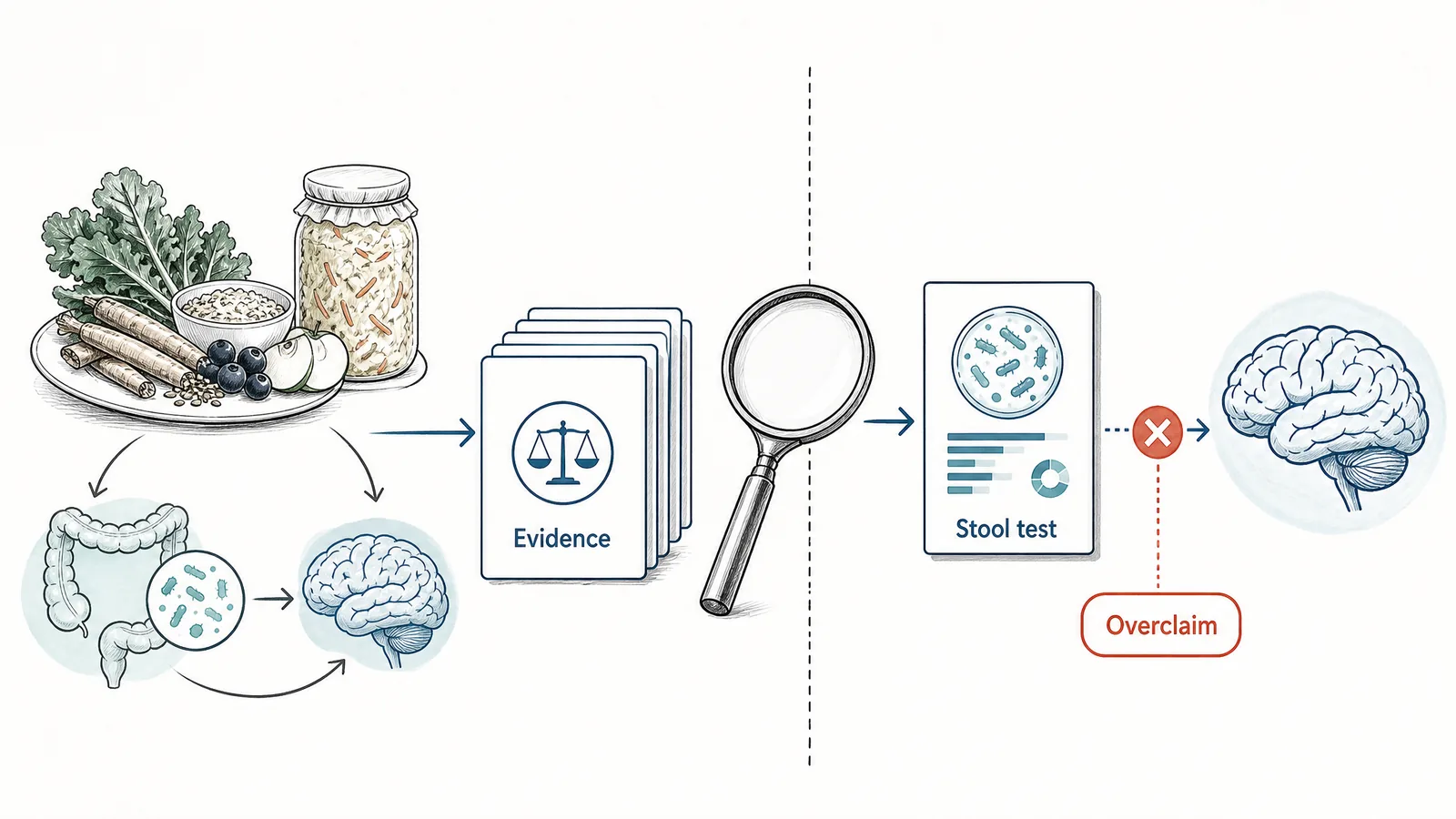
Short answer: Foods that most plausibly support the gut-brain axis are varied plant fibers, fermented foods with live cultures, legumes, whole grains, nuts, seeds, polyphenol-rich plants, and omega-3-rich fish where appropriate. The evidence is strongest for broad dietary patterns and specific studied interventions. It is not strong enough to promise sharper focus, emotional resilience, or a personalized brain-food plan from a consumer stool test.
What does the gut-brain axis actually mean?
The gut-brain axis is a two-way communication system linking the intestine, immune system, endocrine signals, vagus nerve, microbial metabolites, and the brain. Gut microbes can produce or modify compounds that interact with inflammation, barrier function, stress biology, and appetite. That makes the topic real science, not just wellness language.
The clinical boundary matters. Most human evidence does not show that eating one probiotic food or changing one microbial species reliably improves cognition or mood in healthy adults. The better-supported claim is narrower: diet can shape microbial activity, and microbial activity may influence brain-related pathways.
Which foods are best supported?
The most defensible starting point is a high-diversity, plant-forward diet. Beans, lentils, oats, barley, vegetables, fruit, nuts, seeds, and resistant starch provide fermentable substrates for gut microbes. Those substrates can increase short-chain fatty acid production, including acetate, propionate, and butyrate, which are involved in immune and epithelial signaling.
Fermented foods such as yogurt, kefir, sauerkraut, kimchi, or fermented vegetables can also be reasonable additions. A controlled dietary intervention found that a fermented-food-rich diet increased microbiome diversity and reduced several inflammatory markers. That is meaningful, but it does not prove fermented foods are a treatment for anxiety, depression, ADHD, brain fog, or cognitive decline.
Can probiotics improve mood or cognition?
Some randomized studies of probiotic or psychobiotic interventions report changes in depressive symptoms, stress measures, microbial patterns, or brain-related signals. For example, a probiotic add-on trial in depressed patients found symptom and neural changes after four weeks. A psychobiotic diet study reported reduced perceived stress in healthy adults.
These results are promising, not a license for broad promises. Effects depend on population, strain, dose, background diet, medication use, baseline symptoms, and outcome measured. A yogurt, capsule, or food plan should not be marketed as a guaranteed cognitive enhancer.
Can microbiome testing tell you which foods your brain needs?
This is where marketing often outruns the evidence. Stool microbiome tests can describe organisms detected in one sample and may suggest broad dietary hypotheses. They cannot diagnose the cause of poor focus, anxiety, fatigue, depression, or memory problems. They also cannot prove that a specific food will improve your mood because one bacterial group is low.
Microbiome-informed nutrition is an active research field, and future tools may become more clinically useful. Today, consumer testing should be treated as exploratory context, not a stand-alone mental-health or cognition tool.
What is actually supported?
- Diet can shape microbial metabolites that interact with immune, barrier, and brain-related pathways.
- Fermented-food-rich diets have shown measurable effects on microbiome diversity and inflammatory markers in humans.
- Some probiotic and psychobiotic studies report mood or stress effects, but results are not universal.
- Fiber-rich dietary patterns are a safer recommendation than chasing one branded probiotic food.
- Consumer microbiome tests cannot diagnose mental-health symptoms or prescribe proven brain foods.
What does gut-brain marketing get wrong?
It often turns plausible mechanisms into promises. Serotonin production in the gut, vagus nerve signaling, short-chain fatty acids, and immune communication are real. But a real pathway is not the same as a proven consumer outcome. The existence of a gut-brain axis does not mean a test result can explain every mood change or that fermented foods will improve cognition in everyone.
Mentioning InnerBuddies once is enough here: the safer alternative to any test-led promise is to use microbiome data cautiously, alongside symptoms, diet history, medications, sleep, stress, and clinician assessment when needed.
When should symptoms be checked clinically?
Low mood, anxiety, panic symptoms, cognitive decline, severe fatigue, disordered eating, unexplained weight loss, blood in stool, persistent diarrhea, anemia, fever, or night-time bowel symptoms should not be managed through gut-brain diet experiments alone. Seek qualified care, especially if symptoms are new, severe, worsening, or affecting daily function.
Bottom line
The gut-brain axis is biologically credible, and diet is one practical way to support it. The strongest advice is not exotic: eat diverse plant fibers, consider fermented foods if tolerated, and avoid treating a stool test as a mental-health prescription engine.
Evidence notes
- Berding et al. (2023). Feed your microbes to deal with stress: a psychobiotic diet impacts microbial stability and perceived stress. Molecular Psychiatry. 10.1038/s41380-022-01817-y
- Wastyk et al. (2021). Gut-microbiota-targeted diets modulate human immune status. Cell. 10.1016/j.cell.2021.06.019
- Schaub et al. (2022). Clinical, gut microbial and neural effects of a probiotic add-on therapy in depressed patients. Translational Psychiatry. 10.1038/s41398-022-01977-z
- Schneider et al. (2024). Feeding gut microbes to nourish the brain: unravelling the diet-microbiota-gut-brain axis. Nature Metabolism. 10.1038/s42255-024-01108-6
- Mizuno et al. (2017). Gut microbiome as a clinical tool in gastrointestinal disease management: are we there yet? Nature Reviews Gastroenterology & Hepatology. 10.1038/nrgastro.2017.29
This article is educational and does not diagnose, treat, or replace care from a qualified clinician.