Evidence-based response
Struggling with Brain Fog? How Gut Health Impacts Symptoms + Science-Backed Insights in 2026: What Science Actually Says
Gut health may influence brain fog through the gut-brain axis, but symptoms and stool tests cannot diagnose the cause on their own.
By Sandra McKenzy, Pharmacist · 2026-08-04
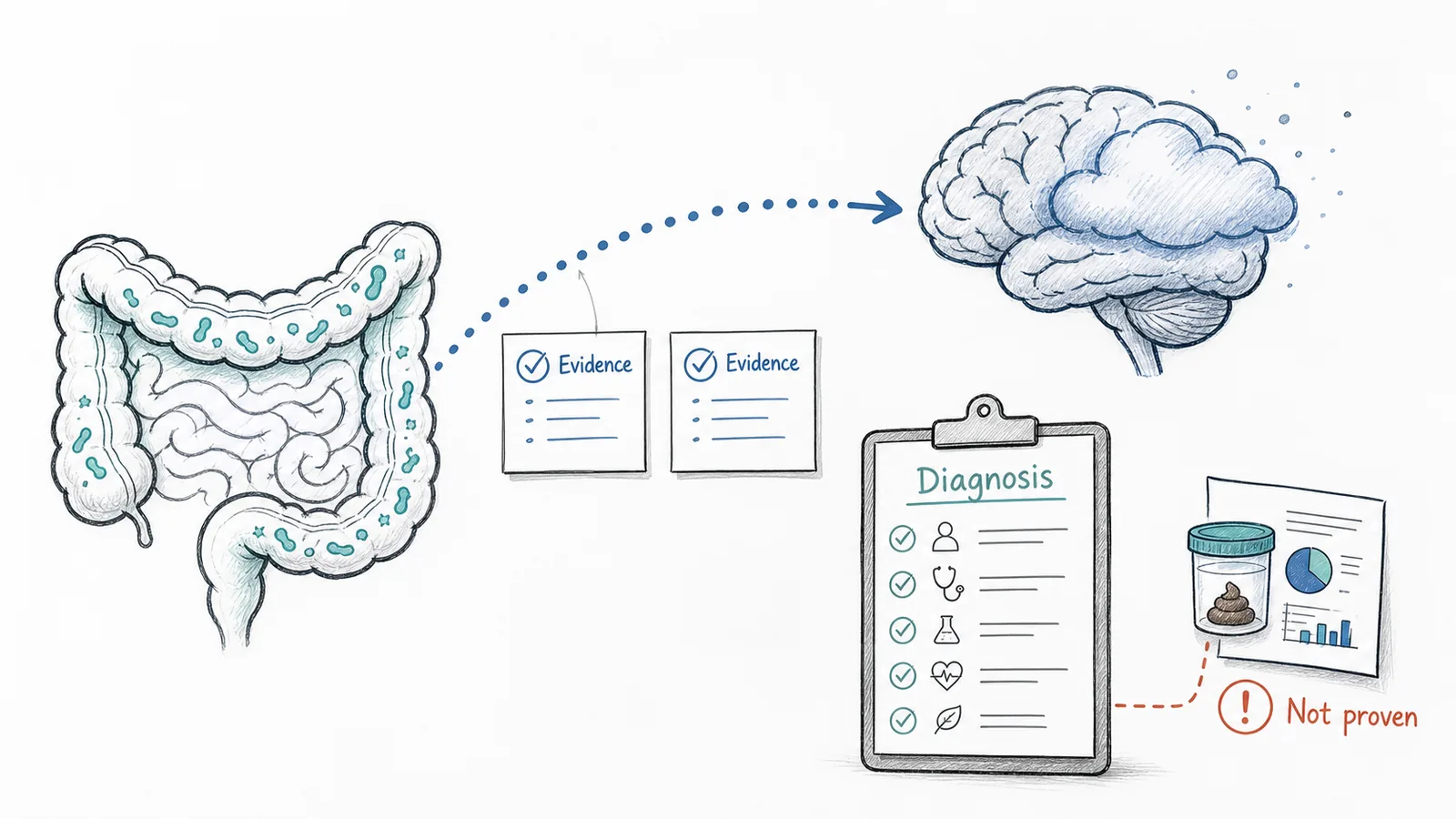
Short answer: Gut health can be linked to brain fog through the gut-brain axis, immune signaling, stress biology, metabolites, and digestive symptoms. But brain fog is not a diagnosis, and current evidence does not show that a stool microbiome test can identify the cause of mental cloudiness or prescribe a personalized fix. Persistent or severe brain fog needs a broader clinical evaluation.
The source article raises a real question. Many people notice that concentration, fatigue, bloating, bowel changes, sleep, stress, and food patterns move together. The problem is not the gut-brain idea itself. The problem is when a plausible biological connection becomes a consumer certainty: if you feel foggy, your gut is the cause, and a microbiome test can show you what to do next.
Can gut health cause brain fog?
Sometimes gut-related illness may contribute to feeling mentally slow, tired, distracted, or less clear. The gut and brain communicate through the vagus nerve, immune mediators, endocrine signals, microbial metabolites, intestinal barrier biology, and the stress response. That makes the gut-brain axis a serious scientific field, not wellness decoration.
But cause is a high bar. Brain fog is a symptom description, not a laboratory diagnosis. It can appear with poor sleep, depression, anxiety, anemia, thyroid disease, medication effects, dehydration, post-viral illness, migraine, blood sugar swings, nutrient deficiencies, autoimmune disease, inflammatory bowel disease, celiac disease, menopause, chronic pain, or heavy stress. Digestive symptoms can be part of that picture, but they do not automatically prove that the microbiome is the driver.
Evidence summary
- The gut-brain axis is biologically plausible and supported by human and mechanistic research.
- Brain fog has many possible causes, so gut symptoms alone cannot identify the mechanism.
- IBS and related gut-brain disorders can involve altered brain networks, metabolites, mood symptoms, and microbiome patterns.
- Probiotic studies show mixed and strain-specific signals for cognition or brain activity, not a universal brain-fog treatment.
- Consumer stool microbiome testing can generate hypotheses, but it cannot diagnose brain fog or prescribe treatment by itself.
What does the gut-brain axis actually mean?
The gut-brain axis is a two-way communication system. The intestine sends signals to the nervous system through sensory nerves, immune activity, gut hormones, microbial metabolites such as short-chain fatty acids, and inflammatory pathways. The brain also changes the gut through stress hormones, autonomic nerve activity, motility, pain sensitivity, secretion, and eating behavior.
This is why stress can worsen diarrhea or constipation, and why gut disorders can affect mood, sleep, pain perception, and quality of life. It also explains why microbiome research often finds associations between gut organisms, metabolites, inflammation, and neurological or psychiatric outcomes. Association, however, is not the same as a personal diagnosis. A stool sample taken on one day cannot show the entire mucosal microbiome, small-intestinal biology, immune state, sleep debt, medication effects, or psychological stress load.
Does brain fog prove dysbiosis?
No. Dysbiosis is a broad research term for a disrupted microbial community. It is not a single disease with one accepted clinical threshold. Two people can have different stool profiles and both be healthy. A person with digestive symptoms can have a stool pattern that looks unusual, but that still may not explain mental fogginess. The finding may be a consequence of diet, illness, medication, bowel speed, or inflammation rather than the original cause.
That matters because many gut-health claims treat dysbiosis like a hidden diagnosis behind every vague symptom. Brain fog plus bloating may justify a thoughtful medical and lifestyle review. It does not prove that bad gut bacteria are poisoning the brain, that intestinal permeability is the main cause, or that a supplement plan can correct the problem on command.
What evidence links IBS, mood, cognition, and the microbiome?
IBS is one of the clearest examples of a brain-gut disorder. Research has found differences in brain networks, fecal metabolites, psychological symptoms, pain sensitivity, and microbiome features in some IBS groups. Studies of IBS with depression also suggest that microbiome and metabolite patterns may help explain why bowel symptoms and mood symptoms often overlap.
This does not mean every person with IBS has microbiome-caused brain fog. IBS is heterogeneous. Some people have constipation-predominant symptoms, some diarrhea-predominant symptoms, some mixed symptoms, and some major stress or pain-sensitization components. Microbiome and short-chain-fatty-acid relationships may differ across IBS subtypes, which is exactly why one generic stool report or one generic gut protocol is too simple.
Can probiotics or diet clear brain fog?
They might help some people indirectly, especially when digestive symptoms, diet quality, sleep, stress, or an identifiable gut disorder are part of the problem. A fiber-rich dietary pattern, adequate hydration, enough protein, regular meals, sleep, movement, and treatment of real gastrointestinal disease can improve energy and wellbeing. Those changes may also help someone feel clearer.
Probiotics are more complicated. Recent reviews and meta-analyses suggest that some probiotic interventions can influence stress, mood, brain activity, or cognitive measures in selected populations. The effects are not uniform. They depend on strain, dose, duration, age, baseline health, outcome measured, and study quality. A product that affects one cognitive test in older adults cannot be marketed as a proven brain-fog cure for everyone. A probiotic can be plausible without being the right treatment.
Can microbiome testing help with brain fog?
A stool microbiome test may describe detectable organisms, diversity, and sometimes predicted functions in a sample. That can be educational, especially for people trying to understand diet patterns, antibiotic history, or broad gut-health questions. It can also create useful questions for a clinician or dietitian.
But a consumer microbiome test cannot diagnose brain fog. It cannot rule out anemia, thyroid disease, sleep apnea, medication adverse effects, depression, celiac disease, inflammatory bowel disease, long COVID, or neurological illness. It also cannot prove that a recommended food, prebiotic, probiotic, or supplement will fix mental cloudiness. The safer interpretation is: the test may provide context, not certainty.
What does marketing often get wrong?
Marketing often compresses a complex chain into a simple story: gut imbalance causes inflammation, inflammation causes brain fog, and a personalized test reveals the solution. Each step may be biologically plausible in some settings, but the chain is rarely clinically proven for an individual reader. A plausible mechanism is not the same as a validated care pathway.
The other mistake is treating ordinary symptoms as if they point to one hidden cause. Brain fog, bloating, fatigue, and stress are common. They overlap across many conditions. A reader-protective article should widen the differential diagnosis before narrowing it to the microbiome.
When should you see a clinician?
Seek medical advice if brain fog is new, persistent, worsening, severe, or affecting work, driving, safety, memory, speech, or daily functioning. Get urgent care for sudden confusion, weakness on one side, fainting, chest pain, severe headache, seizures, high fever, dehydration, or neurological symptoms. With digestive symptoms, also seek care for blood in stool, black stool, unexplained weight loss, anemia, nighttime diarrhea, persistent vomiting, severe abdominal pain, fever, new bowel changes after age 50, or family history of colorectal cancer, celiac disease, or inflammatory bowel disease.
Bottom line
Gut health can be part of the brain-fog conversation, especially when digestive symptoms, IBS, stress, sleep disruption, diet, or inflammation are also present. The evidence supports a cautious gut-brain link, not a shortcut diagnosis. The best next step is to look for patterns, address basic health foundations, and investigate red flags, rather than assuming one stool test can explain or solve mental cloudiness.
Educational disclaimer: This article is for general information and science communication. It is not medical advice, diagnosis, or treatment. Do not use a microbiome test, probiotic, or supplement plan to replace professional evaluation for persistent, severe, or concerning brain fog.
Evidence notes and sources
- Zhang et al. (2024). Microbiota-gut-brain axis and its therapeutic applications in neurodegenerative diseases. Signal Transduction and Targeted Therapy. https://doi.org/10.1038/s41392-024-01743-1
- Foster et al. (2025). Distinguishing the causative, correlative and bidirectional roles of the gut microbiota in mental health. Nature Mental Health. https://doi.org/10.1038/s44220-025-00498-0
- Kohler et al. (2026). The effects of oral probiotic intervention on brain structure and function in human adults: a systematic review. npj Science of Food. https://doi.org/10.1038/s41522-025-00872-x
- Liu et al. (2026). Effects of probiotics on cognitive function across the human lifespan: a meta-analysis. European Journal of Clinical Nutrition. https://doi.org/10.1038/s41430-025-01660-8
- Gupta et al. (2020). Analysis of brain networks and fecal metabolites reveals brain-gut alterations in premenopausal females with irritable bowel syndrome. Translational Psychiatry. https://doi.org/10.1038/s41398-020-01071-2
- Chen et al. (2022). Altered metabolome and microbiome features provide clues in understanding irritable bowel syndrome and depression comorbidity. The ISME Journal. https://doi.org/10.1038/s41396-021-01123-5
- Kiely et al. (2025). Microbiota and short chain fatty acid relationships underlie clinical heterogeneity and identify key microbial targets in irritable bowel syndrome. Scientific Reports. https://doi.org/10.1038/s41598-025-19363-2