Evidence-based response
Boost Your Health in 2026: Michael Mosley 5:2 Diet & Personalized Gut Test Revealed: Evidence-Based Answer Without the Hype
The 5:2 diet can help some adults lose weight and may shift microbiome markers, but a consumer gut test cannot prove that fasting is safe, necessary, or personally prescribed for you.
By Sandra McKenzy, Pharmacist · 2026-07-07
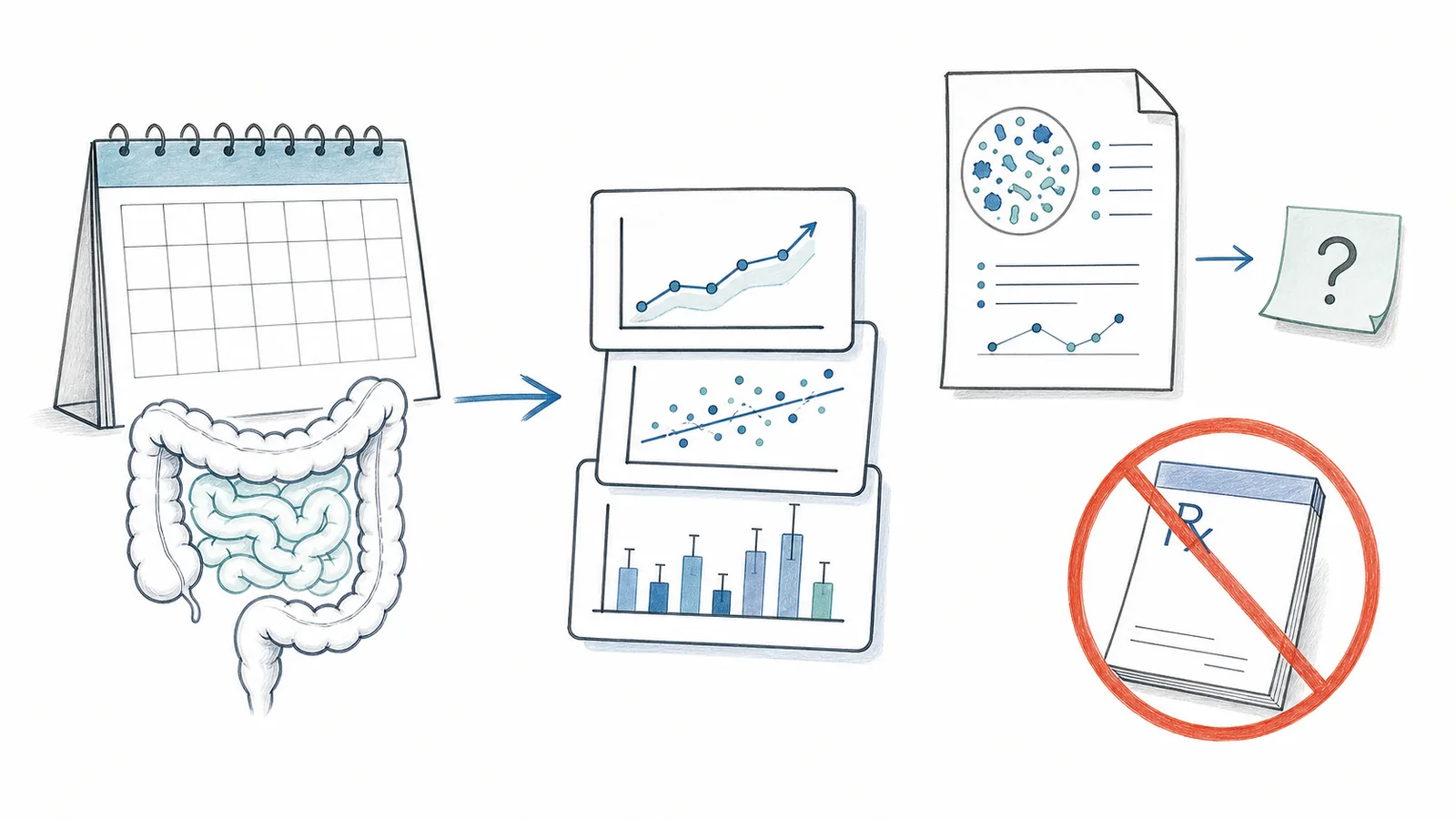
Short answer: The 5:2 diet is a structured form of intermittent energy restriction that can help some adults lose weight when total energy intake falls. Early studies also show microbiome changes during fasting programs. But a consumer stool microbiome test cannot prove that the 5:2 diet is right for you, predict safety, or replace medical advice.
Michael Mosley helped make intermittent fasting understandable for a wide audience. That public communication mattered. The evidence question is narrower: what can science actually say about the 5:2 diet, the gut microbiome, and personalized gut tests in 2026?
What Is the 5:2 Diet?
The 5:2 diet is a pattern of intermittent energy restriction. Most versions involve eating normally on five days each week and eating much less on two nonconsecutive days. It is not a specific microbiome therapy, and it is not automatically healthier than other calorie reduction plans. Its practical appeal is simplicity: some people find two low-calorie days easier than daily restriction.
That simplicity can also create confusion. A clear rule does not mean the rule is safe for everyone. People with diabetes using glucose-lowering medicines, a history of eating disorders, pregnancy, frailty, underweight, active cancer treatment, kidney disease, or complex medication schedules should not treat fasting advice as generic wellness content. For them, timing and calorie restriction can change risk.
Does the 5:2 Diet Improve Weight or Metabolic Health?
The best-supported claim is modest. Intermittent energy restriction can produce weight loss when it creates a sustained energy deficit. In a 12-month follow-up study, intermittent energy restriction, including a 5:2 approach, was reported as broadly comparable to continuous energy restriction for modest weight loss and cardiometabolic markers. That does not make it superior. It means it can be one workable format for some people.
A 2023 study in npj Biofilms and Microbiomes followed 72 adults during a three-week 5:2 intermittent fasting program. Participants lost an average of 3.67 kg, and the authors reported shifts in intestinal microbial composition and functional potential. Those findings are scientifically interesting because they suggest the microbiome may respond to fasting rhythms and energy restriction. They do not prove that a commercial stool test can choose the right fasting plan for an individual.
Another randomized study compared intermittent fasting with protein pacing against continuous calorie restriction and found distinct microbiome and metabolomic changes. Again, the result supports a research direction. It does not mean that fasting has a single microbiome signature that every person should chase.
Does Intermittent Fasting Change the Gut Microbiome?
Yes, it can. Diet timing, calorie intake, weight loss, fiber intake, protein intake, and recent food choices can all change microbial patterns. The important boundary is that change is not automatically benefit. A stool sample can show that organisms or genes shifted. Clinical benefit requires more: better symptoms, better metabolic markers, lower risk, or a patient-relevant outcome measured in a reliable way.
Microbiome studies often measure groups. They compare averages before and after an intervention or compare one diet pattern with another. A consumer, however, wants an individual answer: should I fast, should I avoid fasting, and what should I eat on nonfasting days? Current evidence is not strong enough for a generic microbiome report to answer those questions alone.
Evidence summary
Evidence summary
- 5:2 fasting can support modest weight loss when it reduces total energy intake, but it is not clearly superior to continuous calorie restriction for everyone.
- Human studies show that intermittent fasting can shift gut microbiome markers, especially during weight loss or structured diet programs.
- Microbiome change is not the same as proven clinical benefit for an individual patient.
- Personalized nutrition research is promising, but consumer stool tests are not validated as stand-alone diet prescriptions.
- Fasting can be inappropriate or risky for some people, especially with diabetes medicines, pregnancy, eating-disorder history, frailty, or significant illness.
Can a Gut Microbiome Test Personalize the 5:2 Diet?
Not in the way many marketing pages imply. Personalized nutrition is a real research field. Large studies have shown that people can have very different post-meal glucose, lipid, and inflammatory responses to the same foods, and microbiome features may help explain some of that variation. Reviews in Nature Reviews Microbiology describe diet and microbiota as a two-way system that could eventually help tailor nutrition.
The word eventually matters. A useful clinical tool must be analytically reliable, clinically validated, interpretable, and tied to an action that improves outcomes. Many consumer microbiome tests can describe detected microbial DNA, relative taxa, or diversity metrics. That can be educational. It is not the same as a validated decision tool that tells a person to start 5:2 fasting, skip fasting, or choose a specific fasting-day menu.
MedicalBrain retrieval for this article found a relevant caution from Quigley's Nature Reviews Gastroenterology & Hepatology perspective: gut microbiome research has advanced rapidly, but translation into routine gastrointestinal disease management remains incomplete. That warning applies even more strongly to broad wellness claims.
What the Source Article Gets Right
The source article is right that Michael Mosley's public work brought attention to fasting, weight management, sleep, exercise, and everyday health experiments. It is also fair to say that diet patterns interact with digestive wellbeing and that people differ in how they respond to food and lifestyle changes.
Those points are reasonable. A careful article can honor Mosley's science communication without converting public interest into a microbiome product claim. The evidence supports curiosity, not certainty.
Where the Marketing Framing Overreaches
The risky move is linking a popular fasting story to personalized gut insights in a way that makes testing sound more clinically actionable than it is. A stool microbiome profile cannot diagnose whether fasting is safe for you. It cannot detect hypoglycemia risk from medication. It cannot rule out an eating disorder. It cannot replace blood pressure, glucose, lipid, kidney, liver, or nutritional assessment when those are clinically relevant.
Another overreach is treating microbiome optimization as the main reason to fast. Most human fasting studies are still interpreted through body weight, energy intake, cardiometabolic markers, appetite, adherence, and safety. Microbial changes may be part of the mechanism, but they are not yet a routine target for self-treatment.
Who Should Be Careful With 5:2 Fasting?
Speak with a clinician before attempting 5:2 fasting if you use insulin, sulfonylureas, blood pressure medicines that cause dizziness, lithium, diuretics, anticoagulants, or other medicines affected by food intake or dehydration. Get medical advice first if you are pregnant, breastfeeding, underweight, recovering from an eating disorder, older and frail, immunocompromised, or living with diabetes, kidney disease, liver disease, inflammatory bowel disease, cancer, or recurrent fainting.
Seek urgent care for fainting, confusion, chest pain, severe weakness, vomiting, black stools, blood in stool, severe abdominal pain, persistent fever, dehydration, or unexplained weight loss. These are not problems for a microbiome report to manage.
What Is a Sensible Evidence-Based Takeaway?
The 5:2 diet is best viewed as one possible structure for calorie reduction, not as a microbiome cure. It may help some adults because it creates a pattern they can follow. It may change the microbiome because food timing and calorie intake influence gut ecology. But the clinical decision should still be grounded in goals, medical history, medications, symptoms, nutritional adequacy, and whether the plan is sustainable.
A gut test can be a conversation starter. It should not be the final authority. If a result motivates better diet quality, more fiber-rich foods, less ultra-processed food, or a thoughtful discussion with a qualified professional, that may be useful. If it produces fear, unnecessary supplements, rigid restriction, or confidence without clinical validation, it has crossed the line from education into overclaim.
Bottom Line
Michael Mosley's 5:2 diet remains influential because it made intermittent fasting easy to explain. The science supports a balanced view: 5:2 can be a practical weight-loss pattern for some adults, fasting can shift microbiome markers, and personalized nutrition is an active research field. The unsupported leap is using a consumer microbiome test as proof that a specific fasting plan is right, safe, or necessary for one person.
Educational disclaimer: This article is for general science education. It does not diagnose, treat, prescribe fasting, or replace care from a licensed clinician. Decisions about fasting, weight loss, diabetes medication, pregnancy, digestive symptoms, eating-disorder risk, or microbiome testing should be made with a qualified healthcare professional.
Evidence Notes and Sources
- Intermittent fasting modulates the intestinal microbiota and improves obesity and host energy metabolism. npj Biofilms and Microbiomes. DOI: 10.1038/s41522-023-00386-4
- Gut microbiome remodeling and metabolomic profile improves in response to protein pacing with intermittent fasting versus continuous caloric restriction. Nature Communications. DOI: 10.1038/s41467-024-48355-5
- Impact of intermittent vs. continuous energy restriction on weight and cardiometabolic factors: a 12-month follow-up. International Journal of Obesity. DOI: 10.1038/s41366-020-0525-7
- Diet-microbiota interactions and personalized nutrition. Nature Reviews Microbiology. DOI: 10.1038/s41579-019-0256-8
- Human postprandial responses to food and potential for precision nutrition. Nature Medicine. DOI: 10.1038/s41591-020-0934-0
- Gut microbiome as a clinical tool in gastrointestinal disease management: are we there yet?. Nature Reviews Gastroenterology & Hepatology. DOI: 10.1038/nrgastro.2017.29
- Effects of underfeeding and oral vancomycin on gut microbiome and nutrient absorption in humans. Nature Medicine. DOI: 10.1038/s41591-020-0801-z