Evidence-based response
How Much Gut Microbiome Transfer Happens Between Partners? What Science Actually Says
Close partners can share some microbial strains through household life and intimate contact, but a fixed 30 percent transfer claim is not an individual medical measurement.
By Sandra McKenzy, Pharmacist · 2026-06-03
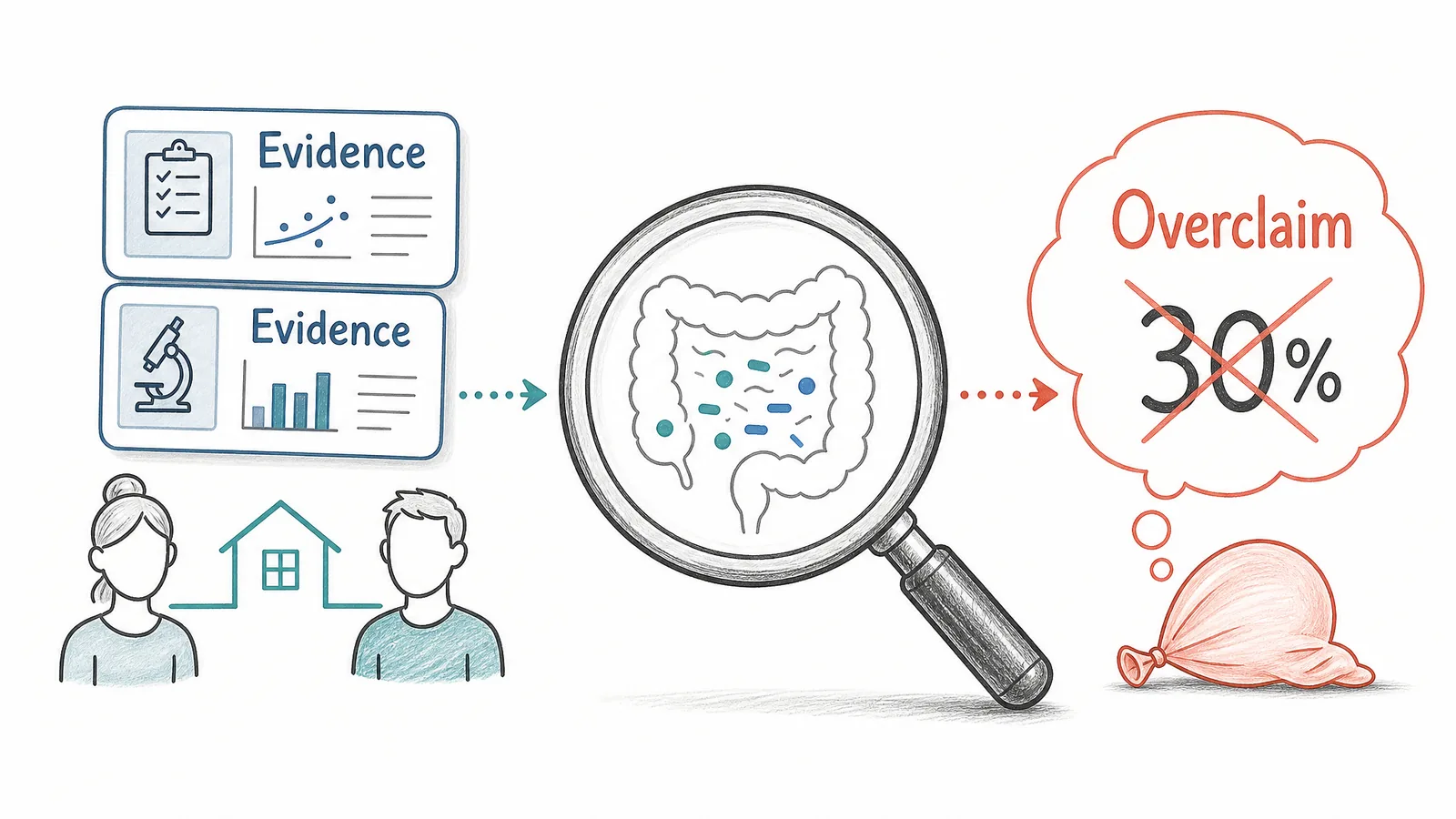
Short answer: Partners can share microbial strains, especially through long-term cohabitation, shared environments, and oral contact. But the claim that you simply “adopt 30 percent” of a partner’s gut bacteria is too precise for the current evidence. Studies support microbial sharing at strain level; they do not turn that finding into a personal health score or relationship diagnosis.
Do partners really share gut bacteria?
Yes, but the careful answer is narrower than the marketing version. Large strain-level studies show that people in the same household and social network can share more microbial strains than unrelated people who do not live together. Oral microbes appear especially transmissible, while gut strain sharing is harder to interpret because diet, geography, pets, family history, and sampling methods all overlap.
Evidence summary
- Close social contact and cohabitation are associated with microbial strain sharing.
- Oral strain sharing is generally easier to detect than gut strain sharing.
- A fixed 30 percent number is not a validated personal measurement.
- Shared strains do not automatically mean shared disease risk or better gut health.
- Consumer stool tests cannot reliably tell how much of your microbiome came from one partner.
What does the 30 percent claim get wrong?
The problem is not the idea that microbes move between people. They do. The problem is turning population-level strain sharing into a universal percentage for romantic partners. A couple may share meals, a bed, pets, bathrooms, travel, infections, medications, and local exposures. A test result cannot cleanly separate those influences and assign an exact fraction to one person.
Can shared microbes affect health?
Microbial transmission is biologically plausible and important, but it should not be oversold. Some shared microbes may be harmless passengers. Others may matter in specific contexts, such as infection, immune vulnerability, or early-life exposure. Most relationship-related sharing is not a reason to panic, detox, or buy repeated tests.
Can a microbiome test show partner transfer?
A standard consumer stool test can describe organisms or DNA patterns in one sample. It usually cannot prove direction of transfer, timing, source, or clinical effect. Even paired testing would need strain-level analysis, careful sampling, and context. For most couples, the actionable basics remain hygiene when ill, prudent antibiotic use, fiber-rich eating, and medical care for persistent symptoms.
When should you see a clinician?
Seek care for persistent diarrhea, blood in stool, fever, unexplained weight loss, severe abdominal pain, dehydration, recurrent infections, or symptoms after travel or antibiotic exposure. Those situations call for targeted clinical testing, not relationship-based microbiome interpretation.
Bottom line
Partners can influence each other’s microbial environment. That is real science. But “30 percent of your gut bacteria comes from your partner” is best treated as an over-neat headline, not a clinical fact about your body.
How should readers interpret partner microbiome studies?
The strongest partner and household studies usually look at shared strains, not broad labels such as “good bacteria” or “bad bacteria.” A strain-level match is more informative than seeing the same genus name on two reports, because many people can carry organisms with similar names that are genetically different. Even then, a match does not always prove who gave what to whom. It may reflect shared food, shared surfaces, shared geography, shared pets, or exposure to the same community.
This is why cautious language matters. A study can show that cohabitation increases the chance of sharing strains. It cannot usually say that one partner transferred an exact fixed percentage of the other partner’s gut microbiome, that the transfer happened recently, or that the shared strains are clinically good or bad. Those are different questions.
Does kissing explain the whole effect?
Kissing can plausibly contribute to oral microbial sharing. Saliva is an easier route for oral microbes than for organisms that mostly live in the colon. But romantic partners also share many ordinary exposures: meals, kitchen surfaces, bathrooms, sleep environments, social networks, travel, infections, and medication patterns. The science is less about one dramatic route and more about repeated small exposures over time.
Can shared microbiomes be measured at home?
Not with the certainty implied by simple marketing. A direct partner-transfer study would need paired samples, repeated timing, strain-level sequencing, careful control of shared exposures, and a plan for interpreting direction. Most consumer reports are not designed for that. They may show similarities or differences, but they usually cannot assign ownership or origin. A couple could receive two reports with overlapping taxa and still not know whether those organisms came from each other, food, pets, earlier life, or the local environment.
What is a safer practical takeaway?
Treat the relationship microbiome idea as a reminder that humans are biologically connected to their environments. It does not mean your partner is contaminating you, and it does not mean a test should be used to judge relationship health. If one partner has an infectious illness, basic hygiene and medical advice matter. If both partners want better gut-health foundations, shared meals rich in fiber, less ultra-processed food, regular sleep, and appropriate medical care are more evidence-aligned than chasing a transfer percentage.
How to read claims like this safely
A safer article separates three layers. The first layer is mechanism: what could happen biologically. The second layer is association: what has been observed in people or cohorts. The third layer is clinical action: what a patient should do differently. Many gut-health claims are plausible at the first layer, interesting at the second layer, and still unproven at the third. That does not make the science fake. It means the conclusion must be smaller than the sales pitch.
For readers, the practical question is not whether the microbiome matters. It does. The question is whether a claim has enough evidence to change care, justify a purchase, or delay medical evaluation. If the answer relies mainly on broad microbiome language, weak biomarkers, or personalized recommendations without validation, caution is appropriate. Good science should make uncertainty clearer, not hide it.
What a more evidence-based recommendation looks like
A responsible recommendation states who it applies to, what outcome it targets, how strong the evidence is, and when it should not be used. It also distinguishes general wellness advice from diagnosis. For example, increasing plant-food diversity gradually is different from claiming that a report can identify the exact cause of symptoms. Seeing a clinician for red flags is different from saying every symptom needs advanced testing. The most useful microbiome guidance is specific, modest, and connected to outcomes people can actually monitor.
Evidence notes
- Transmission of human-associated microbiota along family and social networks. Nature Microbiology. 10.1038/s41564-019-0409-6
- The person-to-person transmission landscape of the gut and oral microbiomes. Nature. 10.1038/s41586-022-05620-1
- Variation and transmission of the human gut microbiota across multiple familial generations. Nature Microbiology. 10.1038/s41564-021-01021-8
- Gut microbiome strain-sharing within isolated village social networks. Nature. 10.1038/s41586-024-08222-1
- Introduction to host microbiome symbiosis in health and disease. Mucosal Immunology. 10.1038/s41385-020-00365-4
This article is educational and does not diagnose, treat, or replace care from a qualified clinician.