Evidence-based response
How Much Gut Bacteria Do You Share with Your Partner? What Science Actually Says
Close contact and cohabitation can increase gut microbe strain sharing, but current evidence does not support a simple fixed percentage that every couple “adopts” from each other.
By Sandra McKenzy, Pharmacist · 2026-06-01
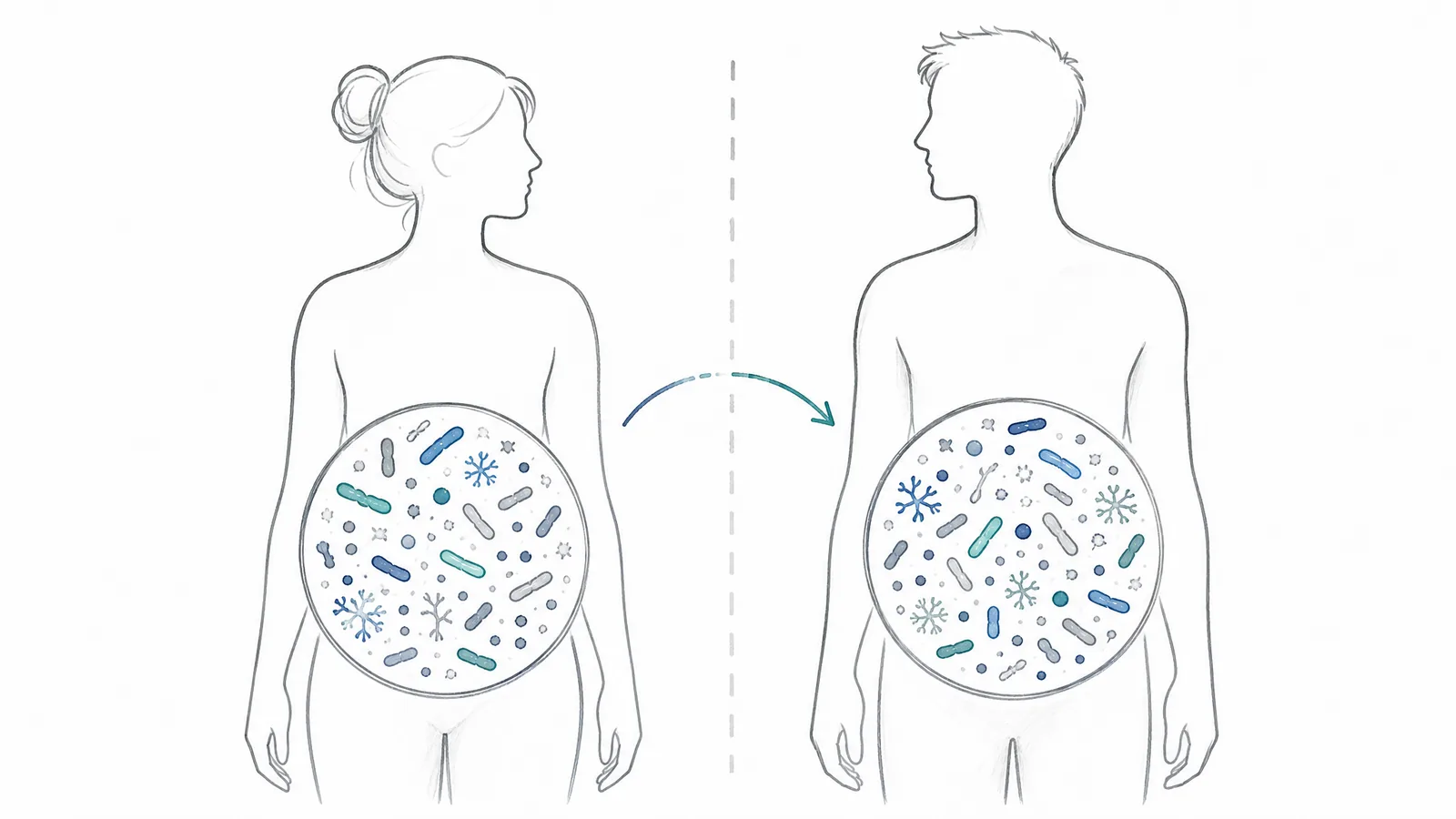
Short answer: Partners can share some gut microbial strains through long-term close contact, shared environments, meals, and routines. But there is no strong evidence that every couple “adopts 30%” of each other’s gut bacteria in a simple, universal way. The effect is real enough to study, yet far too variable to reduce to a fixed headline number.
What does “sharing gut bacteria” mean clinically?
Microbiome studies can compare people at the level of species, strains, or broader community patterns. Two partners may show some overlap because they live together, eat similarly, touch the same surfaces, and sometimes exchange microbes directly. That is not the same as one person permanently acquiring a neat fraction of the other person’s microbiome.
Evidence summary
- Cohabitation and social contact can increase microbial strain sharing.
- The signal is probabilistic, not a fixed number that applies to all couples.
- Shared diet, household exposures, geography, pets, and antibiotics can matter as much as the relationship itself.
- Similarity does not mean one partner’s microbiome is “good” or “bad” for the other.
- Consumer percentages are usually more confident than the underlying science.
What studies actually show
Human transmission studies support the idea that close contact shapes the microbiome. Family members and socially connected people can share strains more often than unrelated or unconnected individuals. Newer work suggests social networks create microbial “niches” where certain strains spread more easily.
That is a meaningful scientific finding, but it does not automatically translate into a consumer-facing percentage for romantic partners. The effect depends on what is measured, how long the people have cohabited, how often they interact, whether they share food and bathroom space, and what sequencing methods are used.
Can one partner “change” the other’s gut?
Yes, in the broad sense that human microbiomes are dynamic and responsive to shared environment. But “change” is not necessarily dramatic, harmful, or measurable by one stool test. One partner’s antibiotics, diet shift, infection, travel, or pet exposure can also affect the shared microbial environment.
In other words, a relationship can shape the microbiome without turning it into a microbial merger.
What marketing gets wrong
The common mistake is turning a complex transmission signal into a catchy certainty: a couple shares a specific fraction of bacteria, therefore a test can tell you how compatible or healthy your pair microbiome is. That leap goes beyond the evidence. A stool test can describe overlap patterns, but it cannot currently reduce relationship microbiology to a clean diagnostic score with proven health meaning.
Should partners test together?
Testing together can be educational if both people want a rough snapshot and understand the limits. It is weak as a medical strategy. Similarity between reports does not prove shared disease risk, and difference does not prove a problem. If either partner has symptoms, the right next step depends on the symptom, not on couple-based microbiome storytelling.
When to see a clinician
If one or both partners have red flags such as persistent diarrhea, weight loss, GI bleeding, fever, severe abdominal pain, or ongoing symptoms after travel or antibiotics, this is a clinical evaluation problem, not a partner-transfer curiosity problem.
Bottom line
Partners can share gut microbes, especially with long-term close contact. What science does not support is a tidy universal claim that you adopt a fixed 30% of your partner’s gut bacteria. The real story is more interesting and less marketable: microbial sharing is contextual, uneven, and shaped by biology plus daily life.
Evidence notes
- Arrieta et al. (2025). Gut microbiome strain-sharing within isolated village social networks. Nature. 10.1038/s41586-024-08222-1
- Brito et al. (2019). Transmission of human-associated microbiota along family and social networks. Nature Microbiology. 10.1038/s41564-019-0409-6
- Valles-Colomer et al. (2022). Variation and transmission of the human gut microbiota across multiple familial generations. Nature Microbiology. 10.1038/s41564-021-01021-8
- Beghini et al. (2023). The person-to-person transmission landscape of the gut and oral microbiomes. Nature. 10.1038/s41586-022-05620-1
- Shanahan et al. (2021). The healthy microbiome—what is the definition of a healthy gut microbiome? Gastroenterology. 10.1053/j.gastro.2020.09.017
- He et al. (2018). Regional variation limits applications of healthy gut microbiome reference ranges and disease models. Nature Medicine. 10.1038/s41591-018-0164-x
This article is educational and does not diagnose, treat, or replace care from a qualified clinician.