Evidence-based response
Discover the Secrets of Your Gut Health: Evidence-Based Guide to Microbiome Testing
Microbiome testing can describe stool DNA patterns and generate hypotheses, but it cannot diagnose most conditions or prescribe treatment on its own.
By Sandra McKenzy, Pharmacist · 2026-05-29
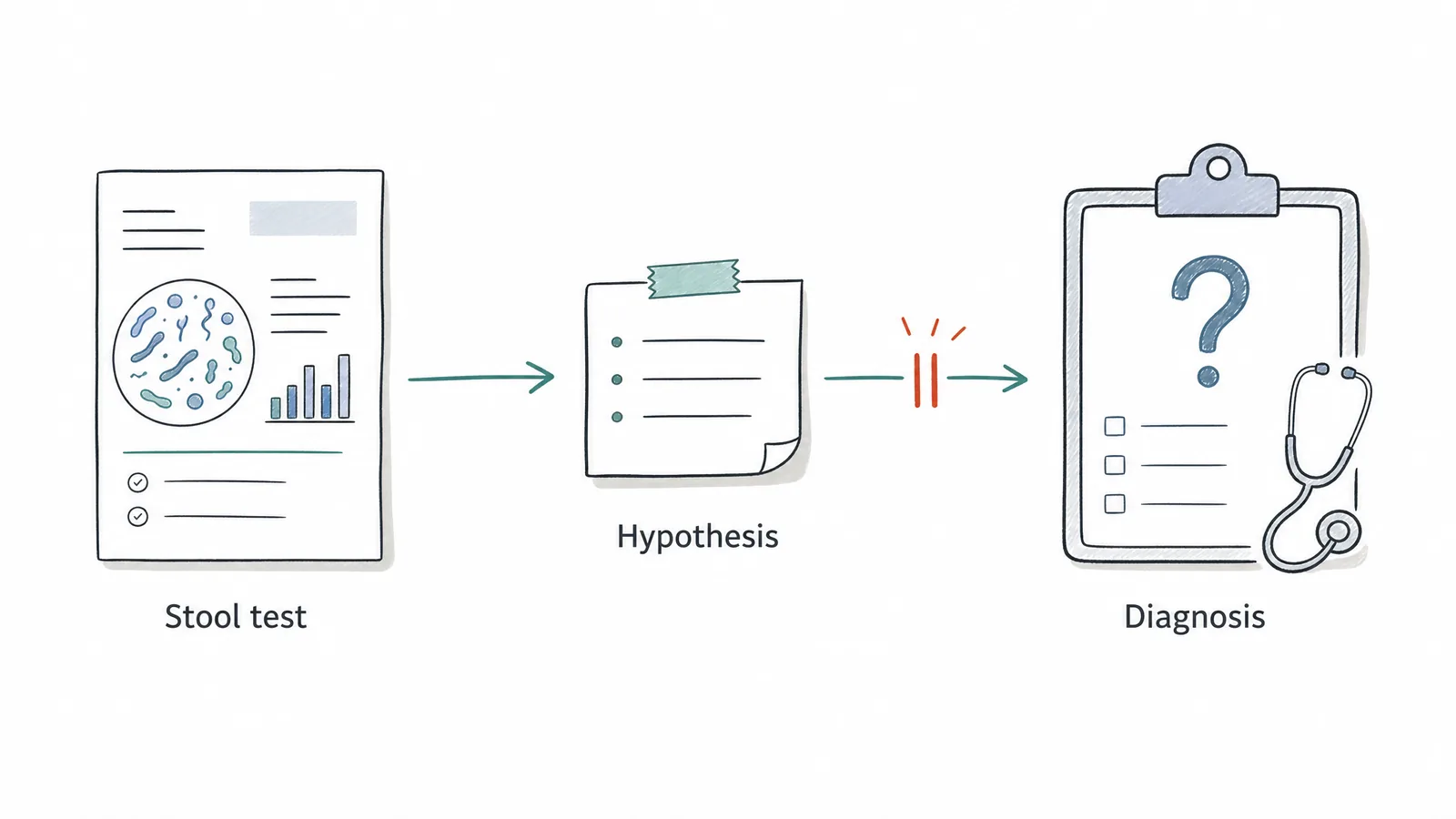
Short answer: Microbiome testing can describe broad patterns in a stool sample and may help generate diet or research hypotheses. It cannot, by itself, diagnose most gut conditions, prove the cause of bloating or fatigue, or prescribe precise probiotics, supplements, or treatments. Use results as context, not as a stand-alone health plan.
What does a gut microbiome test actually measure?
A consumer gut microbiome test usually analyzes DNA in a stool sample. Depending on the method, it may use 16S rRNA sequencing to profile bacterial groups or shotgun metagenomics to identify more genes and potential functions. These tools are scientifically valuable. They are also easy to overinterpret.
Stool mostly reflects organisms and DNA shed into feces. It does not directly measure the small intestine, the mucus layer, immune activity, gut permeability, inflammation, motility, or whether a symptom has a microbial cause. A report can say what was detected under one lab pipeline. It cannot see the whole clinical picture.
Can microbiome testing diagnose dysbiosis?
Not in the way many readers expect. “Dysbiosis” means a disturbed microbial community, but there is no single universal healthy microbiome reference range that works across all people, regions, diets, ages, medications, and diseases. Large studies show geography and lifestyle can strongly affect what looks normal.
Some microbial patterns are associated with disease, and selected microbiome biomarkers may eventually become clinically useful. That is different from saying an at-home stool report can diagnose dysbiosis as the cause of symptoms. For most digestive complaints, clinicians still rely on history, exam, blood tests, stool inflammation markers, infection testing, breath testing in selected cases, imaging, endoscopy, and other validated tools.
Can a test personalize diet, probiotics, or supplements?
Personalized nutrition based on microbiome data is a real research area. Some studies suggest people respond differently to foods partly because of host and microbial features. The clinical translation is still uneven. A test may support general advice such as increasing tolerated fiber variety, moderating ultra-processed foods, or tracking whether a diet change shifts broad microbial patterns.
It is much weaker as a precise prescription engine. A low Bifidobacterium result does not automatically mean one probiotic will work. A high Proteobacteria signal does not prove inflammation. A predicted vitamin pathway does not prove nutrient deficiency. These are clues, not diagnoses.
What does the evidence actually support?
- 16S and shotgun sequencing can profile microbial DNA, but results depend on sampling, methods, and reference databases.
- Healthy microbiome ranges vary across populations, which limits simple “good” and “bad” cutoffs.
- Microbiome-informed nutrition is promising, but many commercial recommendations exceed validated clinical use.
- Symptoms such as bloating, fatigue, constipation, and diarrhea are nonspecific and need clinical context.
- Consumer microbiome testing is best treated as hypothesis-generating unless a specific use has been clinically validated.
What marketing gets wrong about microbiome testing
The source guide describes testing as a way to reveal imbalances, guide dietary choices, monitor interventions, and support targeted strategies. Parts of that are reasonable when phrased cautiously. The risky leap is implying that a stool report can identify the underlying cause of broad symptoms or create a precise repair plan.
Microbiome science is powerful because it deals with ecosystems. Commercial reports often compress that ecosystem into simple scores, green and red labels, and recommended products. That can be useful for engagement, but it can also make uncertainty look more certain than it is.
When is microbiome testing more or less useful?
Testing may be more useful for people who understand its limits, want to track broad changes, and are working with a clinician or dietitian who can interpret results alongside symptoms, medications, diet, and standard labs. It is less useful when someone expects a single report to explain chronic symptoms, replace medical testing, or choose supplements with high precision.
Preparation also matters. Antibiotics, bowel prep, acute infection, major diet changes, travel, probiotics, and timing can shift results. A single sample is not a permanent identity card for the gut.
When should symptoms be checked clinically?
Do not use a microbiome report to delay care for blood in stool, persistent diarrhea, vomiting, fever, anemia, unexplained weight loss, night-time symptoms, severe abdominal pain, dehydration, new symptoms after age 50, or a family history of colorectal cancer, inflammatory bowel disease, or celiac disease. Also seek medical advice before changing prescribed medication based on test results.
Bottom line
Gut microbiome testing can be informative, especially as a snapshot of microbial DNA and a prompt for better questions. It is not a diagnostic shortcut. The safest use is to combine microbiome results with ordinary clinical evidence, symptom patterns, diet history, and professional judgment.
Evidence notes
- Quigley (2017). Gut microbiome as a clinical tool in gastrointestinal disease management: are we there yet? Nature Reviews Gastroenterology & Hepatology. 10.1038/nrgastro.2017.29
- He et al. (2018). Regional variation limits applications of healthy gut microbiome reference ranges and disease models. Nature Medicine. 10.1038/s41591-018-0164-x
- Zmora et al. (2019). Diet-microbiota interactions and personalized nutrition. Nature Reviews Microbiology. 10.1038/s41579-019-0256-8
- Schmidt et al. (2024). Utilization of the microbiome in personalized medicine. Nature Reviews Microbiology. 10.1038/s41579-023-00998-9
- Peterson et al. (2023). Metagenomic profiling pipelines improve taxonomic classification for 16S amplicon sequencing data. Scientific Reports. 10.1038/s41598-023-40799-x
- Eloe-Fadrosh et al. (2016). Metagenomics uncovers gaps in amplicon-based detection of microbial diversity. Nature Microbiology. 10.1038/nmicrobiol.2015.32
- Leite et al. (2019). Small intestinal microbial dysbiosis underlies symptoms associated with functional gastrointestinal disorders. Nature Communications. 10.1038/s41467-019-09964-7
This article is educational and does not diagnose, treat, or replace care from a qualified clinician.