Evidence-based response
Why Cardiologists Warn Against Probiotics? Evidence-Based Caution Without Fear
Cardiologists do not broadly warn every person against probiotics. The real caution is for people with serious illness, immune compromise, central venous catheters, high infection risk, or complex cardiac histories where live microbes may be unsafe.
By Sandra McKenzy, Pharmacist · 2026-06-21
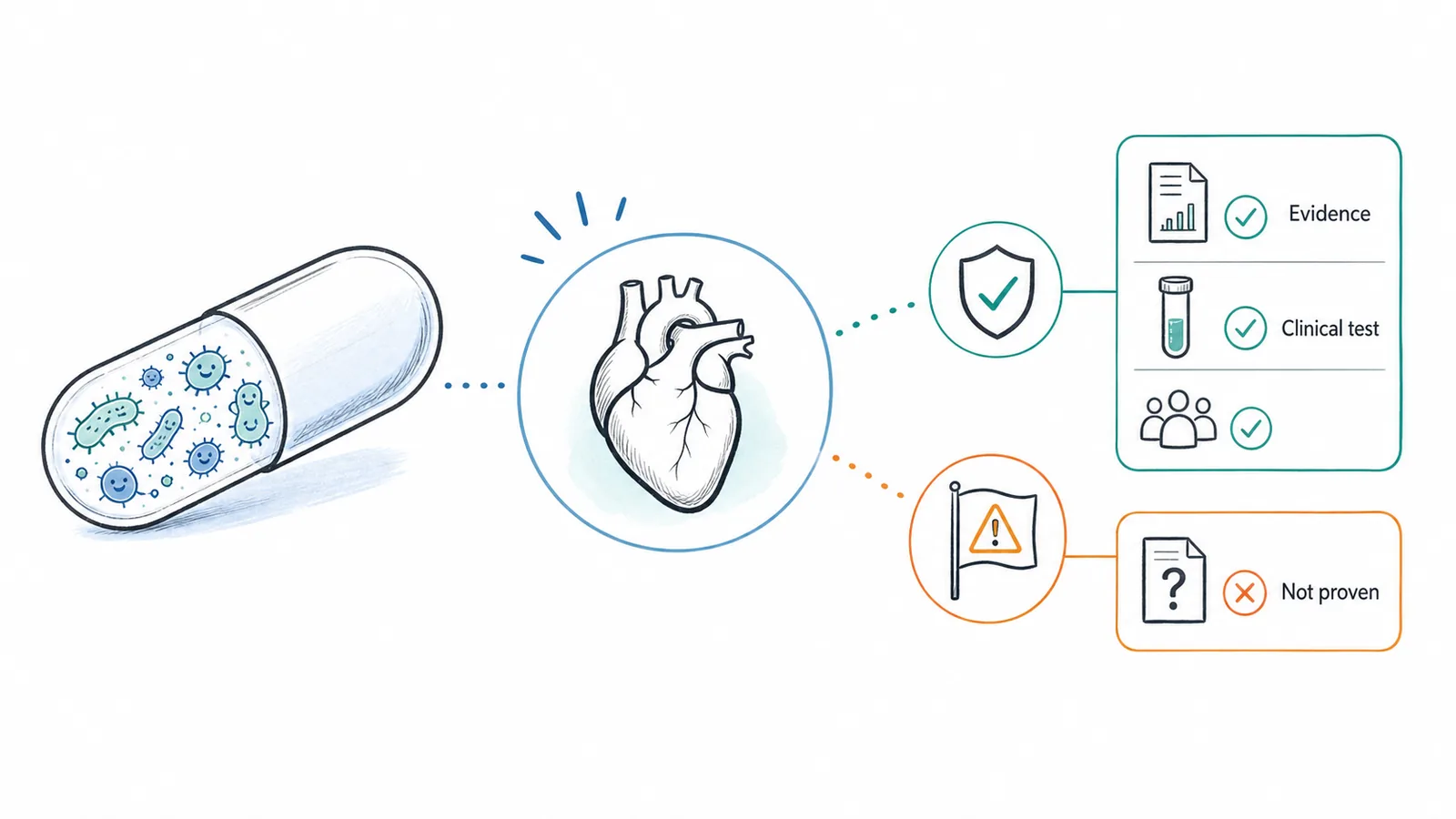
Short answer: Cardiologists do not broadly warn every person against probiotics. The real caution is for people with serious illness, immune compromise, central venous catheters, high infection risk, or complex cardiac histories where live microbes may be unsafe.
This evidence-based response addresses a common online claim about probiotics, cardiovascular patients, infection risk, immune compromise, central lines, endocarditis risk, and clinical caution. The topic is legitimate because microbiome science is real. It also needs careful boundaries, because real biology is often stretched into practical promises that current clinical evidence does not support.
Why Cardiologists Warn Against Probiotics: The Evidence-Based Answer
Probiotics are usually low risk for healthy people, but case reports and guidelines support caution in vulnerable clinical groups. That does not mean the topic can be reduced to a simple score, food list, product claim, or one-step protocol. In clinical practice, similar symptoms or outcomes can arise from immune activation, infection, diet, medication effects, stress biology, motility, sleep loss, and pre-existing disease.
The source article makes or implies that cardiologists warn against probiotics as a general gut-test insight. That framing contains a grain of truth, yet it becomes risky when it skips the gap between association and diagnosis. Microbiome research often finds group-level patterns. A consumer report or broad online guide is usually an individual snapshot or simplified summary, influenced by sampling, databases, recent meals, medications, stool consistency, lab methods, and interpretation.
Evidence summary
Evidence summary
- Probiotics are usually low risk for healthy people, but case reports and guidelines support caution in vulnerable clinical groups.
- Symptoms, stool patterns, and wellness concerns are real, but they are often nonspecific and can reflect diet, medication, infection, inflammation, motility, stress, sleep, or other disease.
- Consumer microbiome outputs can describe detected microbial DNA or taxa, but most are not validated to diagnose disease or prescribe individualized treatment.
- Clinical decisions should combine symptoms, history, examination, risk factors, and validated tests rather than a microbiome score alone.
- Plausible mechanisms are useful for research and cautious discussion, but they are not the same as proven clinical action.
What Probiotics, Cardiovascular Patients, Infection Risk, Immune Compromise, Central Lines, Endocarditis Risk, And Clinical Caution Actually Means Clinically
Clinically, the microbiome is one part of a larger digestive ecosystem. It interacts with the intestinal barrier, immune cells, bile acids, short-chain fatty acids, the nervous system, diet, medicines, infections, and the host genome. That complexity is why simple online answers can sound confident while being less useful than they appear.
For a reader, the practical question is not whether the microbiome matters. It does. The practical question is whether the available test, claim, food, supplement, or intervention can answer the specific health question in front of you. That standard is stricter. A test should measure reliably, mean what it says, and lead to an action that improves care or reduces risk.
What Is Best Supported by Studies?
Probiotics are usually low risk for healthy people, but case reports and guidelines support caution in vulnerable clinical groups. Several peer-reviewed sources found through MedicalBrain support the broader principle that microbiome research is moving toward more precise interpretation, while also emphasizing reproducibility, phenotype quality, method differences, and careful clinical translation.
The most reliable conclusions are usually modest. Microbial diversity can be lower in some disease states, but diversity alone is not a wellness score. Certain organisms, genes, metabolites, or pathways can be associated with inflammation, metabolism, mood, bowel function, or barrier biology, but association does not prove causation in a single person. Sequencing can reveal DNA patterns, but the report still needs context.
Which Claims Go Beyond the Evidence?
The overreach is turning targeted medical caution into a broad fear claim. That kind of claim is attractive because it makes a difficult health question feel measurable and solvable. The problem is that most consumer microbiome outputs and broad wellness claims have not been validated as stand-alone diagnostic or treatment tools. A colorful result can be scientifically interesting and still be clinically insufficient.
Be especially cautious when a page moves quickly from symptoms to a product, from a microbial name to a disease label, or from a stool profile to supplement advice. These jumps may be plausible hypotheses, but they are not the same as guideline-supported medical care. A good explanation should tell you what is known, what is uncertain, and what would require a clinician or validated laboratory test.
What Marketing Often Gets Wrong
Marketing often compresses a long chain of evidence into one sentence. It may say the microbiome affects immunity, mood, metabolism, digestion, or inflammation, then imply that a single test, food, product, or lab panel can optimize those systems. The first part can be true in broad biology. The second part is where the evidence often thins out.
Another common mistake is treating stool data or symptom clusters as stable enough for definitive personal scoring. Stool microbiome composition can vary with diet, bowel transit time, recent antibiotics, illness, travel, menstrual cycle, sleep, and lab pipeline. Responsible interpretation explains uncertainty instead of hiding it behind confident labels.
When Should You See a Clinician?
Seek medical advice urgently for blood in stool, black stools, persistent fever, severe or worsening abdominal pain, signs of dehydration, fainting, unintentional weight loss, persistent vomiting, symptoms after travel or suspected food poisoning, symptoms in pregnancy, symptoms in infants or older adults, or symptoms in someone who is immunocompromised. Also seek care if diarrhea, constipation, pain, appetite changes, mood symptoms, or fatigue persist or recur.
These red flags matter because they can point to infection, inflammatory bowel disease, celiac disease, medication complications, endocrine disease, cancer, mental-health conditions, or other problems where delay is unsafe. A consumer microbiome report should not be used to rule these out.
Bottom Line
The balanced answer is simple: probiotics, cardiovascular patients, infection risk, immune compromise, central lines, endocarditis risk, and clinical caution is a legitimate scientific topic, but the strongest claims are narrower than many marketing pages suggest. Use microbiome information as context, not as a diagnosis. If symptoms are significant, persistent, or alarming, prioritize clinical evaluation and validated testing.
Educational disclaimer: This article is for general science education and does not diagnose, treat, or replace care from a licensed clinician. Decisions about symptoms, testing, medication, diet, supplements, mental health, infection risk, or inflammatory disease should be made with a qualified healthcare professional.
Evidence Notes and Sources
- Clinical trial of the effects of postbiotic supplementation on inflammation, oxidative stress, and clinical outcomes in patients with CVA (2024). Nature Portfolio journal. DOI: 10.1038/s41598-024-76153-y
- Genomic and epidemiological evidence of bacterial transmission from probiotic capsule to blood in ICU patients (2019). Nature Portfolio journal. DOI: 10.1038/s41591-019-0626-9
- RETRACTED ARTICLE: Role of the gut microbiome in chronic diseases: a narrative review (2022). Nature Portfolio journal. DOI: 10.1038/s41430-021-00991-6
- The aging gut microbiome and its impact on host immunity (2021). Nature Portfolio journal. DOI: 10.1038/s41435-021-00126-8
- Dysbiotic microbiota contributes to the extent of acute myocardial infarction in rats (2022). Nature Portfolio journal. DOI: 10.1038/s41598-022-20826-z