Evidence-based response
Best Way to Test the Gut Microbiome: Evidence-Based Answer Without the Hype
The best test depends on the question. Stool sequencing can describe microbial DNA, but symptoms often require targeted clinical tests rather than a consumer microbiome profile.
By Sandra McKenzy, Pharmacist · 2026-06-03
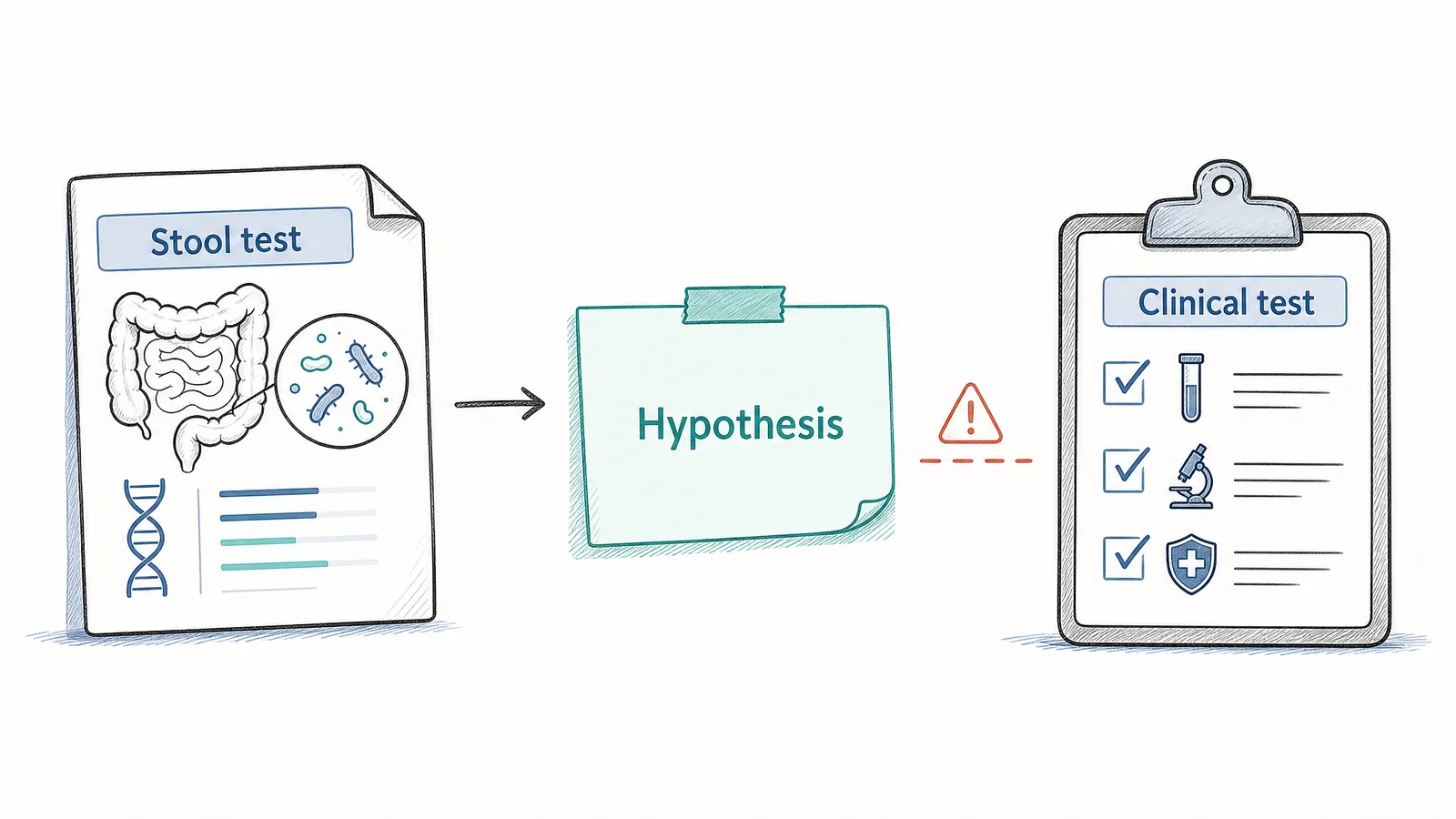
Short answer: The best way to test the gut microbiome depends on what you are trying to learn. Stool sequencing is the standard practical sample for many gut microbiome studies and consumer reports. But if you have symptoms, the best test may instead be calprotectin, pathogen testing, celiac blood tests, FIT, breath testing, endoscopy, or another clinician-directed investigation.
What can a stool microbiome test measure?
Most consumer kits analyze microbial DNA in stool using 16S rRNA sequencing or shotgun metagenomics. These methods can estimate which organisms or genes are present in a sample. They do not directly inspect the whole intestine, prove cause and effect, or diagnose most diseases.
Evidence summary
- Stool is practical and widely used, but it is still a sample with method-dependent limits.
- 16S sequencing is lower resolution; shotgun metagenomics can provide broader microbial and gene information.
- Collection, storage, extraction, and databases affect results.
- Consumer reports are not substitutes for clinical diagnostic tests.
- The right test starts with the symptom or medical question.
Is shotgun metagenomics always best?
Shotgun sequencing can offer more detail than many 16S tests, especially for strain-level and functional questions. More detail does not automatically mean better clinical usefulness. The interpretation still depends on validation, reference databases, sample quality, and whether a result changes care.
What marketing gets wrong
Some articles imply that a single microbiome kit is the best first step for nearly every digestive complaint. That is too broad. A person with bleeding, inflammatory symptoms, or suspected infection needs targeted testing before a wellness profile.
When should clinical testing come first?
Blood in stool, fever, persistent diarrhea, unintentional weight loss, anemia, severe pain, dehydration, or nighttime symptoms should prompt medical evaluation. A microbiome report should not delay tests that can detect inflammation, infection, bleeding, or structural disease.
Bottom line
For curiosity or research-style tracking, a well-run stool sequencing test can be informative. For diagnosis, the best test is the one matched to the clinical question.
How 16S and shotgun tests differ
16S rRNA sequencing targets a marker gene found in bacteria. It is relatively affordable and can describe broad bacterial composition, often around genus level. Shotgun metagenomics sequences more genetic material from the sample and can sometimes provide species, strain, gene, and functional information. That extra detail can be valuable for research. It can also create a longer report without solving the clinical question.
Why sample handling matters
Microbiome results can shift with collection kits, storage temperature, time to processing, DNA extraction, sequencing depth, and reference databases. This does not make all tests useless. It means comparisons across companies or across time should be cautious. If you repeat a test, using the same method and similar collection conditions is more meaningful than comparing unrelated reports.
What consumer reports cannot diagnose
A stool microbiome profile cannot reliably diagnose IBD, colorectal cancer, celiac disease, pancreatic insufficiency, SIBO location, food allergy, or the cause of bleeding. Some reports include risk language around inflammation or permeability, but those claims need validation against clinical tests. If a result sounds like a diagnosis, ask what study validated that exact claim, in what population, and with what outcome.
How to choose a test responsibly
Start with the question. If the question is curiosity about microbial diversity, a transparent microbiome test may be acceptable. If the question is persistent diarrhea, blood, pain, weight loss, anemia, infection risk, or malabsorption, choose clinical evaluation first. A useful company should explain methods, limitations, privacy, and what the report cannot do. The best test is not the most futuristic one. It is the one that answers the question safely.
How to read claims like this safely
A safer article separates three layers. The first layer is mechanism: what could happen biologically. The second layer is association: what has been observed in people or cohorts. The third layer is clinical action: what a patient should do differently. Many gut-health claims are plausible at the first layer, interesting at the second layer, and still unproven at the third. That does not make the science fake. It means the conclusion must be smaller than the sales pitch.
For readers, the practical question is not whether the microbiome matters. It does. The question is whether a claim has enough evidence to change care, justify a purchase, or delay medical evaluation. If the answer relies mainly on broad microbiome language, weak biomarkers, or personalized recommendations without validation, caution is appropriate. Good science should make uncertainty clearer, not hide it.
What a more evidence-based recommendation looks like
A responsible recommendation states who it applies to, what outcome it targets, how strong the evidence is, and when it should not be used. It also distinguishes general wellness advice from diagnosis. For example, increasing plant-food diversity gradually is different from claiming that a report can identify the exact cause of symptoms. Seeing a clinician for red flags is different from saying every symptom needs advanced testing. The most useful microbiome guidance is specific, modest, and connected to outcomes people can actually monitor.
One final check is proportionality. A claim should not become stronger just because it mentions sequencing, artificial intelligence, or personalization. The evidence standard should rise when the advice becomes more specific, more expensive, or more likely to affect medical decisions. That is the reader-protective standard used here.
In short, test selection should be question-led, method-aware, and clinically cautious, not driven by the most expansive marketing claim or sales funnel online.
Evidence notes
- Gut microbiome as a clinical tool in gastrointestinal disease management: are we there yet?. Nature Reviews Gastroenterology & Hepatology. 10.1038/nrgastro.2017.29
- Stool sampling and DNA isolation kits affect DNA quality and bacterial composition following 16S rRNA gene sequencing. Scientific Reports. 10.1038/s41598-019-49520-3
- Introduction to host microbiome symbiosis in health and disease. Mucosal Immunology. 10.1038/s41385-020-00365-4
- Structure, function and diversity of the healthy human microbiome. Nature. 10.1038/nature11234
- Gut microbiome profiling tests propelled by customer demand. Nature Biotechnology. 10.1038/nbt0117-9
This article is educational and does not diagnose, treat, or replace care from a qualified clinician.